Corporate Gifting Compliance: What UAE Businesses Can and Cannot Give
Corporate gifting compliance in UAE sits at the intersection of multiple regulatory frameworks — UAE anti-bribery legislation (Federal Decree-Law No. 31 of 2021), Saudi Arabia’s anti-bribery framework (Anti-Bribery Law by Royal Decree), Western multinational frameworks (US FCPA, UK Bribery Act 2010, EU anti-bribery directives), industry-specific frameworks (banking, pharmaceutical, government contracting), and corporate-policy frameworks (per-recipient value caps, declaration requirements, prohibited-recipient categories). The substantive consequences of violations — criminal prosecution, regulatory fines, business-licence implications, reputational damage, individual employee criminal liability — make compliance one of the highest-stakes operational considerations for UAE businesses with substantive gift programmes. This guide covers the regulatory frameworks, per-recipient value frameworks, prohibited categories, declaration requirements, public vs private sector distinctions, GCC cross-border considerations, and operational best practices.
The UAE Regulatory Framework
UAE anti-bribery legislation establishes the baseline regulatory framework for corporate gifting compliance. Public sector anti-bribery provisions: UAE Federal Decree-Law No. 31 of 2021 and associated regulatory framework prohibit substantively-valuable gifts to public officials, government employees, judicial officers, and quasi-government entity employees in circumstances construable as inducement or facilitation. The substantive threshold is purposive (whether the gift could influence official action) rather than purely value-based. Private sector anti-bribery provisions: UAE legislation extends anti-bribery framework to private-sector corruption — substantively-valuable gifts to corporate employees, decision-makers, or contractors construable as inducement against the recipient’s employer interests are prohibited. Per-recipient value frameworks: regulatory guidance and corporate-policy norms typically apply caps in the AED 200-500 range for standard gifts; senior-relationship gifts up to AED 1500-3000 with documented justification; gifts above AED 3000 typically warrant senior-management approval and declaration. The private label printing UAE programmes operate within these frameworks for corporate-branded gift production.
Saudi Arabia and GCC Cross-Border Compliance
Saudi Arabia maintains substantively-strict anti-bribery framework that applies to UAE companies running cross-border gift programmes targeting KSA recipients. Saudi Anti-Bribery Law: Royal Decree-issued anti-bribery framework establishes criminal penalties for bribery of public officials and substantial framework for private-sector corruption. The Saudi framework operates at lower per-recipient thresholds — typically SAR 500-1000 (AED 500-1000) per recipient per occasion. KSA public sector strict prohibition: substantively-valuable gifts to KSA government officials, ministers, judicial officers, and quasi-government employees are subject to particularly-strict scrutiny — many UAE companies operating in KSA apply policy frameworks prohibiting gifts to KSA government recipients entirely. Vision 2030 transformation context: Saudi Arabia’s Vision 2030 includes substantive governance and anti-corruption reform with intensified enforcement. UAE companies running KSA programmes apply elevated compliance protocols. The UAE National Day corporate gifts programmes apply standard UAE frameworks distinct from KSA cross-border considerations.
Western Multinational Compliance Frameworks
UAE subsidiaries of Western multinationals operate within Western anti-bribery frameworks that often impose more-restrictive per-recipient limits than UAE-domestic norms. US Foreign Corrupt Practices Act (FCPA): applies to US-listed companies and their global subsidiaries — establishes criminal liability for foreign-bribery offences with substantively-strict interpretation. FCPA-covered UAE entities typically apply per-recipient caps in the USD 50-150 (AED 180-550) range. UK Bribery Act 2010: applies to UK-incorporated entities and their global operations — establishes corporate criminal liability. UK Bribery Act-covered UAE entities typically apply per-recipient caps in the GBP 25-100 (AED 110-450) range. EU anti-bribery directives: apply to EU-incorporated entities and their global operations — vary by member-state implementation but generally align with strict per-recipient frameworks. Cross-framework compliance: UAE entities subject to multiple frameworks apply the most-restrictive framework as the operational standard.
Industry-Specific Compliance Frameworks
Three industries operate at substantively-stricter frameworks than baseline UAE practice. Banking and financial services: UAE Central Bank, DFSA (DIFC), and ADGM regulatory frameworks apply substantively-strict compliance for licensed banks, asset managers, brokers, and financial services entities — typically per-recipient caps in the AED 200-500 range with substantial declaration documentation for any gifts above the threshold. Pharmaceutical industry: UAE Ministry of Health and Prevention applies substantively-strict compliance for pharmaceutical and medical device companies — gifts to healthcare professionals are substantively-restricted with strict per-recipient frameworks, prohibited categories, and mandatory declaration. Government contracting: companies bidding on or holding UAE government contracts apply substantially-strict frameworks during active procurement processes — typically substantial-prohibition during procurement windows rather than per-recipient value analysis.
Public vs Private Sector Recipient Distinctions
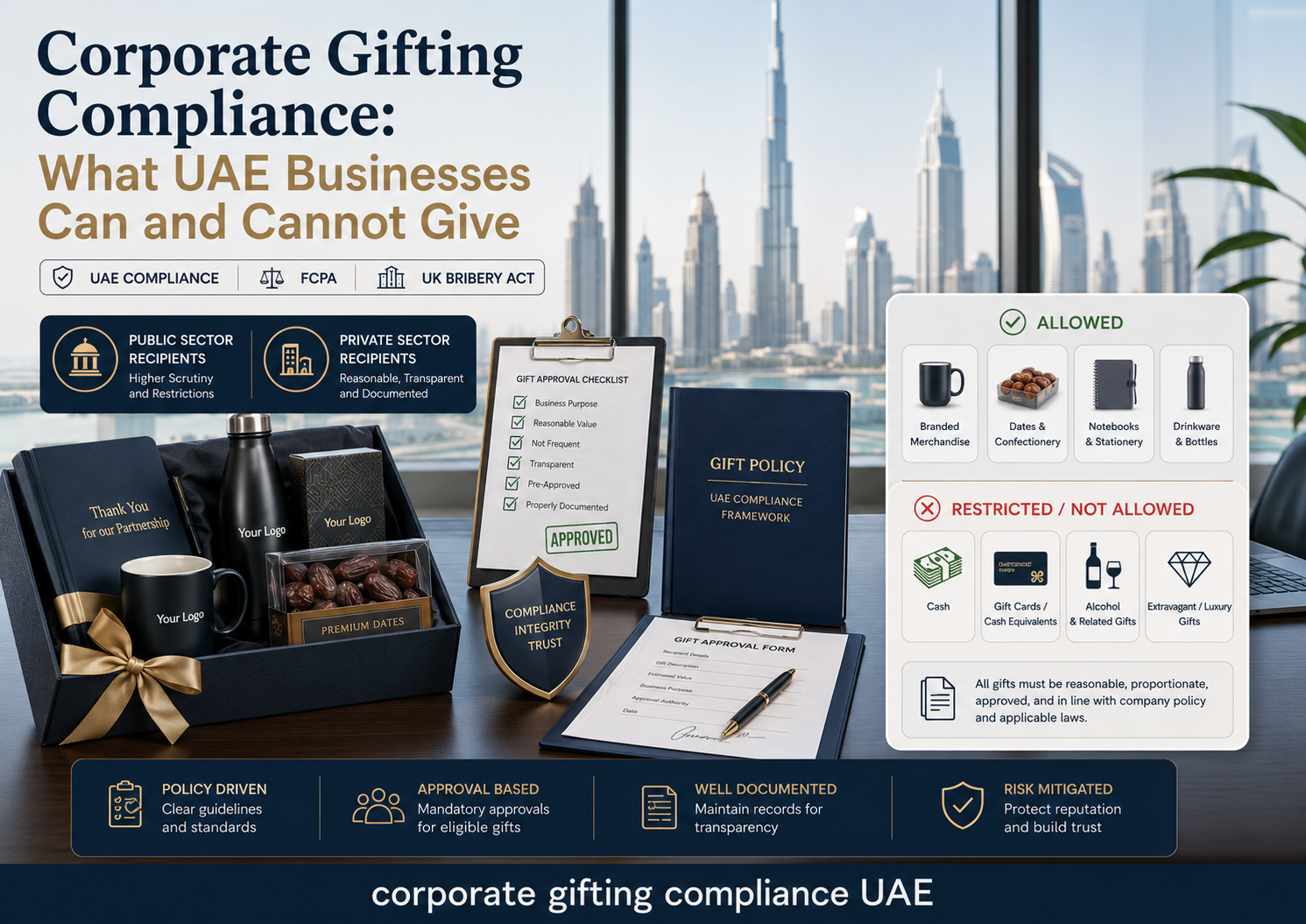
The public-sector vs private-sector distinction is the most-substantial compliance consideration in UAE corporate gift programmes. Public sector recipients (substantially-restricted): federal government officials, emirate government officials, judicial officers, quasi-government entity employees (national oil companies, government-owned investment entities, government-owned commercial entities at substantial scale), military and security officials. Standard corporate gifts to public sector recipients are subject to substantially-strict scrutiny — many UAE companies apply policy frameworks prohibiting or substantially-limiting gifts to public sector recipients regardless of value. Private sector recipients (standard frameworks apply): corporate employees, executives, decision-makers, and contractors at private-sector entities — standard corporate gift compliance frameworks apply with per-recipient caps and declaration requirements. Mixed-status entities: some UAE entities operate at mixed public-private status (free zone authorities, government-owned commercial entities at smaller scale, quasi-government professional bodies) — apply public-sector frameworks by default unless specific clarification establishes private status.
Prohibited Gift Categories
Four gift categories are substantively-prohibited or restricted across most UAE corporate compliance frameworks regardless of recipient register. Cash and cash-equivalents: direct cash gifts, gift cards convertible to cash, prepaid debit cards, and similar items are substantively-prohibited across virtually all compliance frameworks (eidiyah envelopes for personal-family contexts are distinct). Excessive-value gifts: gifts substantially exceeding per-recipient caps without documented business justification are prohibited. Gifts coinciding with active procurement or decision processes: gifts to recipients during active procurement, commercial negotiations, or regulatory processes are substantively-restricted regardless of value — the timing creates inducement-context concerns regardless of intent. Inappropriate-content gifts: gifts including alcohol (for Muslim recipients in UAE and KSA contexts), gambling-related items, adult-content items, or items construable as personal-relationship rather than business-relationship gifts are prohibited or substantially-restricted.
Declaration and Documentation Requirements
Substantive corporate gift programmes maintain declaration and documentation systems. Gift register documentation: per-recipient log of gifts given, including recipient, recipient entity, gift category, gift value, occasion or business justification, date, and authorising decision-maker. Senior-management approval for substantial gifts: gifts above per-recipient thresholds (typically AED 1500-3000) require senior-management approval with documented business justification. Counterparty declaration where required: some recipient entities (regulated financial services, government, pharmaceutical) require recipients to declare gifts received above specific thresholds. Annual programme review: substantive programmes undergo annual compliance review covering structure, distribution analysis, exception handling, and compliance incidents. The logo mug printing and similar standard corporate gift categories typically sit comfortably within compliance frameworks at per-piece economics.
Order Yours Today
Execute UAE corporate gift programmes within applicable compliance frameworks with documented justification.
UAE Federal Decree-Law No. 31, Saudi Anti-Bribery Law cross-border compliance, US FCPA and UK Bribery Act for multinational subsidiaries, industry-specific frameworks (banking, pharmaceutical, government contracting), public-sector vs private-sector distinctions, per-recipient AED 200-3000+ caps with documented justification, declaration systems.
Same-day Dubai delivery for orders placed before 11am (12pm for UV-printed items). UAE-wide delivery 1–3 business days. GCC cross-border 7–14 days. Order via WhatsApp or our online form.
Frequently Asked Questions About Corporate Gifting Compliance UAE
What are the per-recipient gift value caps for corporate gifts in UAE?
UAE-domestic frameworks typically apply per-recipient caps in the AED 200-500 range for standard corporate gifts, with senior-relationship gifts up to AED 1500-3000 per occasion permitted with documented business justification, and gifts above AED 3000 typically requiring senior-management approval and declaration. Thresholds vary by industry (banking, pharmaceutical, government contracting apply stricter frameworks) and by recipient register (public sector vs private sector). UAE entities subject to Western multinational frameworks (US FCPA, UK Bribery Act, EU directives) apply substantially-stricter caps.
Can UAE companies give corporate gifts to government officials?
Substantively-valuable gifts to UAE government officials, judicial officers, and quasi-government employees are subject to substantively-strict scrutiny under UAE Federal Decree-Law No. 31 of 2021 and associated anti-bribery framework. Many UAE companies apply policy frameworks substantially-limiting or prohibiting gifts to public sector recipients regardless of value. For substantively-modest cultural-courtesy gifts at occasions like UAE National Day or Eid, restrained gifts may be permissible with documented business justification; for substantial corporate gifts, public sector recipients warrant elevated compliance scrutiny. Industries with active government contracting relationships typically apply substantial-prohibition during procurement windows.
What corporate gift categories are prohibited under UAE compliance frameworks?
Four categories are substantively-prohibited or restricted. Cash and cash-equivalents (gift cards convertible to cash, prepaid debit cards) are prohibited across virtually all compliance frameworks. Excessive-value gifts substantially exceeding per-recipient caps without documented justification are prohibited. Gifts coinciding with active procurement or decision processes are substantively-restricted regardless of value. Inappropriate-content gifts (alcohol for Muslim recipients, gambling-related items, adult-content items, items construable as personal-relationship rather than business-relationship gifts) are prohibited or substantially-restricted.
Do US FCPA and UK Bribery Act apply to UAE companies?
Yes — US Foreign Corrupt Practices Act applies to US-listed companies and their global subsidiaries, including UAE subsidiaries. UK Bribery Act 2010 applies to UK-incorporated entities and their global operations, including UAE subsidiaries. UAE entities subject to these frameworks apply substantially-stricter per-recipient frameworks than UAE-domestic norms — typically USD 50-150 (AED 180-550) per recipient for FCPA-covered entities, GBP 25-100 (AED 110-450) for UK Bribery Act-covered entities. UAE entities subject to multiple frameworks apply the most-restrictive framework as operational standard.
What are the cross-border compliance considerations for UAE-to-Saudi corporate gifts?
Saudi Arabia maintains substantively-strict anti-bribery framework with lower per-recipient thresholds than UAE practice — typically SAR 500-1000 (AED 500-1000) per recipient per occasion. KSA public sector recipients are subject to particularly-strict scrutiny; many UAE companies operating in KSA apply policy frameworks prohibiting gifts to KSA government recipients entirely. Vision 2030 transformation includes substantive anti-corruption reform with intensified enforcement. UAE companies running KSA corporate gift programmes typically apply elevated compliance protocols including senior-management review, documented business justification, and per-recipient declaration where applicable.
Should corporate gift programmes maintain declaration and documentation?
Yes — substantive corporate gift programmes maintain declaration systems. Per-recipient gift register documentation covering recipient, recipient entity, gift category, gift value, occasion or business justification, date of distribution, and authorising decision-maker. Senior-management approval documentation for gifts above per-recipient thresholds (typically AED 1500-3000). Counterparty declaration accommodation where recipient entities require gift declarations. Annual programme review covering structure, distribution analysis, exception handling, and compliance incidents. Documentation supports internal compliance and regulatory inquiry response.
What industries require stricter corporate gifting compliance in UAE?
Three industries operate at substantively-stricter frameworks than baseline UAE practice. Banking and financial services: UAE Central Bank, DFSA, and ADGM regulatory frameworks apply substantially-strict compliance for licensed banks, asset managers, brokers, and financial services entities. Pharmaceutical industry: UAE Ministry of Health and Prevention applies substantially-strict compliance for pharmaceutical and medical device companies, with substantively-restricted gifts to healthcare professionals. Government contracting: companies bidding on or holding UAE government contracts apply substantially-strict compliance during active procurement processes, typically substantial-prohibition rather than per-recipient value analysis.
What documentation should accompany substantial corporate gifts?
Substantial corporate gifts (approaching or exceeding per-recipient compliance thresholds) should be accompanied by documented business justification — the substantive business reason for the gift (anniversary recognition, project completion, ongoing relationship, cultural courtesy at recognised occasions like UAE National Day or Eid), the authorising decision-maker, and the relationship context. Senior-management approval for gifts above the senior-approval threshold (typically AED 1500-3000). Compliance review confirming the gift conforms with applicable framework. Recipient-side acknowledgement where applicable. Annual aggregation documentation supporting annual compliance review.