Why Dates and Dry Fruits Matter in GCC Gifting
Dates and dry fruits sit at the centre of GCC gifting culture in a way that has no real equivalent in Western gift traditions. They are not “edible gifts” in the Western sense — afterthoughts compared to the “real” gift; in the GCC they often are the gift, the thing the host sets out for guests, the thing the visitor brings to the household, the thing exchanged at every major celebration from weddings to Eid to Saudi National Day. Understanding why they hold this position — and what makes a premium dates or dry fruits gift land vs an unremarkable supermarket-tier one — is one of the more useful pieces of GCC cultural literacy for UAE expats who want to gift well across the region.
The Cultural Position of Dates in GCC Hospitality
Dates are foundational to Arabian Peninsula hospitality. They have been cultivated in the region for thousands of years, are mentioned repeatedly in Islamic religious tradition, and are the food traditionally used to break the Ramadan fast each evening. When a guest arrives at an Emirati or Saudi household, the standard offering is Arabic coffee and dates — a ritual repeated millions of times daily across the region. Gifting dates carries cultural weight that gifting, say, chocolate does not. The host who receives a premium dates box from a guest receives a gift that fits naturally into their home routine and signals the guest’s understanding of the regional context.
The Premium Dates Hierarchy
Not all dates are the same. The varietal and grade matter materially to the gift’s perceived register.
Sukkari
Saudi-origin, golden-tone, soft and crystalline-sweet. Considered one of the most premium varietals; widely associated with high-quality gift hampers in the GCC. Sukkari dates are often the default choice for senior-tier corporate gift hampers and Saudi-destination gifts.
Mejdoul (Medjool)
Large, dark, soft-textured dates with a distinctive caramel-rich flavour. The most-internationally-recognised premium date varietal. Pairs well with mixed dry-fruit hampers.
Ajwa
Saudi-origin (specifically Medina region), small, dark, with a deep almost-fig-like sweetness. Carries strong religious significance in Islamic tradition, which gives Ajwa a register of reverence other varietals don’t share. Used carefully for religious-context gifts and high-tier ceremonial moments.
Khalas, Lulu, Khidri
Mid-tier varietals widely available in UAE supermarkets. Suitable for everyday hospitality and casual gifting; less suitable for high-tier corporate or premium occasions.
Dry Fruits as the Companion Category
Premium dry fruit gift hampers — typically combining dates with pistachios, almonds, cashews, dried apricots, walnuts, and figs — are the broader gift category that sits alongside pure dates boxes. Dry fruit hampers are particularly common at Eid, weddings, and corporate gifting moments where the gift needs to feel substantive without being narrowly tied to a single varietal. The premium dry fruits typically associated with GCC gift hampers: Iranian pistachios (mid-to-premium tier), Turkish dried apricots, California almonds (mid-tier), and increasingly UAE-grown organic varieties for the local-luxury register.
Personalised Packaging Lifts the Gift Meaningfully
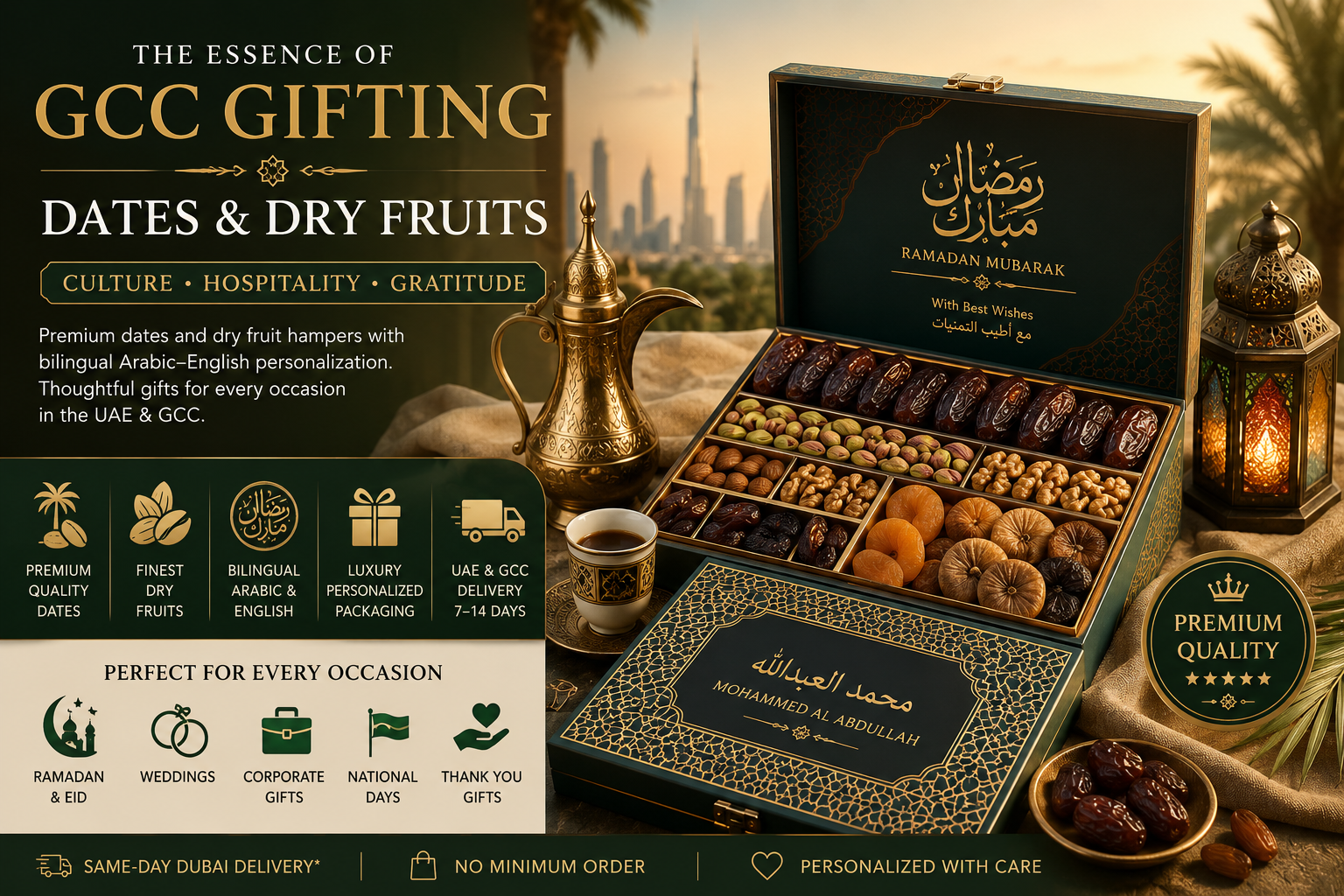
The transition from supermarket-tier to premium-tier dates and dry fruits gift is largely about packaging. A 1kg box of premium Sukkari dates costs roughly the same in supermarket plastic packaging as in a personalised dates gift box with the recipient’s bilingual name on the lid — but the perceived value gap is substantial. UV-printed wooden or rigid-board gift boxes with Arabic calligraphy of the recipient’s name, the occasion, and a brief blessing transform the dates from grocery-purchase to ceremonial gift. The cost difference is AED 30–80 per piece; the impression difference is significant.
Gifting Occasions for Dates and Dry Fruits
Ramadan and Eid al-Fitr
The peak season for dates gifting in the GCC. Premium dates boxes given to family, neighbours, colleagues, and clients during Ramadan and at Eid al-Fitr at Ramadan’s end. Ramadan gifts and Eid gifts consistently feature dates as the central element, often accompanied by dry fruit hampers and Arabic coffee accessories.
Saudi National Day, UAE National Day, Saudi Founding Day
Premium dates boxes are the highest-volume corporate gift category for these national celebrations. Saudi National Day on September 23 particularly drives heavy cross-border volume from UAE-based companies sending dates hampers to Saudi clients and partners.
Weddings and Corporate B2B
Dates and dry fruit hampers work as wedding favours and as year-round B2B corporate gifts. They fit the “thoughtful, regionally-appropriate, edible” register that survives across recipient demographics — easier than alcohol (which has cultural restrictions for many recipients) and more region-specific than chocolate.
Bilingual Personalisation on Dates Gift Packaging
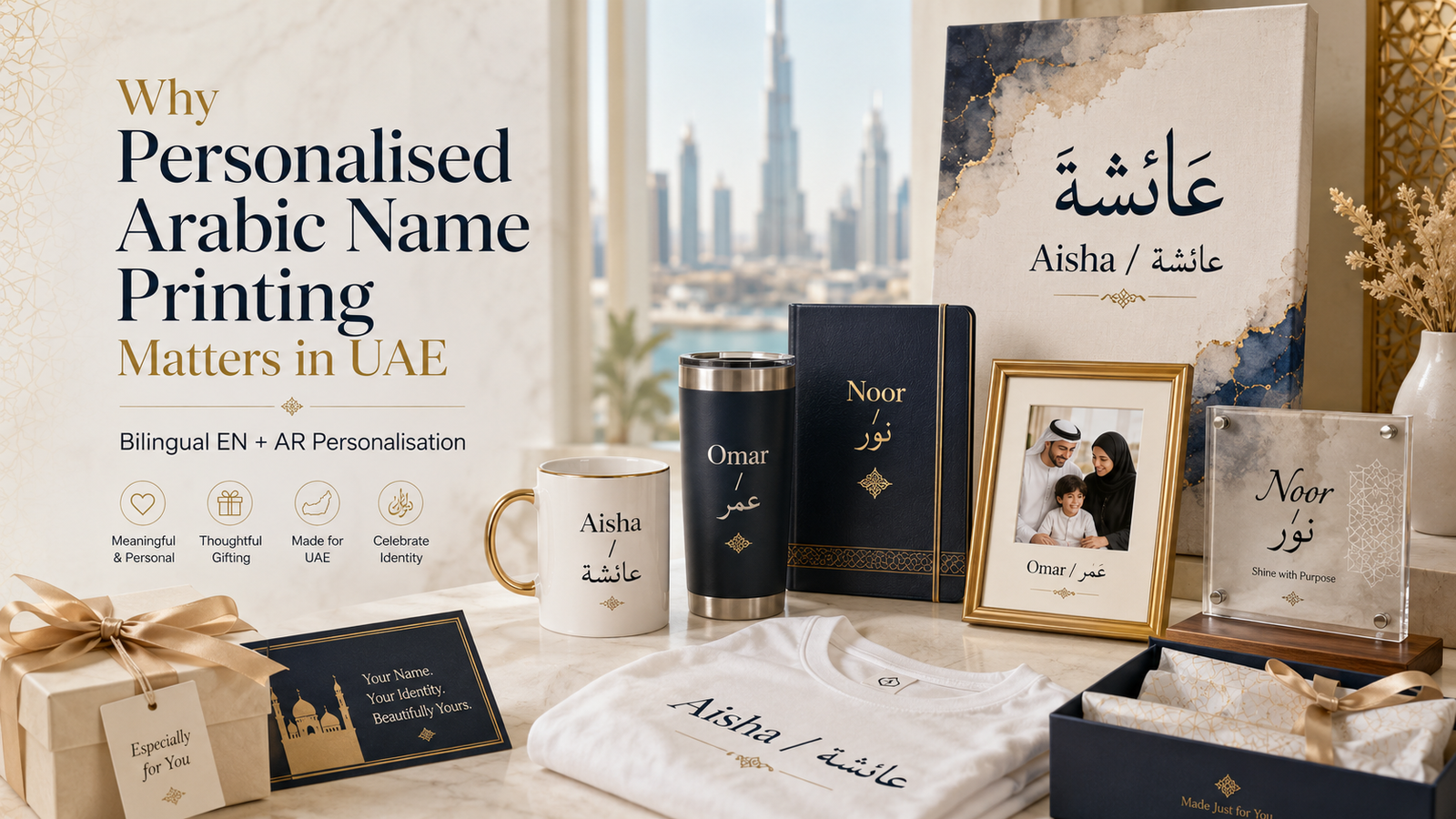
For UAE and GCC contexts, bilingual EN+AR personalisation on dates and dry fruit gift packaging is the default. The recipient’s name in Diwani for ceremonial occasions (weddings, premium client gifts), Naskh for traditional or religious-context gifts (Ramadan, Eid, Ajwa-based hampers), Modern Arabic for contemporary corporate. Every Arabic layout is reviewed by a typography specialist before production. For Ajwa hampers specifically, Naskh is the strongly preferred style given the religious-register weight; Diwani is generally inappropriate.
Common Dates Gifting Mistakes in UAE/GCC Contexts
Three mistakes recur on dates-and-dry-fruits gift programmes and are easily avoided. Wrong varietal for the register: using mid-tier Khalas or Lulu dates in a senior-tier corporate hamper undermines the gift’s perceived value; the supermarket-tier varietal is recognisable to anyone familiar with the category. Match the varietal to the gift tier. Plastic-tray packaging on a personalised gift: the supermarket plastic tray inside personalised premium packaging looks like a downgrade. Use rigid-board or hand-arranged dates in the personalised box rather than dropping a supermarket tray inside. Overly long shelf-life assumptions: dates are fresh produce; they have shelf-life windows that matter. Don’t order dates hampers 8 weeks ahead of an event “just in case”; the freshness window means production is timed to the delivery date, not to convenience.
Bulk Production and GCC Cross-Border
Dates and dry fruit hamper production for corporate runs typically runs 5–10 working days for 50–300 piece runs, scaling longer for 500+ piece volumes. The fresh-produce element matters: dates have shelf-life considerations that mean inventory holding and timing matter more than for pure non-edible gifts. Cross-border GCC delivery is 7–14 days; for KSA-destination dates hampers, lock orders 4 weeks before the arrival date to maintain margin against customs clearance and product freshness windows. Same-day Dubai applies for stock-personalised hampers at the standard 12pm UV-print cut-off.
Order Yours Today
Gift dates and dry fruits the way the GCC actually gifts them.
Personalised gift boxes with bilingual EN+AR calligraphy, Sukkari and Mejdoul varietals, premium dry fruit hampers — bulk runs from 25 pieces, GCC cross-border 7–14 days.
Same-day Dubai delivery for orders placed before 11am (12pm for UV-printed items). UAE-wide delivery 1–3 business days. GCC cross-border 7–14 days. Order via WhatsApp or our online form.
Frequently Asked Questions About Dates Gifts GCC
Why are dates important in GCC gifting?
Dates are foundational to Arabian Peninsula hospitality — cultivated for thousands of years, central to the Ramadan fast-breaking ritual, and the standard offering when a guest arrives at an Emirati or Saudi household. Gifting dates carries regional cultural weight that gifting non-regional foods does not.
What is the difference between Sukkari, Mejdoul, and Ajwa dates?
Sukkari is Saudi-origin, golden-tone, soft, crystalline-sweet — the default premium varietal. Mejdoul is large, dark, soft, with caramel-rich flavour — the most-internationally-recognised premium varietal. Ajwa is small, dark, with deep fig-like sweetness from Medina; carries strong religious significance and is used carefully for ceremonial moments.
Are dates gifts appropriate for non-Muslim recipients in UAE?
Yes — dates are a regional cultural gift, not a narrowly religious one. Premium dates hampers work well for non-Muslim recipients in UAE and across the GCC. The cultural register comes from the regional context rather than the religious context.
What is a typical budget for a premium dates gift hamper?
AED 80–150 for Sukkari or Mejdoul personalised boxes (500g–1kg); AED 150–280 for premium mixed dates with bilingual personalisation; AED 250–500 for full dry-fruit hampers combining dates, pistachios, almonds, and accessories. Senior-tier corporate hampers AED 500–1000+.
Can dates gift boxes be personalised in Arabic and English?
Yes — bilingual EN+AR on the gift box lid and accompanying card is the default. Diwani for ceremonial occasions; Naskh for traditional and religious-context gifts; Modern Arabic for contemporary corporate. Every Arabic layout is reviewed by a typography specialist before production.
Can dates hampers be sent from UAE to Saudi Arabia for corporate gifting?
Yes — GCC cross-border delivery to KSA is 7–14 days. Lock orders 4 weeks before arrival to maintain margin against customs clearance and product freshness. Saudi National Day on September 23 is the peak cross-border dates-gift volume window each year.
Should I use Ajwa dates for a corporate gift hamper?
Ajwa carries strong religious-register weight and is used carefully for ceremonial and religious-context gifts rather than everyday corporate gifting. For senior-tier corporate hampers, Sukkari and Mejdoul are the more-versatile choices. Reserve Ajwa for genuinely religious moments or high-tier Saudi recipients where the register fits.
Is there a minimum order for personalised dates and dry fruit hampers?
No — single-piece premium dates hampers are produced at the Dubai facility with no minimum. Bulk pricing applies from 25 pieces; corporate run pricing tiers compress meaningfully at 100+ pieces.