T-Shirt Personalisation: Choosing the Right Print Method
T-shirt personalisation is the highest-volume apparel printing category in UAE, and also the one where wrong-method choices cost most — a 100-piece corporate t-shirt run printed via the wrong method can degrade in three washes, a personalised friend-group t-shirt printed on the wrong fabric can crack within months. The four main print methods (DTF, sublimation, screen printing, vinyl) each have distinct sweet spots; getting the choice right depends on fabric, design complexity, run size, and durability requirements. This guide covers each method, when to use it, and when to reach for an alternative.
The Four Main T-Shirt Print Methods
DTF (Direct-to-Film)
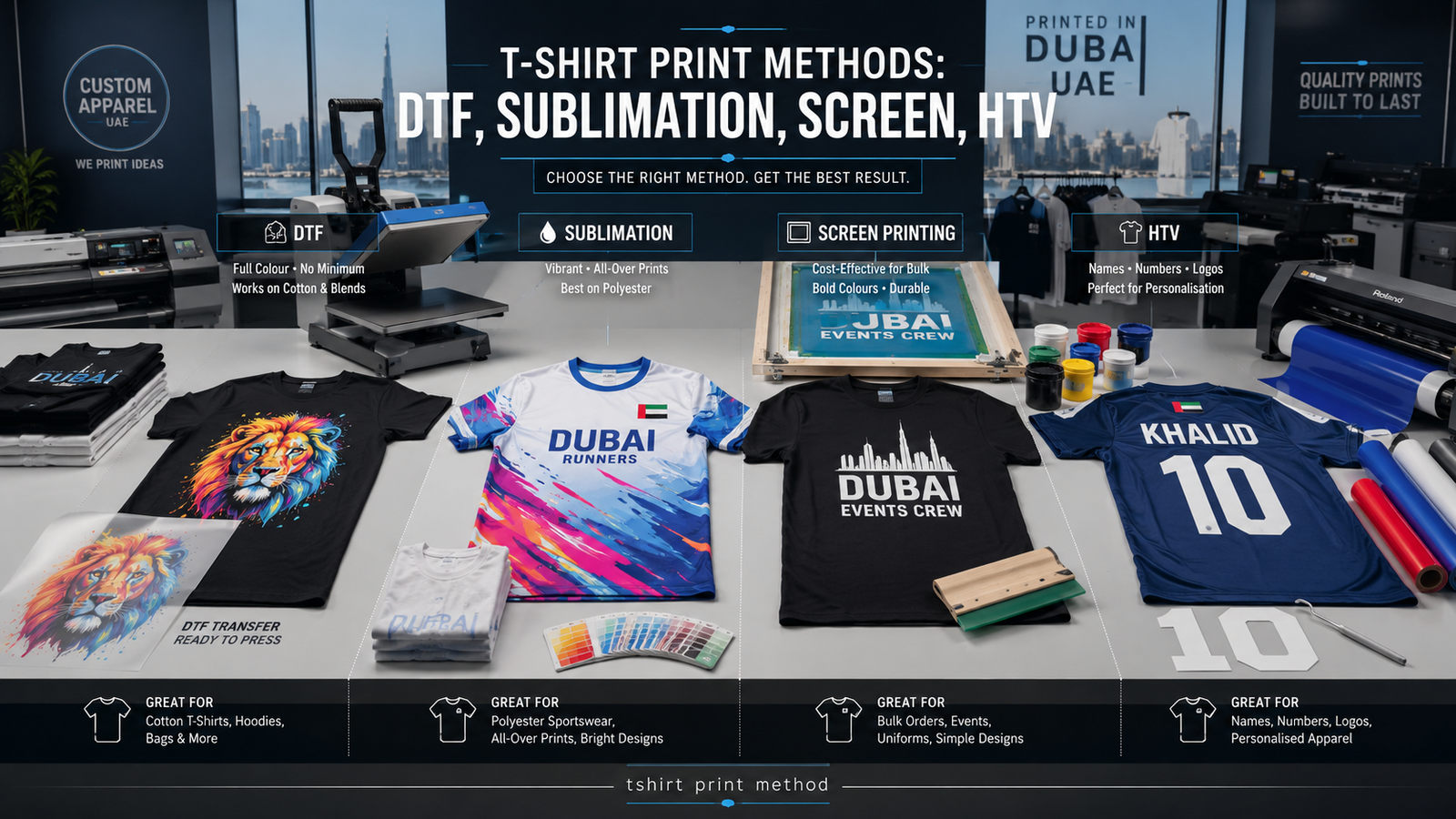
DTF printing prints the design onto a special PET film with CMYK + white ink, applies adhesive powder, then heat-presses the film onto the t-shirt. Works on virtually any fabric — cotton, polyester, blends, dark, light — with consistent vivid colour. The most-versatile t-shirt print method in 2026 UAE.
Sublimation
Sublimation printing uses heat and pressure to vaporise dye into polyester fibre — the design becomes part of the fabric. Excellent for full-colour photographic detail and zero-feel finish. Restricted to polyester and high-poly-blend fabrics; does not work on 100% cotton.
Screen printing
The traditional method — ink applied through screen mesh, one screen per colour. Excellent for simple solid-colour designs at high volume; uneconomical for full-colour photographic designs. Best at 100+ piece runs of single-design solid-colour graphics.
Heat-transfer vinyl (HTV)
Cut vinyl applied to fabric via heat press. Best for single-piece custom names and numbers (sports jerseys, individual personalisation). Less suitable for complex multi-colour designs or photographic detail.
When to Use DTF (the Default for Most Runs)
DTF is the default for most personalised t-shirt runs in 2026 UAE because it works across virtually every fabric and design type. Use DTF for: cotton t-shirts (where sublimation can’t work), dark or coloured fabrics (DTF white-ink underlay produces vivid colour), full-colour designs and photographic prints, small-to-mid runs (10–100 pieces) where screen-printing setup would be uneconomical, and variable-data per-piece personalisation (each shirt with a different name).
DTF cost typically runs AED 25–60 per piece for personalised single-print designs at small volumes; AED 15–35 per piece at 100-piece runs. Lead times 3–5 working days for small runs; 5–7 days for 100-piece runs.
When to Use Sublimation
Sublimation is the cleaner choice when the fabric is polyester or high-poly-blend (the only category sublimation works on), when you need full-coverage all-over-print designs, when the shirt will see heavy washing (sublimation is the most wash-durable method, with the design dyed into the fibre rather than sitting on top), or when the design is photographic and full-colour. Common applications: sports jerseys, athleisure-style t-shirts, sublimated event uniforms. Cost typically AED 30–70 per piece at small runs; AED 18–40 at 100-piece runs.
When to Use Screen Printing
Screen printing remains the most economical method at scale for solid-colour graphics. Use it when run size is 100+ pieces with the same design, the design is solid-colour (1–4 colours typically; more colours compound setup), per-piece cost matters more than design flexibility, or when you specifically prefer the tactile screen-print feel. Per-piece cost runs AED 12–25 for 1-colour designs at 100 pieces; AED 8–18 at 500 pieces; AED 5–12 at 1000+. Setup is per-design (screens cost per colour to make); lead times 5–10 working days including setup.
When to Use Heat-Transfer Vinyl
HTV is the standard for individual-name personalisation on apparel: sports jerseys (player names and numbers), single-piece custom names (one-off personalisation), and individual-piece corporate or event personalisation where the design is text-heavy. Per-piece cost AED 20–40 for single-name personalisation; same-day to 1-day turnaround for single pieces; 1–2 days for 10–25 piece runs.
Decision Matrix: Which Method for Which Job
By design complexity: Full-colour photographic → DTF or sublimation. Solid-colour graphic → screen printing or DTF. Single-name text → HTV or DTF.
By fabric: 100% cotton → DTF (sublimation won’t work). Polyester or high-poly blend → sublimation or DTF. Mixed or unknown → DTF (most-fabric-tolerant).
By run size: 1–10 pieces → DTF or HTV (no setup penalty). 10–100 pieces → DTF (sweet spot). 100–500 pieces → screen printing for solid-colour, DTF for full-colour. 500+ pieces → screen printing for solid-colour, sublimation for polyester all-over.
Per-piece variation: Each piece different (variable-data names, individual sizes) → DTF or HTV (no per-piece setup penalty).
Bilingual EN+AR T-Shirt Designs
For bilingual EN+AR personalised t-shirts, all four print methods support the layout. Modern Arabic and Naskh are the most-picked Arabic styles for casual t-shirts; Diwani works for premium event apparel. Vertical stacking (English on top, Arabic below, both centred on the chest) is the cleanest layout. Every Arabic layout is reviewed by a typography specialist before production.
Proof Step for Bulk T-Shirt Runs
For any bulk t-shirt run above 50 pieces, the proof step is the single highest-value quality-protection investment. The standard process: produce one piece in the exact spec (fabric, print method, design, personalisation, size) before committing to the full run. The proof piece arrives in 1–2 working days; you confirm visually that the colour rendering, design placement, fabric tone, and personalisation are correct. Production of the remaining run begins after proof approval. Skipping the proof step on a 200-piece order saves 1–2 days but produces 200 pieces with whatever the underlying brief miscommunication was. Common proof-stage catches: brand-colour drift across DTF batches, Arabic-text rendering issues, design placement off-centre, fabric-tone variance versus the original swatch.
Common T-Shirt Print Mistakes
Four mistakes recur. Wrong method for fabric: ordering sublimation on cotton (the design simply won’t take). Under-spec ink coverage on dark fabrics: picking a method without white-ink underlay on dark fabric, with the colour disappearing. Mixing setup-heavy with small runs: screen printing a 20-piece run with full setup costs makes per-piece cost uneconomical. Skipping the proof step on bulk runs: 100-piece corporate t-shirt orders without a 1-piece proof can produce 100 pieces with the wrong tone, placement, or size.
Same-Day Dubai for T-Shirt Personalisation
Same-day Dubai applies for DTF and HTV t-shirt personalisation with an 11am cut-off (sublimation also at 11am for polyester apparel). Single-piece custom-name HTV is the fastest in the category. Screen-printed t-shirts cannot be produced same-day because of the setup step. There is no minimum order; UAE-wide is 1–3 business days; GCC cross-border 7–14 days.
Order Yours Today
Pick the t-shirt print method that matches the run.
DTF for full-colour and small-to-mid runs, sublimation for polyester all-over, screen printing for high-volume solid-colour, HTV for single-name personalisation — same-day Dubai for DTF/HTV/sublimation at the 11am cut-off.
Same-day Dubai delivery for orders placed before 11am (12pm for UV-printed items). UAE-wide delivery 1–3 business days. GCC cross-border 7–14 days. Order via WhatsApp or our online form.
Frequently Asked Questions About Tshirt Print Method
Which t-shirt print method should I use for a 50-piece corporate run?
DTF is usually the cleanest choice — works on cotton or polyester, supports full-colour, no setup penalty, consistent results. Screen printing becomes economical at 100+ pieces for solid-colour designs; sublimation at any volume for polyester all-over prints.
Can sublimation be used on cotton t-shirts?
No — sublimation only works on polyester and high-poly-blend fabrics. The dye-vaporisation process bonds to polyester fibre; cotton fibre does not accept sublimation dye. For cotton, DTF is the standard alternative supporting full-colour photographic designs.
What is DTF printing and why is it the default?
DTF (Direct-to-Film) prints designs onto a PET film with CMYK + white ink, applies adhesive powder, then heat-presses the film onto the t-shirt. Works on virtually any fabric, supports full-colour and dark fabrics with white-ink underlay, has no setup penalty for small runs, and supports per-piece variable-data personalisation.
When should I use screen printing for t-shirts?
Screen printing remains the most economical method at scale for solid-colour graphics. Use it when run size is 100+ pieces with the same design, the design is 1–4 solid colours, and per-piece cost matters more than design flexibility. Setup is per-design; MOQ economics favour 200+ pieces.
Is there a minimum order for personalised t-shirts?
No — single-piece personalised t-shirts are produced at standard rates (DTF, HTV, sublimation). Bulk pricing applies from 50 pieces (DTF, sublimation) and 100 pieces (screen printing).
What is HTV used for?
HTV is the standard for individual-name personalisation — sports jerseys (player names and numbers), single-piece custom names, individual corporate or event personalisation. Per-piece cost AED 20–40 for single-name personalisation; same-day to 1-day turnaround.
Which print method is most wash-durable?
Sublimation is most wash-durable because the design is dyed into polyester fibre rather than sitting on top. DTF is second-most-durable. Screen printing is durable for the colours used but can crack over years of washing on flexible fabrics. HTV is the least wash-durable; vinyl can peel after 50+ washes.
Can t-shirts be personalised in Arabic and English together?
Yes — bilingual EN+AR is the default. All four print methods support bilingual layouts. Modern Arabic and Naskh are the most-picked styles for casual t-shirts; Diwani for premium event apparel. Vertical stacking (English on top, Arabic below) is the cleanest layout.
How fast can I get a single personalised t-shirt in Dubai?
Same-day Dubai for DTF, HTV, and sublimation (polyester apparel) at the 11am cut-off. Single-piece custom-name HTV is the fastest. Screen-printed t-shirts cannot be produced same-day.