
How to Choose Arabic Calligraphy Style for Personalised Gifts
The wrong Arabic calligraphy style on a gift doesn’t just look a bit off — to a native eye, it can read as careless. Diwani on a religious gift feels theatrical. Kufic on a wedding gift feels cold. Choosing the right style is about matching the calligraphy’s emotional register to what the gift is for, who it’s for, and where it’s being read. This guide walks through the six styles we offer and when each is the right call.
The Six Calligraphy Styles Available
1. Naskh (نسخ) — The Default for Religious Text
Naskh is what you see in printed Qurans, Islamic textbooks, and most readable signage. It’s clean, balanced, and unmistakably classical. If your gift involves a Quranic verse, a Hadith, a religious phrase like “Bismillah” or “Alhamdulillah”, or anything where readability and respect both matter — Naskh is correct. It’s also the safest choice for religious-context gifts when you’re unsure: never wrong, never showy.
2. Diwani (ديواني) — Royal, Decorative, Premium
Diwani is flowing, ornate, and feels formal in a regal way. It’s the calligraphy of Ottoman court documents and luxury wedding invitations. Use Diwani for: premium wedding gifts, anniversary plaques, high-end name engravings, and anything where you want the script itself to feel like an event. Avoid Diwani for religious quotations — it overstates what should be solemn.
3. Kufic (كوفي) — Geometric, Modern, Architectural
Kufic is the oldest Arabic script style — angular, geometric, and modular. Modern designers love it because it doubles as a graphic element. Use Kufic for: contemporary gifts, modern home decor, monogram-style name prints, urban brand merch, anything where minimalism is the brief. Avoid Kufic for warm, personal gifts — it reads as “designed”, not “intimate”.
4. Modern Arabic — Contemporary, Casual, Friendly
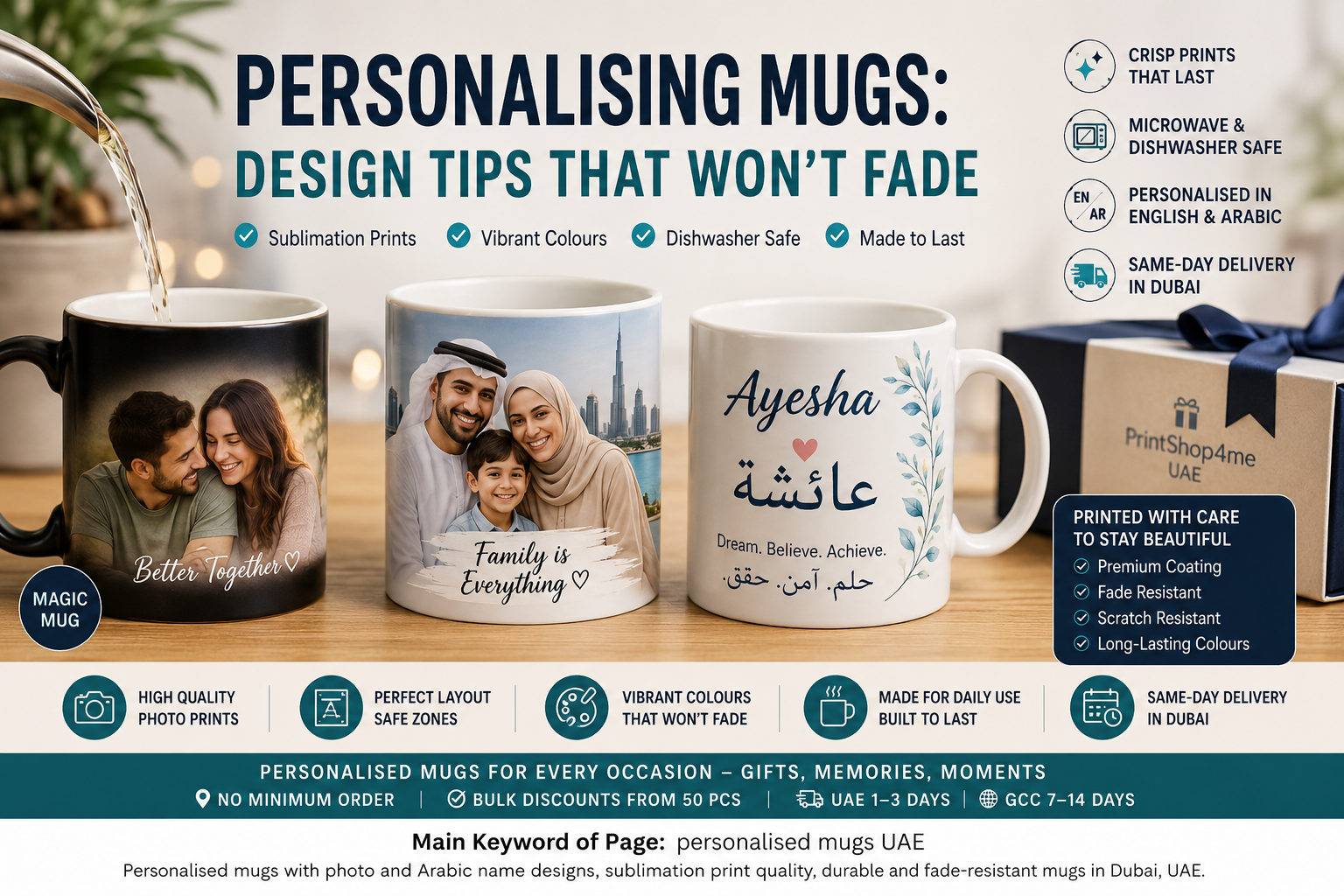
Modern Arabic fonts are the bridge between classical scripts and everyday legibility. They feel current without being self-conscious. Use Modern Arabic for: kids’ gifts, friend gifts, casual personalisation, social media references, anything that should feel “today” rather than ceremonial. Most personalised mugs and T-shirts default here unless the buyer asks otherwise.
5. Thuluth (ثلث) — Large-Scale Formal, Premium Wall Art
Thuluth is the script you see on mosque domes, large-format calligraphy panels, and historical inscriptions. It’s bold, complex, and demands space. Use Thuluth for: large wall canvas, premium framed wall art, stand-out pieces in a home or majlis. Don’t use Thuluth on a mug — at small sizes it loses the proportions that make it Thuluth.
6. Custom Hand-Calligraphy Adaptation — Premium Tier
For premium projects we work with a calligrapher who hand-draws the design and converts it into print-ready vector. This is the right call for once-in-a-lifetime pieces: a Nikkah gift, a milestone wedding anniversary, a corporate retirement plaque, a personal logo for a family. Lead time is longer (5–10 days for the design alone) and pricing reflects the artisan time, but the result is genuinely one of one.
Matching Style to Gift Type
Religious Gifts (Quran cover, prayer mat, framed verse)
Naskh first. Thuluth for large wall pieces. Custom hand-calligraphy for milestone pieces (Hajj return, Aqiqah). A Quranic verse print should always go through specialist typography review — dots, harakat, ligatures and word-spacing all matter and are commonly broken by automated rendering.
Wedding & Engagement Gifts
Diwani for premium and traditional. Modern Arabic for younger, more casual couples. Custom hand-calligraphy for the Nikkah piece itself or the centrepiece anniversary frame.
Corporate Gifts & B2B
Modern Arabic for everyday corporate gifts. Kufic for tech, design, and modern-brand companies. Naskh for traditional, government, or family-business contexts.
Kids & Family Gifts
Modern Arabic. Naskh works too. Avoid Diwani and Thuluth — they read as too formal for a child’s name on a lunchbox or school-bag tag.
Bilingual Name Prints (English + Arabic Together)
This is the most common request. Bilingual name printing works best when the two scripts feel balanced — usually Naskh or Modern Arabic paired with a clean Latin font (Helvetica, Avenir, or a custom display face). Diwani paired with a thin English font reads beautifully. Kufic paired with bold English geometric fonts is a strong contemporary look.
Quranic Verses — Special Considerations
If your gift includes any Quranic text, several things must be right:
- Correct script: Naskh or Thuluth, never Diwani or Kufic.
- Harakat (vowel marks): Must be present and correctly placed, especially for verses where the meaning depends on them.
- Word-spacing and ligatures: Specialist review catches the issues automated rendering misses.
- Source verification: We cross-check the verse text against a recognised Mushaf before printing.
- Respectful product context: Quranic text appears on prayer mats, framed wall art, Quran covers, and prayer-bead boxes. It does not appear on mugs, cushions, or anything that contacts the floor.
What an Arabic Typography Review Actually Checks
“Reviewed by an Arabic typography specialist” can sound like marketing copy. In practice, here’s what the review catches that automated rendering misses:
- Ligatures — Arabic letters change shape depending on whether they sit at the start, middle, or end of a word. Cheap fonts use the same shape everywhere, which a native eye reads as broken.
- Dot positioning — most Arabic letters are distinguished only by the number and position of dots above or below. A misplaced dot can change one word into another.
- Harakat (vowel marks) — short vowels are written as small marks above or below the consonants. They’re optional in most contexts but mandatory and exact in Quranic text.
- Kashida (letter elongation) — Arabic letters can be stretched horizontally for visual balance, but the rules are strict. Stretching the wrong letters reads as amateur.
- Word-spacing and line-height — Arabic flows differently from Latin script. Inappropriate spacing breaks rhythm.
- Verse accuracy — Quranic verses are cross-checked against a recognised Mushaf before printing. We do not print verses from memory or unverified sources.
Common Mistakes to Avoid
- Using a free Arabic font you found online without a typography review. Many free fonts have broken ligatures, missing dots, or incorrect harakat positioning. We review every Arabic design before print — but if you’re DIYing, this is the #1 failure point.
- Stretching or condensing Arabic letters. The letterforms have proportional rules — stretch them and they look amateur even to non-native eyes.
- Mixing styles within one piece. Pick one Arabic style and one English font; don’t combine three scripts in one design.
- Putting Quranic verse on a mug or T-shirt. Beyond aesthetic — culturally inappropriate.
- Forgetting that Arabic reads right-to-left. Layout decisions (alignment, image position, where the name “starts”) need to flip when Arabic is the primary script.
Choosing Calligraphy When You Don’t Read Arabic
A common UAE situation: an English-speaking buyer wants to gift an Arabic-reading recipient (a spouse, in-laws, a Muslim friend) and isn’t confident judging the script. Three tactics that work:
- Match the recipient’s age and context. Older, traditional recipient → Naskh. Younger, modern recipient → Modern Arabic or Kufic. Religious context → Naskh always.
- Ask a native speaker to sanity-check the design before approval. We send a digital proof for every Arabic order — share it with someone who reads Arabic.
- When in doubt, default to Naskh. It’s never wrong. It may be slightly less stylish than Diwani for a wedding, but it will never offend or look mismatched.
Quick Recommendations by Use-Case
- Personalised name on a mug or cushion: Modern Arabic or Naskh. Personalised mugs from AED 39.
- Premium wedding gift: Diwani or custom hand-calligraphy.
- Religious/Quranic wall piece: Naskh for medium, Thuluth for large.
- Modern corporate gift: Kufic or Modern Arabic.
- Bilingual name print: Naskh or Modern Arabic + clean Latin font.
Order Yours Today
Arabic calligraphy on personalised gifts — six styles, expert typography review, no minimum order.
Naskh, Diwani, Kufic, Modern Arabic, Thuluth, and custom hand-calligraphy adaptations. Every Arabic design reviewed by an Arabic typography specialist before printing.
Same-day Dubai delivery for orders placed before 11am (12pm for UV-printed items). UAE-wide delivery 1–3 business days. GCC cross-border 7–14 days. Order via WhatsApp or our online form.
Frequently Asked Questions About Arabic Calligraphy Style Gifts
Which Arabic calligraphy style is best for a personalised mug?
Modern Arabic or Naskh. Both are clean at small sizes. Diwani and Thuluth lose their proportions on a curved mug surface, and Kufic can feel too cold for a personal gift.
Is Diwani appropriate for religious gifts?
Generally no. Diwani is decorative and royal in feel — better suited to weddings and luxury personalisation. Religious text (Quranic verses, Hadith, Bismillah) belongs in Naskh or Thuluth.
Can I send a hand-drawn calligraphy file to be printed?
Yes. We’ll vectorise it for print and confirm proportions before production. This is treated as a custom-calligraphy job and incurs a one-off design fee.
Do you offer specialist Arabic typography review?
Yes — every Arabic design is reviewed by an Arabic typography specialist before printing. We check ligatures, dots, harakat, word-spacing, and verse accuracy where applicable.
Is there a minimum order for Arabic-personalised gifts?
No minimum. A single mug, frame, or plaque with Arabic calligraphy is the same workflow as a bulk run.
Can I print Quranic verses on a personalised gift?
Yes, on appropriate products: framed wall art, prayer mats, Quran covers, prayer-bead boxes. Not on mugs, cushions, or items that contact the floor. Naskh or Thuluth script, with full specialist review.
How long does custom hand-calligraphy take?
Design phase 5–10 days, printing 3–7 working days. Total: 2–3 weeks. Plan accordingly for milestone gifts.
What’s the difference between Kufic and Modern Arabic on a print?
Kufic is geometric and feels architectural — straight lines, sharp angles. Modern Arabic is rounded, friendly, and reads as contemporary without being decorative. Pick Kufic for tech/design contexts, Modern Arabic for everyday personalisation.
Can I get bilingual EN+AR on the same item?
Yes — and bilingual is the default for many UAE customers. We balance the two scripts so neither dominates, with the typography review covering both sides.