
DTF vs Sublimation: Which Is Right for Your Branded Merch
If you’re sourcing branded merch for a UAE company and someone tells you “we’ll DTF it” without explaining when sublimation would be the better call, you’re probably getting the supplier’s preferred process — not the right process for the job. DTF and sublimation are both excellent printing methods, but they win on different fabrics, in different volumes, and for different design types. This guide tells you which one fits which job, in plain English.
How DTF Works (Plain English)
DTF stands for Direct-to-Film. The process: print the design onto a special PET film with white-base ink, dust adhesive powder onto the wet ink, cure under heat, then heat-press the cured film onto the garment. The adhesive bonds the printed design to the fabric.
DTF printing works because the white underbase makes the design vivid on dark fabrics, and the adhesive bonds to nearly any textile fibre — cotton, polyester, blends, leather, denim, even some synthetics that sublimation can’t touch. The print sits as a thin layer on top of the fabric (rather than dyeing the fabric itself).
How Sublimation Works (Plain English)
Sublimation prints the design onto special paper using sublimation ink, then heat-presses the paper against the fabric. Under heat, the ink converts directly from solid to gas (sublimes) and bonds with the polyester fibres of the fabric. The design becomes part of the fabric, not a layer on top.
Sublimation printing produces the most vivid, sharpest, longest-lasting print available — but only on polyester (or polyester-coated surfaces like mugs, ceramic plates, metal panels). On cotton, sublimation simply doesn’t work — the ink has nothing to bond with.
Head-to-Head: Fabric Compatibility
DTF wins on:
- 100% cotton T-shirts
- Cotton-poly blends (any ratio)
- Hoodies (most are cotton-blend)
- Denim, canvas, twill
- Dark-coloured fabrics (white underbase makes designs pop)
- Leather and faux-leather accessories
Sublimation wins on:
- 100% polyester T-shirts and jerseys
- Polyester-blend sportswear
- Light-coloured polyester (white, pastels)
- Sublimation-coated mugs, plates, tumblers, phone cases
- Polyester-coated metal panels (signage, awards)
- Fine-detail designs (gradients, photographs, intricate artwork)
Head-to-Head: Colour, Detail, Durability
Colour Vibrancy
Sublimation produces deeper, more saturated colours on polyester — particularly in gradients and photo-realistic designs. DTF produces vivid colours on any fabric thanks to the white underbase, but on light polyester sublimation has a slight edge.
Fine Detail
Sublimation reproduces the finest detail because the ink penetrates the fibre — there’s no surface texture interference. DTF has slight raised texture (the adhesive layer) that can soften extreme fine detail, though for typical logo and text designs it’s invisible.
Durability
Sublimation is essentially permanent — won’t crack, peel, or fade because it’s part of the fabric. DTF is highly durable too (50+ wash cycles is standard) but eventually a DTF print can crack at high stress points (elbow creases, heavy ironing) where sublimation cannot.
Hand Feel
Sublimation has zero hand feel — you can’t tell the design is there by touch. DTF has a thin perceptible layer, less pronounced than screen-printed plastisol but more than sublimation.
Cost & Bulk Thresholds
Setup & Per-Piece Costs
DTF: low setup (no screens, no plates), per-piece cost roughly constant across small and large runs. Excellent for runs as small as 1–10 pieces. Cost per piece doesn’t drop dramatically at high volume.
Sublimation: similarly low setup, but with the constraint of polyester-only fabric. Cost per piece is similar to DTF on apparel, slightly cheaper on mugs and hard surfaces (sublimation mugs are mass-produced).
Bulk Thresholds
For UAE corporate orders: both DTF and sublimation start at 50 pieces for apparel runs. Below 50, single-piece personalisation is available but per-piece economics shift toward retail pricing.
When to Pick DTF
- Cotton or cotton-blend fabric (most T-shirts, hoodies, totes)
- Dark-coloured garments (DTF’s white underbase is the only reliable way)
- Mixed-fabric campaigns (one design across cotton T-shirts, denim caps, canvas totes)
- Designs with bold colours and graphic shapes
- Smaller runs (1–50 pieces) where setup economics matter
- Custom event merchandise where fabric mix is unpredictable
When to Pick Sublimation
- 100% polyester sportswear, jerseys, training kits
- Photo-realistic designs, gradients, intricate detail
- All-over print designs (full-coverage jersey patterns)
- Mug printing — sublimation is the standard for ceramic mug photo printing
- Sublimation-coated hard goods: phone cases, plates, awards, metal panels
- Premium B2B sportswear runs where the design is expected to outlast the garment
When to Combine Both
For mixed-product corporate campaigns — say, a 200-piece order including personalised T-shirts (cotton, DTF), polyester sports caps (sublimation), and ceramic mugs (sublimation) — using both processes is normal and expected. A good supplier coordinates them on a single timeline so all items ship together.
Other Print Methods You’ll Be Offered (and When to Use Them)
DTF and sublimation aren’t the only options on the menu. UAE suppliers will sometimes pitch screen printing, heat-transfer vinyl (HTV), or embroidery. Quick orientation:
- Screen printing — best for very high volumes (500+ pieces) of single-colour or simple multi-colour designs on cotton. Lower per-piece cost than DTF at scale, but high setup cost and only economical above a threshold.
- Heat-transfer vinyl (HTV) — cut from coloured vinyl rolls and pressed onto fabric. Best for single-colour names and numbers (sports kit, jersey backs). Avoid for multi-colour designs — DTF wins decisively.
- Embroidery — best for caps, polo shirts, and corporate apparel where a tactile premium look matters. Slower and more expensive per piece than DTF, but the look is genuinely different and many B2B clients prefer it.
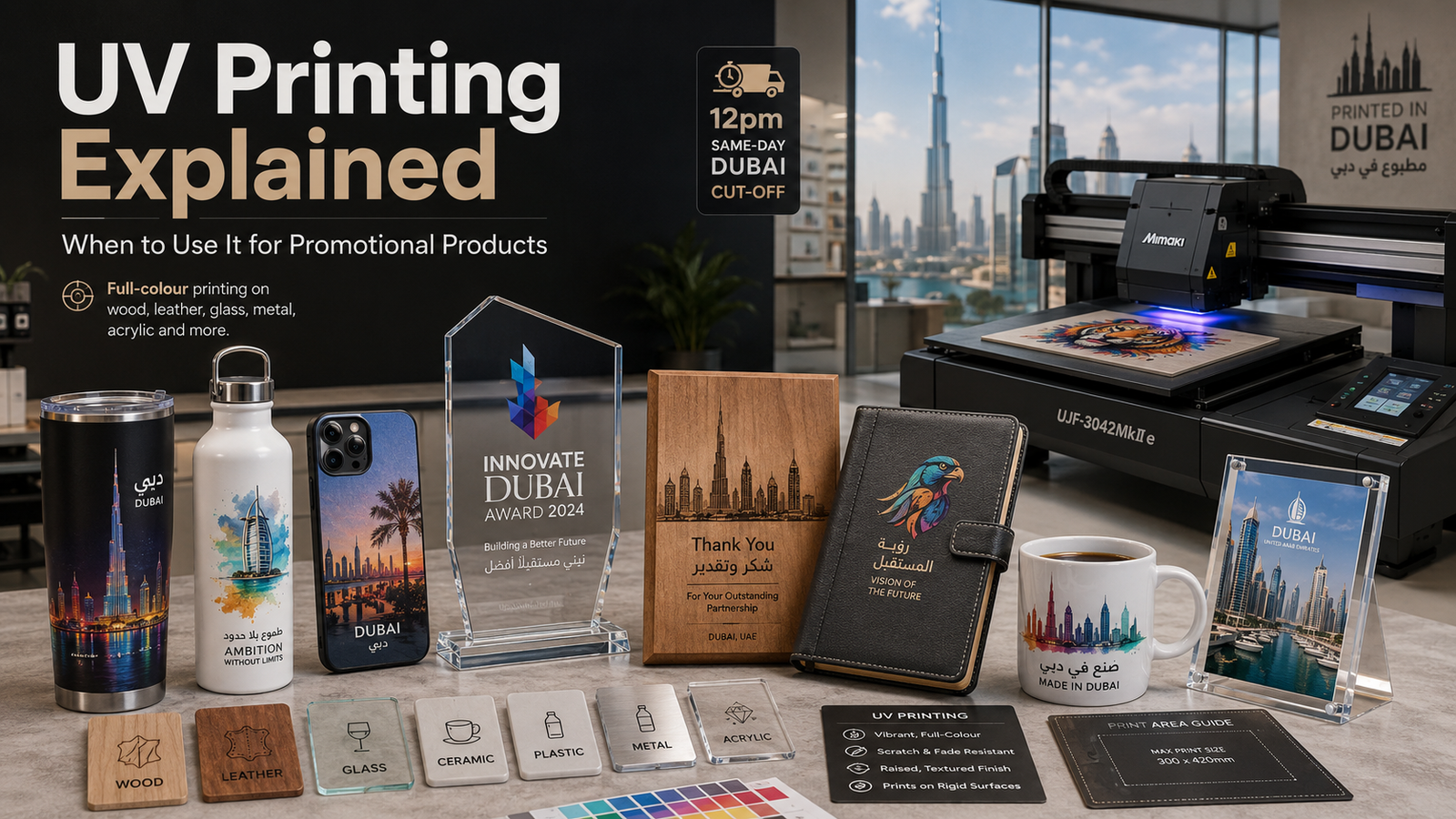
- UV printing — for hard goods (frames, cushions, phone cases, plaques). Different process from DTF and sublimation; not a competitor for apparel.
Personalised T-shirts ordered through us default to DTF unless you specify otherwise. We’ll suggest sublimation if your fabric is polyester, screen printing if your run exceeds 500 pieces of a simple design, or embroidery if you want a polo or cap with a tactile premium feel.
Real-World Cost Comparison (200-Piece Run)
For a 200-piece T-shirt order with a 3-colour logo on the chest, here’s the rough cost shape:
- DTF on cotton T-shirts: AED 18–28 per piece all-in.
- Sublimation on polyester T-shirts: AED 22–32 per piece all-in.
- Screen printing on cotton T-shirts (3-colour): AED 14–22 per piece all-in (cheaper at this volume, but setup fees pull short runs above DTF).
- Embroidery (3-colour logo): AED 28–42 per piece all-in.
The numbers shift with fabric quality, design complexity, and lead time pressure — but this is the order of magnitude. DTF is the all-rounder; sublimation wins on polyester; screen printing wins at high volume; embroidery wins on premium tactile.
Quick Decision Matrix
| Product | Best Process | Why |
|---|---|---|
| Cotton T-shirt (any colour) | DTF | Sublimation doesn’t work on cotton |
| Cotton hoodie | DTF | Cotton-blend, dark fabric, durability |
| Polyester sports jersey | Sublimation | Vivid, durable, no hand feel |
| Polyester running top | Sublimation | All-over print possible, sweat-resistant |
| Cotton tote bag | DTF | Cotton, fast turnaround |
| Ceramic mug | Sublimation | Photo-quality, dishwasher-safe |
| Phone case (sublimation-coated) | Sublimation | Vivid full-wrap print |
| Cotton-poly blend T-shirt (50/50) | DTF | Cotton portion blocks sublimation |
| Denim jacket / cap | DTF | Sublimation can’t bond to denim |
| White polyester T-shirt | Sublimation | Slight colour and durability edge |
| Mixed-fabric merch run | DTF (most), Sublimation (mugs/hard goods) | One process for apparel, one for hard surfaces |
Order Yours Today
DTF and sublimation printing for UAE branded merchandise — apparel, mugs, hard goods.
Cotton T-shirts and hoodies via DTF, polyester sportswear and ceramic mugs via sublimation. Bulk runs from 50 pieces apparel, 20 pieces UV-printed. UAE-wide and GCC delivery.
Same-day Dubai delivery for orders placed before 11am (12pm for UV-printed items). UAE-wide delivery 1–3 business days. GCC cross-border 7–14 days. Order via WhatsApp or our online form.
Frequently Asked Questions About DTF V.s Sublimation
Which is better for branded T-shirts in UAE — DTF or sublimation?
Depends on the fabric. Cotton or cotton-blend = DTF. 100% polyester = sublimation. Most cotton T-shirts (still the dominant choice for UAE corporate gifts) are DTF.
Does sublimation work on cotton at all?
No. Sublimation ink bonds with polyester fibres only. On cotton, the print fades to nearly nothing within a wash or two. Suppliers who claim ‘sublimation on cotton’ usually mean a polyester-coated cotton with a poly outer layer — quality is mediocre.
Which lasts longer in the wash?
Sublimation is essentially permanent. DTF withstands 50+ wash cycles before any visible degradation, often more with cold-wash care. Both outlast cheap heat-transfer vinyl by a wide margin.
Can DTF print on dark fabrics?
Yes — the white underbase is exactly what makes DTF the right call for dark fabrics. Sublimation cannot print on dark polyester at all (the ink is translucent and disappears against dark colours).
Is DTF or sublimation better for fine detail?
Sublimation produces marginally finer detail because the ink penetrates the fibre. For typical logo and text designs, DTF is indistinguishable. For photo-realistic gradients on polyester, sublimation has a clear edge.
What’s the minimum order for DTF or sublimation merchandise in UAE?
Both start at 50 pieces for standard apparel corporate runs. Below 50, single-piece personalisation is available. UV-printed hard goods (frames, cushions) start at 20 pieces.
Can I do all-over print on a T-shirt with DTF?
Limited. DTF works best with localised designs (front, back, sleeve placements). Full all-over coverage is sublimation territory — and only on polyester.
How fast can a DTF or sublimation order be turned around?
50–200 pieces: 3–7 working days. Larger runs scale up. Same-day Dubai is possible for sub-20-piece runs of standard items if ordered before 11am.
Can both processes be used in one corporate campaign?
Yes — and it’s common. Cotton T-shirts via DTF, polyester sports caps and mugs via sublimation, all coordinated on one timeline so the order ships together.