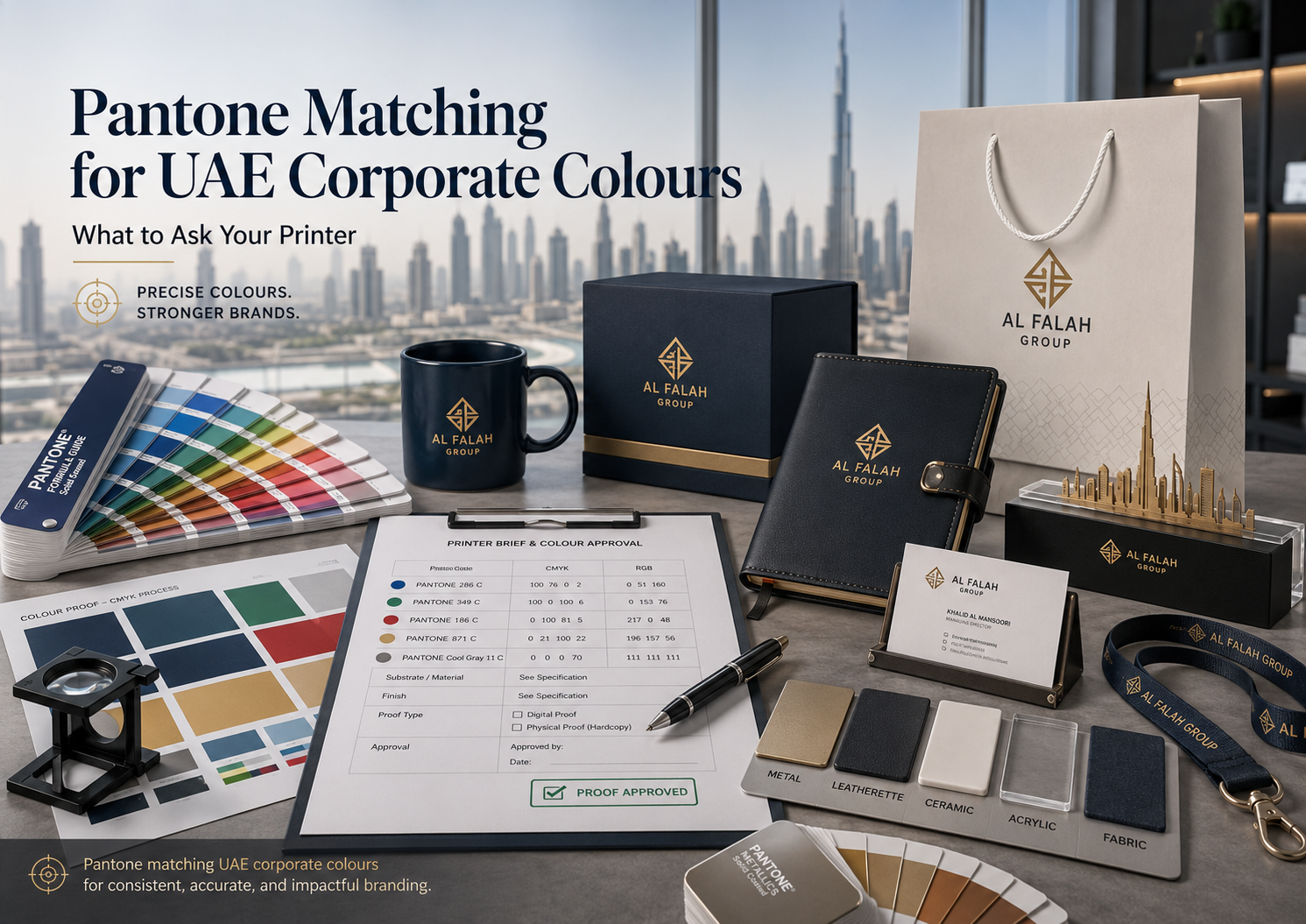
Pantone Matching for UAE Corporate Colours: What to Ask Your Printer
Brand-colour fidelity is the single most-overlooked specification in UAE corporate printing. A logo printed in approximately-the-right-blue is far worse than one printed in correctly-the-right-blue, because the brand the logo represents is partly defined by its exact colour — and a 5% colour drift across 200 corporate gifts dilutes that brand consistently for every recipient who notices. Pantone matching is the production process that prevents this drift. This guide covers what Pantone matching actually does, how it varies across print methods, the asks that matter when briefing a printer, and the limitations to expect on different surfaces.
What Pantone Matching Actually Is
Pantone is a global colour-matching system that assigns a unique code (e.g., PMS 286 C for the classic deep blue used by IBM, or PMS 356 C for the Saudi green) to each defined colour. The Pantone code carries an exact specification — the printer mixes ink to that specification, runs a match-test against a Pantone reference book, and only proceeds to production once the match is verified within the system’s tolerance. Pantone matching is the difference between “print it in the company blue” (which produces unpredictable results across printers and over time) and “print it in PMS 286 C” (which produces consistent results across printers and over years).
Why Brand-Colour Fidelity Matters at Scale
For a 50-piece run of corporate gifts, even a noticeable colour drift may slip past unnoticed. For 500 pieces distributed across a client base or hiring intake, every recipient who knows the brand will notice the drift, and consistent inconsistency erodes brand trust. The cost of Pantone matching versus default printer colour is small (typically 5–15% per-piece premium for Pantone-matched runs at scale). The cost of recall, re-print, or quietly-degraded brand consistency is larger. For ongoing corporate gift programs (quarterly client gifts, monthly hiring kits, annual events), Pantone matching is the cleaner default.
How Pantone Matching Varies Across Print Methods
Offset printing (best Pantone fidelity)
Traditional offset printing supports custom-mixed inks at exact Pantone specifications. The printer mixes ink for each Pantone colour separately and runs a separate plate per colour. Best fidelity, but only economical at high volumes (1000+ pieces) and only available on flat surfaces (printed packaging, paper goods, cardboard inserts).
Screen printing (good Pantone fidelity)
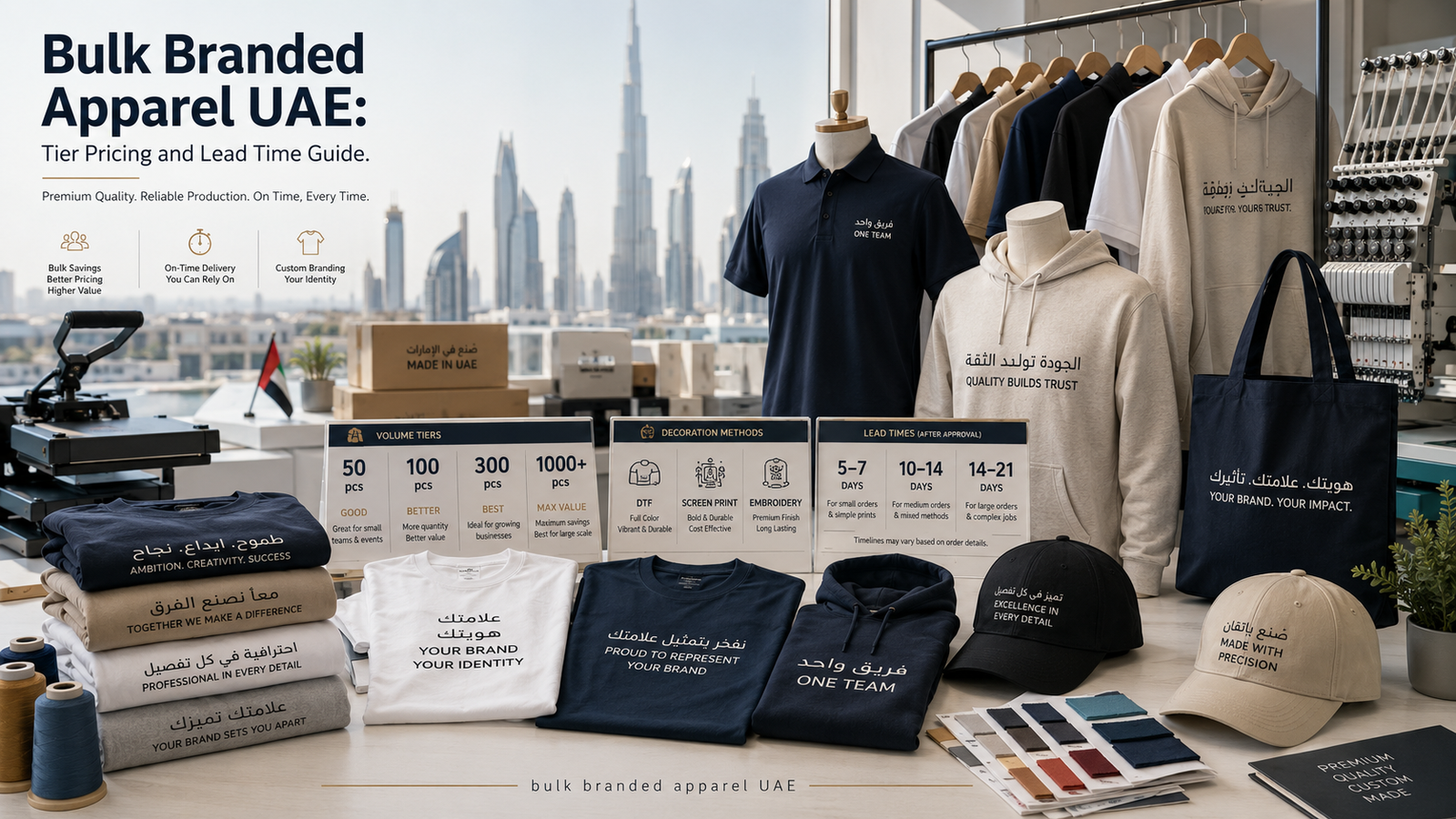
Screen printing also uses custom-mixed inks per colour, with each colour run as a separate screen pass. Excellent Pantone fidelity at mid-volume (100–500 pieces). Used for branded apparel, fabric items, and printed packaging where offset is uneconomical.
UV printing (good fidelity, with calibration)
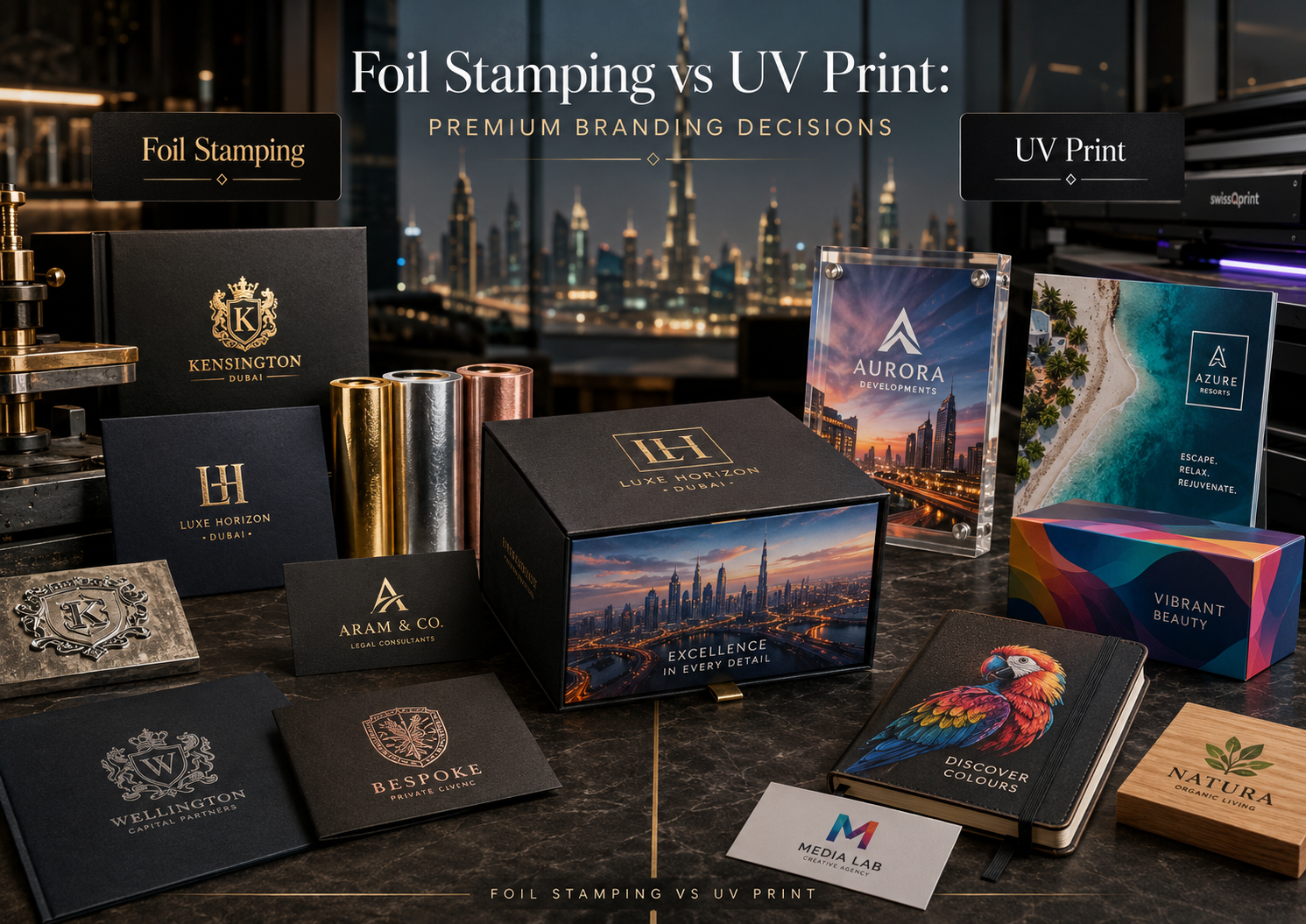
UV printing uses CMYK + white ink to mix colours digitally rather than via custom-mixed inks. Calibrated UV systems can match most Pantone colours within tight tolerances, with three exceptions: bright fluorescents, deep oranges, and high-saturation greens (which exceed CMYK gamut). Setup-free and economical at all volumes — the standard for premium promotional products.
Sublimation (variable fidelity)
Sublimation prints CMYK dye into a polymer coating. Pantone matching is achievable for most colours but with slightly more drift than UV printing on the same colours. For high-fidelity brand-colour requirements, sublimation is acceptable but UV is cleaner.
DTF (variable fidelity)
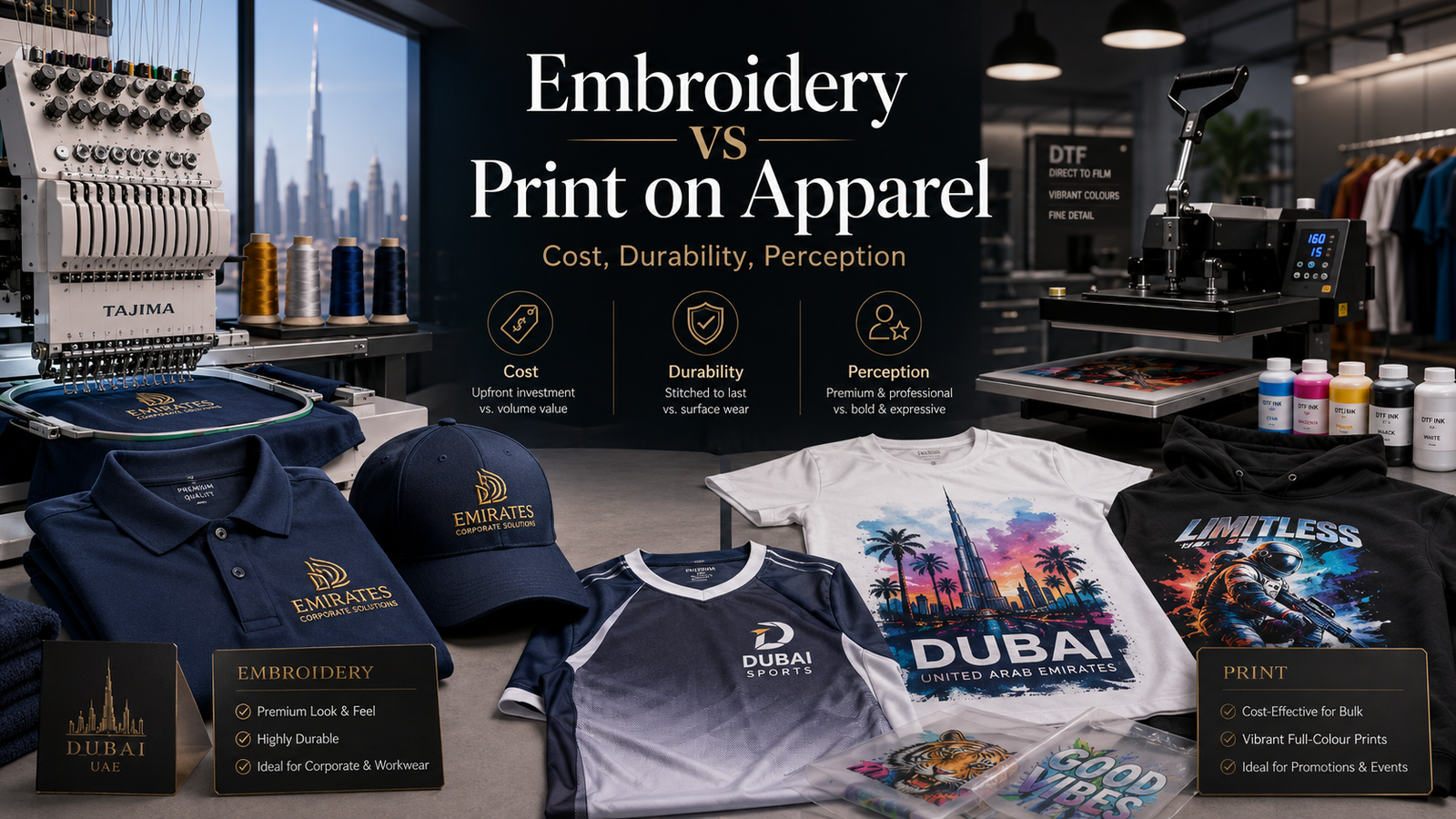
Direct-to-Film printing uses CMYK + white ink on apparel substrates. Pantone matching is achievable within tight tolerances on most colours; bright fluorescents and high-saturation greens are weaker. Better than sublimation for dark-fabric Pantone fidelity; weaker than screen printing for high-volume runs.
What to Send Your Printer
For Pantone-matched corporate runs, send four pieces of information.
1. The Pantone code
PMS 286 C (coated paper) or PMS 286 U (uncoated paper) — the C/U suffix matters because the same Pantone number prints differently on coated vs uncoated stock. For most UAE corporate gifts (printed on coated boxes, UV-printed onto coated substrates), the C suffix applies. Confirm with your printer if uncertain.
2. RGB and CMYK fallback values
Provide the RGB (for screen reference) and CMYK (for digital print fallback) values matching the Pantone code. The printer uses these as cross-reference if the production method falls back to CMYK rather than custom-mixed Pantone ink.
3. The substrate
Same Pantone code prints differently on metal, leather, ceramic, fabric, paperboard, and acrylic. Specifying the substrate at brief time lets the printer calibrate accordingly.
4. Brand colour reference samples
If you have existing branded items with the colour produced correctly, send a sample. Physical reference is more reliable than digital colour swatches because monitor calibration varies. For private label printing programs, supplying a reference sample at briefing reduces colour-drift risk on subsequent re-orders.
The Proof Verification Step
Before any Pantone-matched run goes to full production, request a physical proof — one or two sample pieces produced at full specification — and verify the colour match against the original Pantone reference book under controlled lighting (not phone-screen, not under fluorescent office light). Approve in writing. Then proceed to full production. Skipping the proof step on a 200-piece Pantone-matched run risks the entire run if the calibration drifts during setup. The proof typically adds 1–2 days to the timeline and is included in standard production for Pantone-matched runs.
Limitations: Which Surfaces Hold Colour, Which Don’t
Some surfaces hold Pantone colour better than others. Coated paperboard, leatherette, and rigid acrylic hold colour cleanly across batches. Genuine leather varies batch-to-batch (the underlying leather tone shifts the printed colour). Ceramic mugs hold sublimated colour reliably but have a slight gloss-curing shift. Fabric (cotton, linen, polyester) has the highest batch-to-batch variation; for premium fabric runs, request a per-batch proof. Metal surfaces with anodised finishes hold UV-printed colour well; bare-metal surfaces vary with the underlying metal tone. Custom logo printing workflows account for substrate-specific colour calibration.
Bilingual Brand-Colour Considerations
For corporate gifts with bilingual EN+AR text in brand colours, the same Pantone code applies to both scripts — there is no language-specific colour shift. The typography review process verifies that the Arabic text holds visual weight equivalent to the English at the specified colour, since some colours render with different perceived weight on Arabic vs English letterforms.
Same-Day Dubai and Lead Times
Pantone-matched runs have slightly longer lead times than CMYK-default runs because of the proof verification step. Standard runs add 1–2 days for proof; bulk runs above 200 pieces follow standard production timelines (5–14 working days depending on volume and method). Same-day Dubai is generally not available for first-time Pantone-matched runs because the proof step cannot be skipped. For repeat orders where the Pantone match is already verified and on file, same-day cut-offs apply (11am sublimated/fabric, 12pm UV).
Order Yours Today
Get exact brand-colour fidelity across every corporate gift.
Pantone matching across UV, sublimation, screen, and offset — proof verification on every run, substrate-specific calibration, bilingual EN+AR support.
Same-day Dubai delivery for orders placed before 11am (12pm for UV-printed items). UAE-wide delivery 1–3 business days. GCC cross-border 7–14 days. Order via WhatsApp or our online form.
Frequently Asked Questions About Pantone Matching UAE
What is Pantone matching?
Pantone is a global colour-matching system that assigns a unique code (e.g., PMS 286 C) to each defined colour. The printer mixes ink to that exact specification and verifies the match against a Pantone reference book before production. The result is consistent brand-colour reproduction across printers and over time.
Why does Pantone matching matter for corporate gifts?
Brand-colour drift across a 200-piece run dilutes brand consistency for every recipient who knows the brand. Pantone matching prevents drift. The cost premium (5–15% per piece at scale) is small relative to the cost of inconsistent brand colour across an ongoing corporate gift program.
Which print methods support the best Pantone fidelity?
Offset printing has the best fidelity (custom-mixed inks per colour) but is only economical at 1000+ pieces and on flat surfaces. Screen printing is excellent at mid-volume (100–500 pieces). UV printing is good with calibration and works on almost any rigid surface. Sublimation and DTF are acceptable but weaker than screen and UV.
What is the difference between PMS 286 C and PMS 286 U?
C is coated stock; U is uncoated stock. The same Pantone number prints differently on coated vs uncoated paper because the surface treatment affects how light reflects off the ink. For most UAE corporate gifts (printed on coated substrates), the C suffix applies. Confirm with your printer if uncertain.
Can Pantone-matched corporate gifts be delivered same-day in Dubai?
First-time Pantone-matched runs cannot be produced same-day because the proof verification step cannot be skipped. For repeat orders where the match is already verified and on file, same-day cut-offs apply (11am sublimated/fabric, 12pm UV).
What should I send to my printer for a Pantone-matched run?
Four pieces of information: the Pantone code (with C or U suffix), RGB and CMYK fallback values, the substrate (metal, leather, fabric, etc.), and a physical brand-colour reference sample if you have one. Physical reference samples are more reliable than digital colour swatches.
Why is the proof step important on Pantone-matched corporate gifts?
Before full production, a physical proof verifies the colour match under controlled lighting. Skipping this step on a 200-piece run risks the entire run if the calibration drifts during setup. Proof adds 1–2 days and is included in standard production for Pantone-matched runs.
Are some Pantone colours impossible to match in UV printing?
Three categories exceed CMYK gamut and cannot be exactly matched: bright fluorescents, deep oranges, and high-saturation greens. For these colours, screen printing or offset printing (with custom-mixed inks) is the cleaner path. Most other Pantone colours match within tight tolerances on calibrated UV systems.
Which surfaces hold Pantone colour most reliably?
Coated paperboard, leatherette, and rigid acrylic hold colour cleanly. Genuine leather varies batch-to-batch. Ceramic mugs hold sublimated colour reliably with a slight gloss-curing shift. Fabric has the highest batch-to-batch variation; request per-batch proofs for premium fabric runs.