
Bilingual Name Printing: Best Practices for English + Arabic
Bilingual EN+AR name printing is the most-used personalisation specification in the UAE in 2026, and also the one most likely to be done badly when the production team treats Arabic as an afterthought rather than a co-equal script. This guide covers the five layout patterns that work cleanly, the typeface pairings that hold visual balance, the surface-specific considerations, and the mistakes that consistently undermine bilingual gifts even when the typography itself is technically correct.
Why Bilingual Name Printing Is the UAE Default
UAE recipients of personalised gifts are bilingual or Arabic-dominant in a meaningful share of cases — Emirati nationals, Saudi nationals via cross-border, and Arab expats from across the region. English-only personalisation in 2026 reads as expat-bubble-ish in contexts where bilingual recipients are common. The bilingual name printing service treats EN+AR as the default specification with no unit-cost premium and no production-time penalty.
The Five Layout Patterns That Work
Pattern 1 — Vertical stack (English on top, Arabic below)
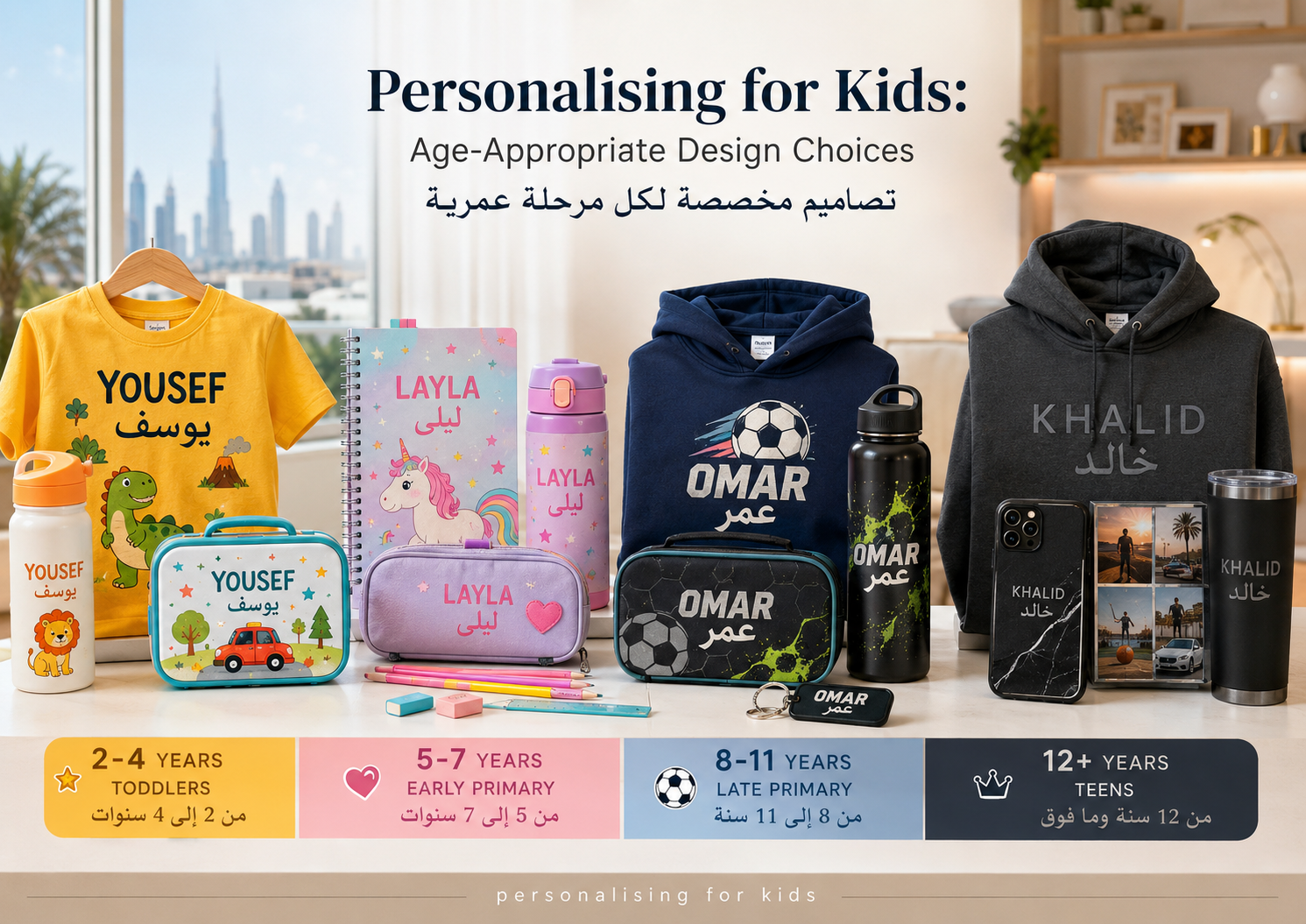
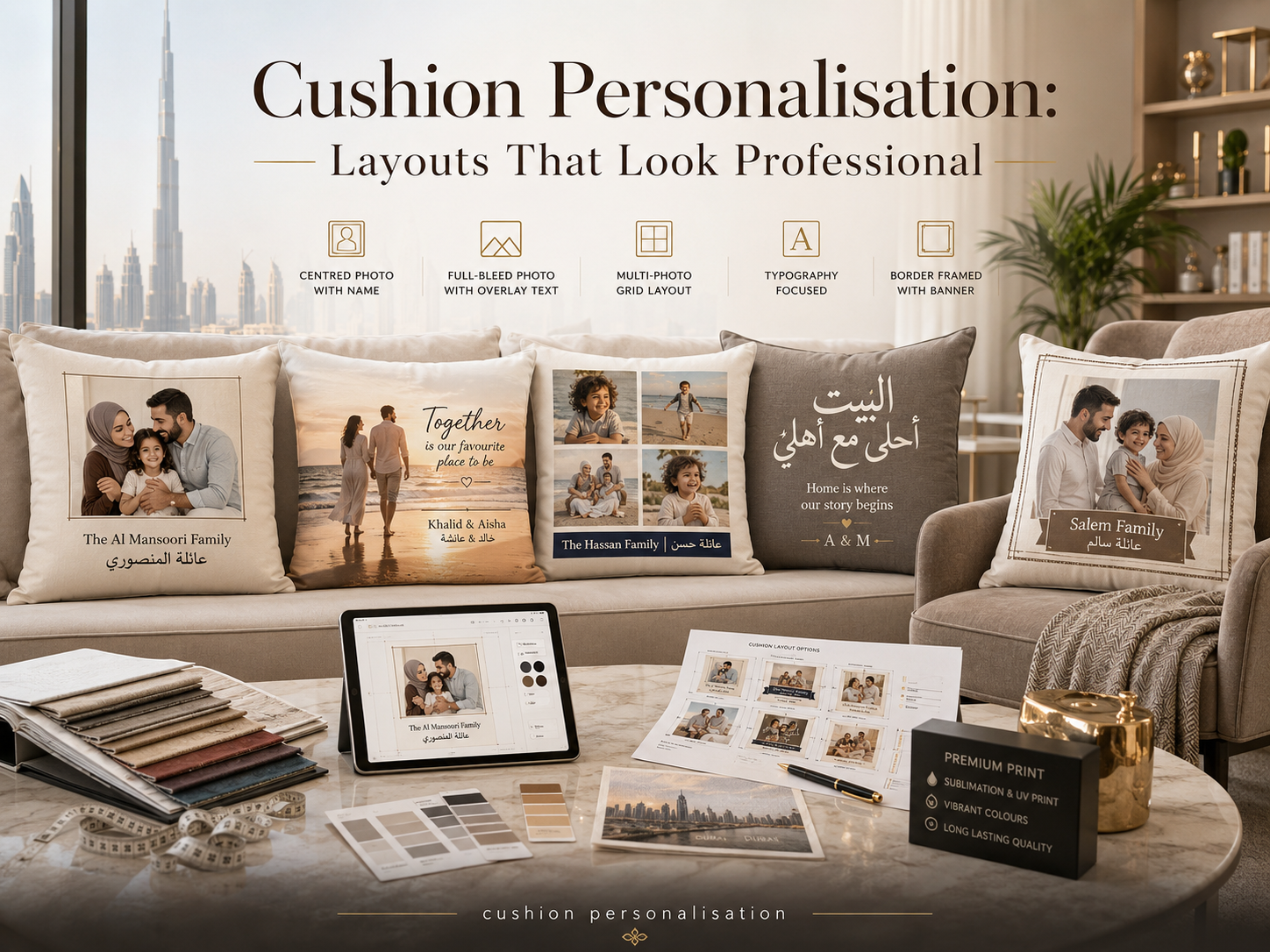
The cleanest pattern for small surfaces. English name centred on top, Arabic name centred below, both at proportional sizes. Works on mugs, small frames, photo cushions, phone cases, and any compact print area. Vertical stacking respects the reading-direction asymmetry of the two scripts and gives each language its own visual line.
Pattern 2 — Side-by-side horizontal (English left, Arabic right)
Works on wider surfaces — large frames, wall canvases, plaques. The two scripts read inward toward the centre (English left-to-right, Arabic right-to-left), which makes the centre of the layout the visual anchor. Choose this for surfaces with horizontal width to spare.
Pattern 3 — Stacked-with-photo
For photo gifts (frames, cushions, canvases) where the photo is the hero element. Names are placed below or above the photo in vertical stack. Works particularly well on multi-aperture photo frames where the names sit in a centre plate.
Pattern 4 — Two-side split (each language on opposite sides)
For curved or cylindrical surfaces (mugs, tumblers, bottles). English name on one side of the handle, Arabic on the other. The recipient rotates the item to read whichever they prefer. Particularly used for items shared in mixed-language settings (office mugs, family kitchen ware).
Pattern 5 — Integrated typographic treatment
Premium-tier wall canvases and ceremonial pieces where the two scripts are integrated into a single composed layout — for example, a large central Arabic name in Diwani or Thuluth, with the English name as a smaller framing element. Requires custom typographic design and adds production time. Used for wedding canvases, recognition awards, and milestone pieces.
Typeface Pairings That Hold Visual Balance
The single most-common bilingual mistake is mismatched optical weight between the English and Arabic typefaces. Five pairings work cleanly:
Naskh + classical English serifs
Use for traditional, religious, formal, and older-recipient registers. Naskh’s measured letterforms pair naturally with traditional serifs (think Times-style typography). Works for Quranic-context gifts, formal corporate registers, and older recipients.
Modern Arabic + contemporary English sans-serifs
Use for everyday and casual personal gifts, contemporary corporate, and friendship gifts. Modern Arabic’s clean letterforms pair with English sans-serifs (Inter-style, Helvetica-style typography). The most-used pairing in 2026 UAE personalisation.
Diwani + elegant English script fonts
Use for wedding, anniversary, and romantic personalisation. Diwani’s flowing letterforms pair with elegant English script (calligraphic, formal-romantic typography). The standard for wedding mug and ceremonial-piece personalisation.
Thuluth + bold formal English
Use for large-format ceremonial pieces — wall canvases, premium plaques, recognition awards. Thuluth’s tall vertical emphasis pairs with bold formal English typefaces. Reserved for premium occasions.
Kufic + minimalist sans-serifs
Use for design-forward recipients — contemporary nursery names, modern wedding favours, design-aware corporate gifts. Kufic’s geometric letterforms pair with minimalist sans-serif English (geometric, Bauhaus-style typography).
Surface-Specific Considerations
Each surface narrows the practical layout choices. Mugs and small curved surfaces: Patterns 1 (vertical stack) and 4 (two-side split). Avoid horizontal pairing on curved surfaces — it compresses awkwardly. Naskh and Modern Arabic are the most-picked styles. Photo frames and flat plaques: All five patterns work depending on size. All five Arabic styles render cleanly on flat surfaces. T-shirts and apparel: Pattern 1 (vertical stack on chest) is the dominant approach. Modern Arabic pairs cleanly with contemporary English sans for casual apparel; Diwani for premium event apparel. Wall canvases and large pieces: Patterns 2, 3, or 5. Thuluth and Diwani particularly benefit from scale. Wedding favours and small premium items: Pattern 1 or 5. Diwani is the standard for couple’s names.
Common Bilingual Mistakes
Wrong style for context
Diwani for a Quranic verse, Kufic for a traditional grandparent’s gift, Thuluth on a curved mug — all read as wrong to Arabic-literate viewers even when the typography is technically correct. Match the style to the register, not just to “what looks nice.”
Skipping typography review
Arabic letters carry diacritical dots that change meaning when misplaced. A single dot in the wrong position can change a name’s meaning entirely. Every Arabic layout is reviewed by a typography specialist before production. Never skip this step on bilingual gifts.
Mismatched optical weight
A thin English typeface paired with a heavy Arabic style (or vice versa) reads as unbalanced. The five pairings above all hold optical balance; mixing across pairings (e.g., Diwani Arabic with a minimalist sans English) typically reads as compromised.
Ignoring reading direction
Arabic reads right-to-left, English left-to-right. On horizontal layouts, the two scripts should read inward toward the centre, not outward toward the edges. Reversing this looks confused even when both names are correctly placed.
Identical sizing for both languages
Arabic letterforms typically have more visual weight per character than equivalent English letters. Setting both at exactly the same point size makes the Arabic visually heavier than the English. Adjust point size to match optical weight, not numerical size.
The Typography Review Process
Every Arabic layout in bilingual personalisation is reviewed by a typography specialist before production. The review checks four things: dot placement (the most-common error), style appropriateness for the gift’s register, optical balance with the English component, and surface-appropriate sizing. Review is included in the standard production timeline at no additional charge and is completed within the same-day window for orders placed before the cut-off.
Same-Day Dubai and Cross-Border
Bilingual EN+AR personalisation does not extend production timelines. Same-day Dubai applies with an 11am cut-off for sublimated and fabric items and a 12pm cut-off for UV-printed pieces. There is no minimum order; UAE-wide is 1–3 business days; GCC cross-border 7–14 days for personalised gifts shipped to KSA, Oman, Kuwait, or Bahrain.
Order Yours Today
Get bilingual EN+AR personalisation that holds optical balance.
Five layout patterns, five Arabic styles, typography specialist review on every layout — across mugs, frames, t-shirts, canvases, and the full personalisation range.
Same-day Dubai delivery for orders placed before 11am (12pm for UV-printed items). UAE-wide delivery 1–3 business days. GCC cross-border 7–14 days. Order via WhatsApp or our online form.
Frequently Asked Questions About Bilingual Name Printing Best Practices
What is the most-used bilingual layout pattern in UAE?
Vertical stacking — English name centred on top, Arabic name centred below — is the most-used pattern, particularly on small and curved surfaces (mugs, photo frames, cushions, phone cases). It respects the reading-direction asymmetry of the two scripts and gives each language its own visual line.
Should the English and Arabic names be the same size?
No — Arabic letterforms typically have more visual weight per character than equivalent English letters. Setting both at the same point size makes the Arabic visually heavier. Adjust point size to match optical weight, not numerical size. The typography specialist review process handles this calibration.
Which Arabic font pairs with which English typeface?
Five clean pairings: Naskh + classical English serifs (traditional/formal); Modern Arabic + contemporary sans-serifs (everyday/casual); Diwani + elegant scripts (wedding/romantic); Thuluth + bold formal English (ceremonial/large-format); Kufic + minimalist sans (design-forward/contemporary).
Can bilingual personalisation be added to any gift type?
Yes — bilingual EN+AR is the default offering across all gift surfaces: mugs, frames, cushions, t-shirts, water bottles, notebooks, plaques, canvases, photo books. Surface narrows the layout pattern but not the language pairing.
Can I get bilingual personalisation delivered same-day in Dubai?
Yes — bilingual personalisation does not extend production timelines. Same-day Dubai applies with an 11am cut-off for sublimated and fabric items, 12pm for UV-printed pieces.
What is the typography specialist review?
Every Arabic layout is reviewed by a typography specialist before production. The review checks dot placement, style appropriateness for context, optical balance with English, and surface-appropriate sizing. Included in standard production timelines at no charge.
Is bilingual EN+AR personalisation more expensive than English-only?
No — bilingual EN+AR adds no unit-cost premium and no production-time penalty. The typography specialist review is included in standard timelines.
Can the same Arabic style be used on every gift type?
No — surface narrows the choice. Mugs and small curved surfaces favour Naskh and Modern Arabic. Wall canvases hold Thuluth dramatically. Ceremonial pieces benefit from Diwani. Design-forward recipients respond to Kufic. The typography specialist review process advises on per-gift style selection.
Why does dot placement matter so much in Arabic typography?
Arabic letters carry diacritical dots that change meaning when misplaced. A single dot in the wrong position can turn a name into an unrelated word. The typography review process catches these errors before production — never skip review on bilingual gifts.