Cushion Personalisation: Layouts That Look Professional
Cushion personalisation is one of the highest-volume product categories in UAE personalised-gifts in 2026 — the cushion’s combination of practical use, generous design surface, and home-presence longevity makes it a workhorse personalisation product. But cushion design is also where amateur personalisation choices show up most visibly: photos centred awkwardly with no border, text fighting the photo for attention, fonts mismatched to the photo’s tone, and colour palettes that clash with the recipient’s actual living-room. This guide covers the design layouts that consistently produce professional-looking personalised cushions, the typography and colour considerations, and the common mistakes that distinguish amateur cushion design from professional.
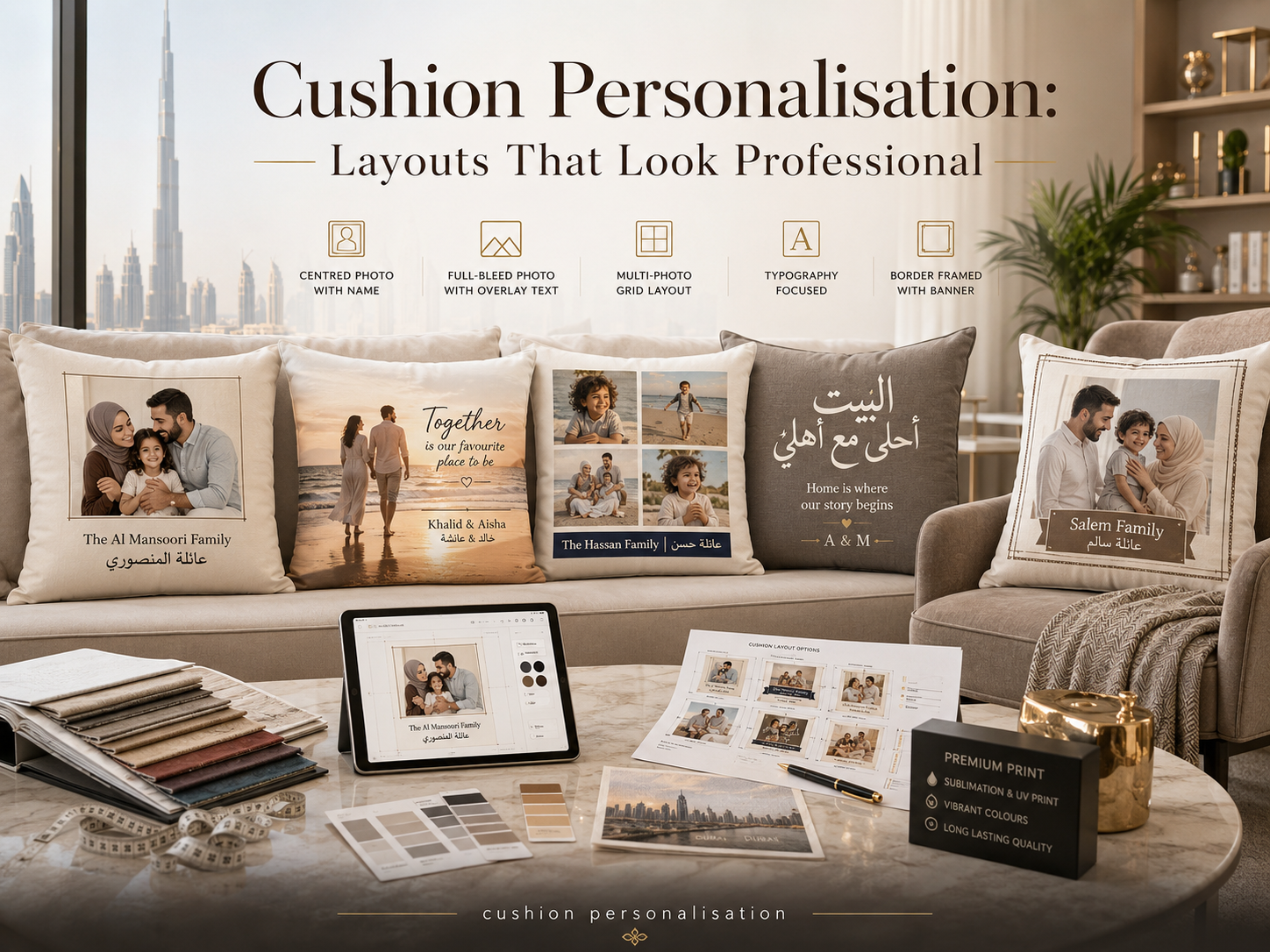
The Five Layouts That Work
1. Centred photo with bilingual name caption below
The most-used professional layout. A square or near-square photo centred on the cushion face, with a generous border of solid colour (typically white, cream, or the cushion’s base colour), and a caption below in bilingual EN+AR (English on top, Arabic below) carrying the recipient’s name and optionally a date or short message. Works across photo subjects (portraits, family group, couple, kids). Photo size typically 60-70% of cushion face; caption sized 1/8 to 1/10 of cushion face height.
2. Full-bleed photo with overlay text
Photo extends to the cushion’s full face, with text overlaid in a strategically-placed area (top-third or bottom-third where the photo’s content allows clean overlay). Best for landscape-style photos with clear sky or simple background regions for overlay. Requires careful photo selection; busy photos make text illegible.
3. Multi-photo grid layout
2×2, 3×3, or 2×3 photo grid covering the cushion face, with the recipient’s bilingual name in a centre-bar or below the grid. Particularly effective for family-collection cushions, anniversary cushions covering multiple years, or friend-group cushions covering friend-network photos. Grid spacing matters: 5-8% gap between photos in white or solid-colour for clean grid presentation.
4. Typography-led with subtle photo accent
Text is the primary visual element — the recipient’s bilingual name in large designed typography, with a small photo accent or no photo at all. Suitable for design-conscious recipients, teen and young-adult gifts, and contemporary aesthetic preferences. The Arabic typography needs to be the design centrepiece; Diwani and Thuluth styles work particularly well in this layout.
5. Border-framed photo with name banner
Photo within a designed border (decorative frame, ribbon, or ornamental motif), with the recipient’s name in a banner-style element above or below. More traditional aesthetic; works well for older-recipient gifts, wedding-anniversary cushions, and ceremonial moments.
Typography Considerations
Cushion typography differs from gift-card or print typography because the cushion is viewed at conversational distance (1–3 metres typically) and at varying angles in the home. Larger sizes than print equivalents: a name that reads cleanly at 12pt on a printed card needs to be 30–40pt equivalent on a cushion. Higher contrast: low-contrast typography (light grey on white) becomes illegible on cushions; aim for solid contrast. Bilingual stacking: English and Arabic on cushions typically stack vertically (English top, Arabic below) rather than side-by-side, because side-by-side fights for visual hierarchy. Arabic style choice: Naskh for traditional cushions, Modern Arabic for contemporary, Diwani for ceremonial, Thuluth for design-led typography-focused layouts. Every Arabic layout is reviewed by a typography specialist before production.
Colour Considerations
Cushion colour considerations matter at two layers. Base cushion colour: the cushion’s base fabric colour determines what photo and text colours work. White or cream base supports any photo; navy or black base supports light photos with white-text overlay. Coloured base (red, blue, green) requires careful photo and text colour matching to avoid clash. Photo treatment: for bright multi-coloured photos on a white-base cushion, photos work as captured. For coloured-base cushions, sepia, black-and-white, or tonal photo treatments often present cleaner than full-colour photos that may clash with the cushion base.
Photo Selection Principles
The photo determines whether the cushion lands or falls flat. Three selection principles. High resolution at print size: a photo that looks fine on a phone screen may pixelate at cushion-print scale. Original camera files (not screenshot, not heavy WhatsApp compression) are essential; minimum 2000px on the longest side for cushion-face print. Clear subject focus: photos with cluttered backgrounds compete with the personalisation text; cleaner backgrounds win. Portrait-style photos with the subject filling 50–70% of the frame work best. Emotional resonance: the photo should mean something specific to the recipient, not just be a generic family or couple photo. Posed studio photos often land less impact than candid moments captured at meaningful events.
UV Print as the Standard Method
Cushion personalisation in UAE 2026 is dominantly produced via UV printing or sublimation. UV print on rigid-cover cushions (with PVC, leather, or composite covers) supports full-colour photographic detail at high durability. Sublimation on polyester-cover cushions produces zero-feel finish with excellent wash durability. Personalised cushions typically use sublimation for fabric-cover cushions; UV for rigid-cover designs.
Common Cushion Design Mistakes
Five mistakes recur on cushion personalisation orders. Low-resolution photos: WhatsApp-compressed photos that look fine on phones pixelate badly at cushion print scale. Use original camera files. Text fighting photo for attention: centring text over a busy photo region produces illegible results. Position text in clean photo regions or use solid-colour text bars. Wrong typography for register: a wedding-anniversary cushion in casual Modern Arabic typography misses the ceremonial register. Match typography to occasion. Coloured cushion base + clashing photo colours: bright multi-coloured photos on a coloured cushion base clash; use white or cream base for full-colour photos, or use tonal photo treatment on coloured base. Single-piece order without proof: for substantial multi-piece runs, the proof step catches design issues before they multiply across the run. The proof adds 1–2 days to the timeline; the alternative is 20+ pieces with whatever the underlying issue is. The cost of the proof piece is negligible compared to the cost of a full run with consistent rendering or layout problems.
Same-Day Dubai for Personalised Cushions
Same-day Dubai applies for sublimated personalised cushions at the 11am cut-off, with UV-printed rigid-cover cushions at the 12pm cut-off. Single-piece orders are produced at standard rates with no minimum and no setup fee. Personalised gifts including cushions ship UAE-wide in 1–3 business days; GCC cross-border 7–14 days.
Order Yours Today
Personalise cushions with layouts that look professional.
Centred-photo with bilingual name caption, multi-photo grids, typography-led designs — high-resolution photos, Arabic styles matched to occasion, sublimation and UV print methods, same-day Dubai.
Same-day Dubai delivery for orders placed before 11am (12pm for UV-printed items). UAE-wide delivery 1–3 business days. GCC cross-border 7–14 days. Order via WhatsApp or our online form.
Frequently Asked Questions About Personalised Cushion Design
What cushion layout looks most professional?
The centred-photo-with-bilingual-name-caption layout is the most-used professional pattern — a square or near-square photo centred with generous border, and a caption below in bilingual EN+AR carrying the recipient’s name. Works across photo subjects. Photo size typically 60-70% of cushion face; caption sized 1/8 to 1/10 of cushion face height.
What photo resolution works for cushion personalisation?
Original camera files (not screenshot, not heavy WhatsApp compression) are essential; minimum 2000px on the longest side for cushion-face print. WhatsApp-compressed photos that look fine on phones pixelate badly at cushion print scale. The single most-common cushion-design mistake is using low-resolution source photos.
Should I use Naskh, Diwani, or Modern Arabic on a personalised cushion?
Naskh for traditional cushions, Modern Arabic for contemporary, Diwani for ceremonial pieces (wedding anniversaries, milestone moments), Thuluth for design-led typography-focused layouts. Match the Arabic style to the cushion’s occasion register. Every Arabic layout is reviewed by a typography specialist before production.
Can I print full-colour photos on a coloured-base cushion?
Bright multi-coloured photos on a coloured cushion base often clash; use white or cream base for full-colour photos, or use sepia, black-and-white, or tonal photo treatments on coloured base. White or cream base is the safest default for full-colour photo cushions.
What is the difference between UV print and sublimation on cushions?
UV print on rigid-cover cushions (PVC, leather, or composite covers) supports full-colour photographic detail at high durability. Sublimation on polyester-cover cushions produces zero-feel finish with excellent wash durability. Sublimation is the standard for fabric-cover cushions; UV for rigid-cover designs.
How big should the personalisation text be on a cushion?
Larger than print equivalents — a name that reads cleanly at 12pt on a printed card needs to be 30–40pt equivalent on a cushion because the cushion is viewed at 1–3 metres typically. Higher contrast required (avoid low-contrast text on similar background); bilingual EN+AR text typically stacks vertically rather than side-by-side.
Should I order a proof before producing a multi-piece cushion run?
For substantial multi-piece runs (10+ pieces), yes — the proof step catches design issues before they multiply across the run. Common proof-stage catches: photo-resolution issues, text positioning, Arabic-rendering problems, colour drift between digital design and printed result. Adds 1–2 days to lead time; cheap insurance against bulk-run failures.
Can I get a personalised cushion delivered same-day in Dubai?
Yes — same-day Dubai applies for sublimated personalised cushions at the 11am cut-off, with UV-printed rigid-cover cushions at the 12pm cut-off. Single-piece orders are produced at standard rates with no minimum and no setup fee.