
How to Write a Meaningful Personalised Gift Message
The personalised gift message is the part most people leave to the last minute and end up regretting. Hours of thought go into picking the gift; thirty seconds go into the message. Then the recipient reads “happy birthday from your loving family” on a beautiful custom-printed mug, and the message — the part that was supposed to make the gift personal — undercuts the rest. This guide covers a simple three-line formula that works across virtually every UAE gifting occasion, examples by occasion, and the bilingual EN+AR considerations that lift a gift message from generic to specific.
Why Most Gift Messages Are Forgettable
Three patterns make gift messages forgettable. Generic openers: “happy birthday,” “best wishes,” “many congratulations” — these say nothing the gift doesn’t already say. Recipient-not-named: “to a wonderful father” instead of “to Sami” — the latter signals that the gift is for this specific person, not the role. No specific reference: the message could be cut and pasted onto any other gift for any other recipient. The fix for all three is the same — anchor the message in something only this recipient will understand.
The Three-Line Formula
The cleanest gift-message formula has three lines: an anchor, a memory or specific reference, and a closing. Each line does specific work; together they read as effortful without being long.
Line 1 — The anchor
State the recipient’s name and the occasion in plain words. “To Layla, on your 30th birthday.” “To Mum, our 40th wedding anniversary.” “Sami — your promotion to Director.” This line is functional but not generic, because the recipient’s name is specific.
Line 2 — The memory or specific reference
This is the line that lifts everything. Reference one specific shared moment, one specific thing the recipient does, one inside joke, or one detail of the relationship. “Remember when you taught me how to drive that summer in Sharjah?” or “Thank you for every Friday morning coffee at the same café for fourteen years.” or “From the kids, who can’t believe their dad has a corner office now.”
Line 3 — The closing
Short, warm, and contextual. “With all our love.” “Proud of you.” “Here’s to the next chapter.” “From your bratty younger brother.” Match the tone to the relationship — formal closings for formal contexts, casual for casual.
Examples by Occasion
Birthday gift to a parent
“To Mum, on your 65th birthday. // Thank you for every Sunday lunch you cooked even when you were tired. // From your three kids, with love.”
Wedding gift to a newlywed couple
“To Hassan and Fatima, on your wedding day. // We’ve watched this whole thing unfold from ‘I might have met someone’ to today. // From the friends who knew first.”
Anniversary gift between partners
“For my wife, our 10th anniversary. // Ten years, three apartments, two kids, and one extremely lost coffee mug we’re still looking for. // I love you more now than I did then.”
Friendship gift
“For Maya — twenty years of friendship and counting. // Thank you for every late-night call I shouldn’t have made and you answered anyway. // Here’s to the next twenty.”
Corporate or professional milestone
“To Ahmed, on your promotion to VP. // The team you built from three to forty did this — and you built it. // With recognition and respect, from the leadership team.”
Sympathy or condolence
“For the Khan family. // We are thinking of all of you, and remembering Uncle Tariq with great love. // From the Hassan family, with our deepest sympathy.”
Bilingual EN+AR Gift Messages
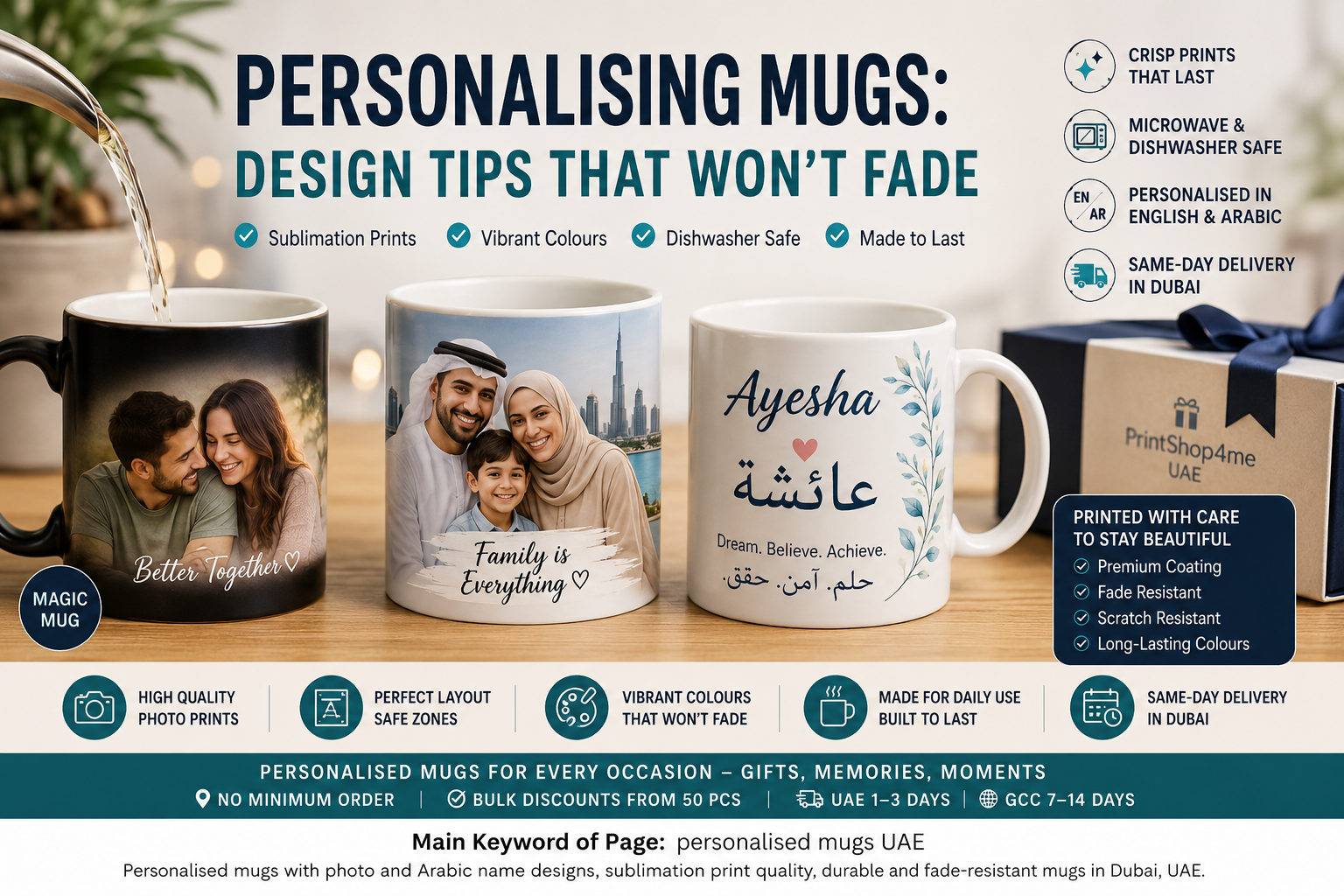
For UAE gift contexts where the recipient is bilingual or Arabic-dominant, bilingual messages add meaningful weight. Two patterns work cleanly. Parallel translation: the same message in English and Arabic, side-by-side or vertically stacked. The recipient reads whichever feels natural; the visible bilingual layout signals cultural awareness. Two distinct messages, one per language: a more colloquial Arabic message and a slightly different English one, each tuned to the language’s natural register. Riskier (requires the giver to be confident in both languages) but more authentic when done well.
For the Arabic component, Naskh and Modern Arabic are the most-used styles for messages. Diwani works for romantic and ceremonial contexts but is harder to read at message-length. Avoid Kufic for prose messages — it works for short names and slogans but compresses awkwardly across multiple sentences. Every Arabic layout is reviewed by a typography specialist before production. For more on style choice, see our guide on personalised mugs and other gift surfaces.
Common Gift Message Mistakes
Too long for the surface
A 5-line message on a small photo frame caption area looks cramped. Match the message length to the print surface. Mugs and small frames hold roughly 2–3 lines comfortably; large frames and canvases hold 5–8 lines.
Inside-jokes that need explaining
“Love you more than the Bluewaters incident” is funny if both giver and recipient remember the Bluewaters incident. If the recipient might not, or if anyone else sees the gift, drop the inside joke and reference the relationship in a more legible way.
Date errors on permanent gifts
Anniversary dates, wedding dates, birthdays, milestone numbers — all permanent on a personalised gift. Confirm dates with someone other than the recipient before finalising. Wedding-date errors on anniversary gifts are the most-painful gift mistake to discover.
Overusing exclamation marks
One exclamation mark per message at most. More than one reads as commercial-greeting-card rather than personal. The substance carries the warmth; punctuation does not need to.
Length and Tone by Gift Type
Mugs and small ceramic items: 2–3 lines, casual to warm tone. Photo frames (single-aperture): 2–4 lines, warm to formal. Cushions: 1–3 lines, warm and personal. Wall canvases: 3–8 lines (more space allows substance), warm to ceremonial. Photo books: 1 line on the cover, longer dedications inside (typically 4–8 lines on the dedication page). Plaques: 2–6 lines depending on size, formal register works well.
Same-Day Dubai and Production
Gift message personalisation is included in standard production timelines at no premium. Same-day Dubai cut-off applies — 11am for sublimated and fabric items, 12pm for UV-printed pieces. There is no minimum order. Bilingual EN+AR personalisation does not extend the production timeline; typography review for Arabic messages is included in the same-day window. For multi-piece coordinated gifts (e.g., a matched mug and frame both carrying the same message), the message can be applied identically across pieces in a single production run.
Order Yours Today
Write the gift message that the recipient will remember.
Personalised mugs, frames, cushions, plaques, and canvases — bilingual EN+AR support, typography specialist review, no premium for personalisation.
Same-day Dubai delivery for orders placed before 11am (12pm for UV-printed items). UAE-wide delivery 1–3 business days. GCC cross-border 7–14 days. Order via WhatsApp or our online form.
Frequently Asked Questions About Personalised Gift Message
What is the best formula for a personalised gift message?
A three-line structure: an anchor (recipient’s name and occasion), a memory or specific reference (one shared moment, inside detail, or relationship-specific note), and a short warm closing. Each line does specific work; together they read as effortful without being long.
Should I use the recipient’s first name in a personalised gift message?
Yes — using the recipient’s name in the anchor line is what separates a personalised message from a generic one. ‘To Layla, on your 30th birthday’ lands harder than ‘happy birthday to a wonderful daughter’ because the latter could be for anyone.
How long should a personalised gift message be?
Match the message length to the print surface. Mugs and small frames: 2–3 lines. Photo frames and cushions: 2–4 lines. Wall canvases and large prints: 3–8 lines. Photo books: 1 line on cover, longer dedications inside on the dedication page.
Can I get a bilingual EN+AR gift message printed?
Yes — bilingual EN+AR personalisation is the default offering. Two patterns work: parallel translation (the same message in both languages) or two distinct messages (one per language, tuned to each language’s natural register). Naskh and Modern Arabic are the most-used Arabic styles for prose messages.
What gift message styles should I avoid?
Generic openers (‘happy birthday’ alone), unnamed recipients (‘to a wonderful father’), inside-jokes that need explaining for non-immediate recipients, multiple exclamation marks, and date errors on permanent gifts. Always confirm dates with someone other than the recipient before finalising.
What Arabic font is best for a personalised gift message?
Naskh and Modern Arabic for prose messages. Both are readable at message length. Diwani works for romantic and ceremonial messages but is harder to read at length. Avoid Kufic for prose; it works for short names and slogans but compresses awkwardly across multiple sentences.
Is there a charge for adding a personalised gift message?
No — gift message personalisation is included in standard production timelines at no premium. Adding a message does not extend production; same-day Dubai cut-off (11am or 12pm depending on item) still applies.
What is the best message structure for a sympathy or condolence gift?
Anchor with the family’s surname, a brief specific remembrance of the deceased, and a formal closing. Avoid attempting humour or inside-jokes in sympathy contexts; restraint and specificity land better than warmth.