
How to Brief a Personalised Gifting Supplier — A UAE Buyer’s Guide
The single biggest cause of corporate gift programme delays, cost overruns, and quality disappointments in UAE B2B procurement is not supplier capability — it is incomplete or unclear briefs. Suppliers receive a request that says “200 personalised mugs for our client appreciation programme, branded with our logo, by next month” and then absorb four rounds of clarification questions over two weeks before production can start. The brief that arrives complete on day one ships clean and on time; the brief that arrives partial drifts by 3–4 weeks. This guide covers what a complete personalised gifting brief contains, how to structure an RFQ for comparison across suppliers, and the procurement realities specific to UAE B2B.
The Anatomy of a Complete Brief
A complete brief contains seven specifications. Send all seven on day one and production lead times are predictable; send fewer and the timeline drifts.
1. Item specification
Exactly what gift is being produced — not “premium tumbler” but “stainless steel insulated tumbler, 500ml, brushed-finish, with screw-top lid”. Include reference images or product codes if available. Specify size, material, colour, and any structural features.
2. Quantity
Total piece count and any breakdown by variant (e.g., 200 total: 80 large, 120 medium). Suppliers price differently at different volume bands (50/100/300/500/1000 pieces), so the quantity changes the per-piece quote materially.
3. Personalisation specification
The exact personalisation per piece. For variable-data personalisation (different name on each piece), provide the full list — or specify when the list will be provided. Specify language(s), font style if you have a preference, and the approximate text length per piece. Bilingual EN+AR? Names only or names + dates + occasion?
4. Branding specification
Logo placement, size, colour. Pantone codes if you need exact brand-colour matching. Include vector logo files (SVG, AI, EPS — not JPG or PNG screenshots from the company website). Specify finish: full-colour print, single-colour spot, embossed, debossed, foil-stamped. For programmes requiring exact corporate colour fidelity across multiple item types, custom logo printing workflows handle the cross-substrate consistency.
5. Packaging specification
Stock branded gift box or fully custom-printed packaging. Tissue paper colour. Whether each gift includes a card and what’s printed on the card. Branded outer carton if shipping in bulk.
6. Delivery specification
Required delivery date (not “soon” or “next month” — the actual date). Delivery location (single address or multi-address split). Same-day Dubai needs vs scheduled delivery. International or GCC cross-border requirements with the destination country specified.
7. Budget
Either a per-piece target (e.g., “AED 150 per gift all-in including packaging”) or a total budget envelope (e.g., “AED 30,000 for 200 gifts including packaging and delivery”). Budget transparency lets the supplier optimise within the constraint rather than bouncing back with quotes the buyer can’t accept.
The RFQ Structure for Multi-Supplier Comparison
For programmes above AED 50,000 in total value, comparing 2–3 supplier quotes makes financial sense. The cleanest comparison structure: send the same brief (the seven specifications above) to each supplier, request a structured response with the same fields, evaluate on three axes — total cost, lead time, and capability fit. Avoid asking for “your best price”; that produces inconsistent quote formats. Ask for itemised breakdown: per-piece gift cost + per-piece packaging cost + setup costs + delivery cost + any additional fees. The itemisation lets you compare apples-to-apples and identify suppliers who are competitive on the gift but expensive on packaging (or vice versa). For complex programmes, consider private-label suppliers who can handle the full programme end-to-end.
Common UAE B2B Procurement Pitfalls
The “send me your catalogue” approach
Catalogues from generic gift suppliers contain hundreds of products, most of which are not relevant to the actual programme. A complete brief filters the catalogue down to the right options without the back-and-forth of “what did you have in mind”.
Late spec changes
Locking the spec at brief stage and then changing the quantity, the personalisation, or the design 2 weeks into production resets timelines. Lock the spec before production starts; treat post-production changes as exceptions requiring formal approval.
Last-minute brand-colour requirements
Adding “and we need exact Pantone matching” 3 days before delivery on a programme briefed without Pantone is a structural conflict. Pantone matching requires proof verification (1–2 days additional lead time) and may require print-method changes. Specify Pantone requirements at brief stage or accept supplier-default colour fidelity.
Vague delivery dates
“By end of month” is not a delivery date; “27 November before noon at our Dubai Marina office” is. Specific delivery dates allow suppliers to schedule production capacity precisely. Vague dates compound across the supplier’s order book and produce inconsistent prioritisation.
Bilingual EN+AR Specifications in the Brief
For UAE B2B contexts, bilingual EN+AR personalisation specifications belong in the brief itself. Specify: which languages, which Arabic style preference (Naskh/Modern Arabic for corporate registers; Diwani for ceremonial; specifying allows the supplier to confirm capability), and whether the text will be supplied in both languages by the buyer or whether the supplier should arrange translation. Every Arabic layout is reviewed by a typography specialist before production at standard suppliers; confirm this is included rather than discovered as an additional cost mid-programme.
Lead Time Realities for UAE B2B Gifts
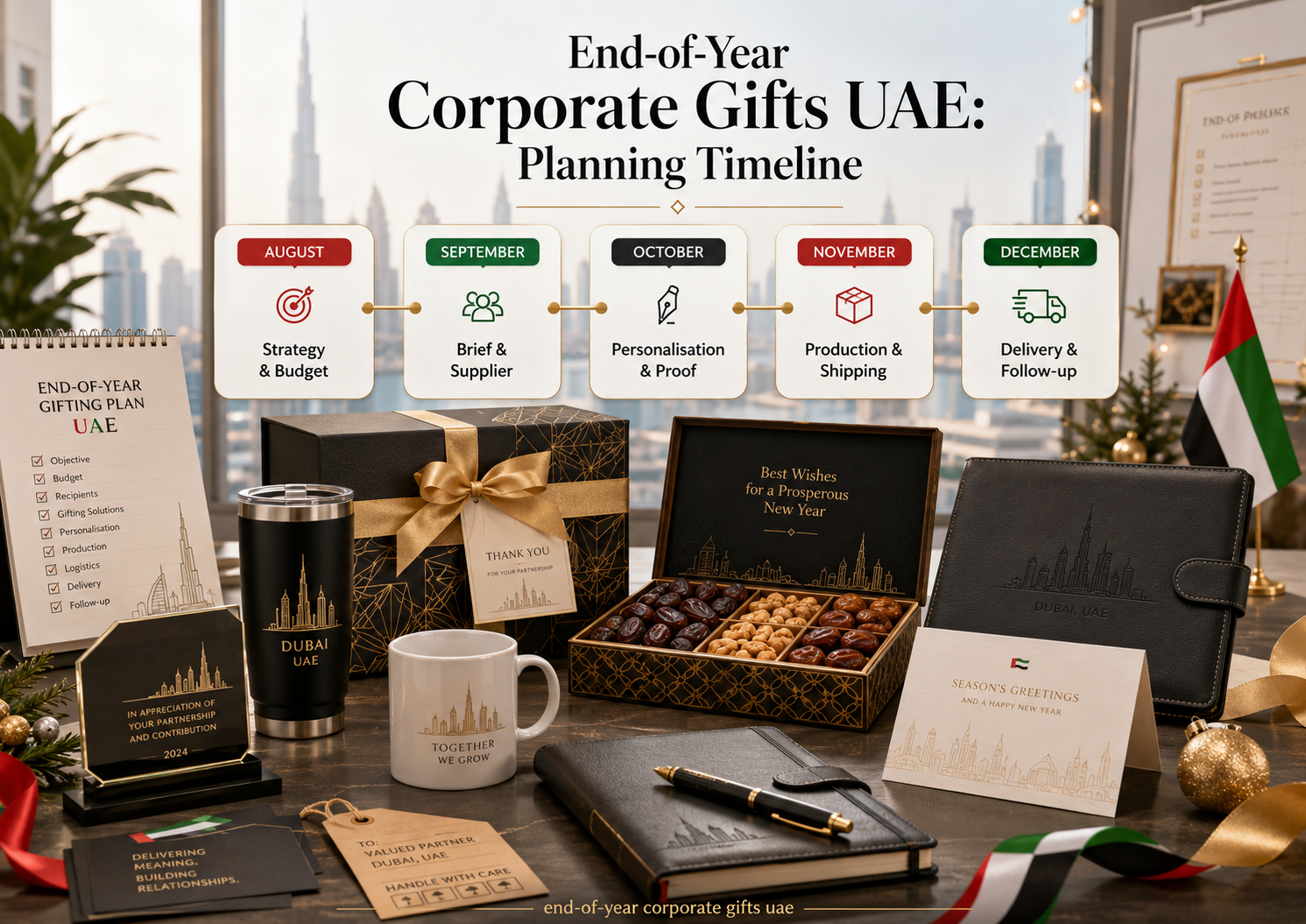
Indicative lead times once the brief is locked: simple personalised drinkware at 50–100 pieces — 5–7 working days. Multi-component personalised hampers at 30–50 pieces — 10–14 working days. Custom-printed packaging at 100–500 pieces — 7–14 working days. Bulk apparel runs at 100–300 pieces — 7–10 working days for DTF, 10–14 for screen-printed. Premium pieces with bespoke personalisation (etched glass, hand-bound notebooks) — 14–21 working days. Plan brief-to-delivery at the lead time + 1 week procurement buffer for first-time programmes; recurring programmes can run tighter.
Supplier Selection Beyond Price
Three factors beyond the per-piece price matter for B2B gift programme selection. Production transparency: can the supplier provide proof samples mid-production, accept design changes at proof stage, and provide visibility into the production timeline? Bilingual capability: does the supplier have Arabic typography review built into the standard process, or is bilingual personalisation an afterthought added at extra cost? Crisis response: when something goes wrong (a 200-piece run with a typo, a delivery delay), how does the supplier respond? Track this on small first orders before committing to large programmes. Logo mug runs are a good first-test category — fast turnaround, clear deliverable, easy quality verification.
Order Yours Today
Brief once, ship clean.
Seven-spec briefs, itemised RFQ structure, Pantone-matched corporate runs, bilingual EN+AR personalisation with typography review built into standard production.
Same-day Dubai delivery for orders placed before 11am (12pm for UV-printed items). UAE-wide delivery 1–3 business days. GCC cross-border 7–14 days. Order via WhatsApp or our online form.
Frequently Asked Questions About Brief Gift Supplier UAE
What should be included in a personalised gift brief?
Seven specifications: item (exactly what gift), quantity (total + variants), personalisation (text per piece, language, style), branding (logo placement, size, colour, Pantone codes if relevant), packaging (stock or custom, contents), delivery (date, location, same-day vs scheduled), and budget (per-piece target or total envelope). Send all seven on day one; partial briefs drift the timeline by weeks.
What is the cleanest RFQ structure for comparing UAE gift suppliers?
Send the same complete brief to each supplier, request a structured response with itemised cost breakdown (per-piece gift, per-piece packaging, setup, delivery, fees), evaluate on three axes — total cost, lead time, capability fit. Avoid asking for ‘your best price’ because it produces inconsistent quote formats.
Why is budget transparency important in a gift brief?
Budget transparency lets the supplier optimise within the constraint rather than bouncing back with quotes you can’t accept. Specifying ‘AED 150 per gift all-in including packaging’ or ‘AED 30,000 total for 200 gifts’ shapes the supplier’s response and shortens the back-and-forth cycle.
Can I add Pantone brand-colour matching to a gift programme last-minute?
Adding Pantone matching after the brief is locked creates structural conflicts. Pantone matching requires proof verification (1–2 days additional lead time) and may require print-method changes. Specify Pantone requirements at brief stage or accept supplier-default colour fidelity.
How early should I lock a gift programme spec to avoid timeline drift?
Lock the spec before production starts. Post-production changes (quantity, personalisation, design) reset timelines and add 1–2 weeks per change. Treat post-production changes as exceptions requiring formal approval rather than routine adjustments.
What lead times should I plan for typical UAE corporate gift programmes?
Simple personalised drinkware at 50–100 pieces: 5–7 working days. Multi-component hampers at 30–50 pieces: 10–14 working days. Custom-printed packaging at 100–500 pieces: 7–14 working days. Bulk apparel at 100–300 pieces: 7–10 days for DTF, 10–14 for screen-printed. Premium bespoke pieces: 14–21 working days. Add 1-week procurement buffer for first-time programmes.
How should bilingual EN+AR personalisation be specified in the brief?
Specify three things: which languages (typically EN+AR for UAE), which Arabic style preference (Naskh/Modern Arabic for corporate; Diwani for ceremonial), and whether the text comes from the buyer or whether the supplier arranges translation. Confirm typography specialist review is included in standard production rather than billed as additional cost.
What supplier factors matter beyond per-piece price?
Three: production transparency (mid-production proofs, design changes accepted at proof stage, timeline visibility), bilingual capability (Arabic typography review in standard process or as add-on), and crisis response (how the supplier handles typos, delivery delays, quality issues). Track these on small first orders before committing to large programmes.