Custom Packaging for Amazon UAE: What’s Required, What Wins
Amazon UAE sellers in 2026 navigate a packaging environment with two layers — what Amazon’s FBA UAE warehouses require for fulfilment compliance (the structural baseline) and what wins on the customer experience layer (the discretionary brand-building tier). Most first-time Amazon UAE sellers focus on the compliance baseline and miss the customer-experience tier; the most-successful Amazon UAE brands invest deliberately in both. This guide covers what Amazon FBA UAE actually requires of seller packaging in 2026, what’s optional but high-impact for brand-building, and how to navigate the compliance bar without overspending on requirements that aren’t actually requirements.
What Amazon FBA UAE Actually Requires
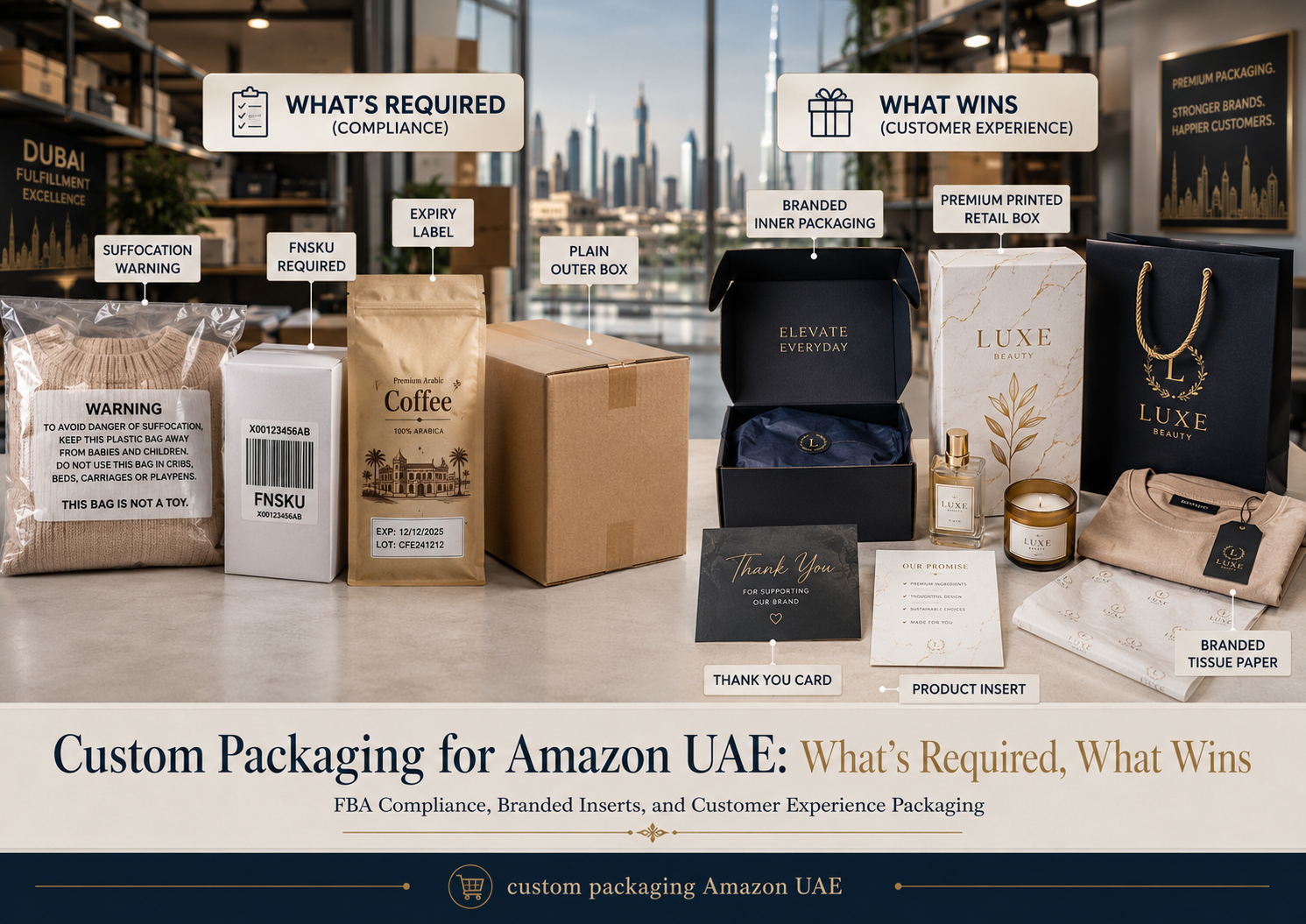
Amazon’s FBA UAE compliance requirements break into three baseline categories. FNSKU labelling: every unit shipping into FBA UAE warehouses must carry a unique FNSKU barcode label that Amazon uses for inventory tracking. Generated through Seller Central, applied to each unit before shipment. Polybag suffocation warnings: any soft-good item shipped in a polybag larger than 5×7 inches requires a printed suffocation warning on the bag. Standard requirement; missing this triggers receipt-failure issues at FBA. Expiry-date labelling for consumables: any food, supplement, or short-shelf-life product must carry visible expiry-date labelling matching FBA’s documented format. Beyond these three baseline requirements, FBA UAE allows substantial flexibility on outer packaging, brand presentation, and value-added inserts.
What FBA UAE Doesn’t Require (But Sellers Often Assume It Does)
Three packaging elements are commonly assumed required but aren’t. Branded outer boxes are not required for FBA UAE — plain corrugated outers work fine for warehouse fulfilment. Sellers spending heavily on branded outer boxes for the FBA-fulfilled segment are typically wasting margin since FBA discards the outer at warehouse receipt. Multi-language packaging is not required across all categories — only specific consumer categories (food, cosmetics, electronics under SASO conformity) require Arabic-language compliance. General merchandise FBA UAE products can ship with English-only packaging if they don’t fall in the regulated categories. Premium printed inserts are not required at all — they’re a brand-building choice, not a compliance requirement. Custom packaging printing programmes for FBA UAE often overspend in these three areas without compliance reason.
The Customer-Experience Tier — What Wins
Beyond the compliance baseline, the customer-experience tier is where Amazon UAE brands differentiate. Three categories of investment consistently lift the unboxing experience.
Branded inner packaging visible at unboxing
The customer never sees the FBA outer box (Amazon discards it). The first branded surface the customer sees is the inner product packaging or wrapper. Custom-printed inner sleeves, branded tissue paper, branded mailer-bag interiors, or branded retail boxes all create the unboxing-moment brand impression. AED 0.50–4.00 per unit for branded inner elements, depending on complexity and volume.
Personalised thank-you cards and inserts
A small printed thank-you card or product information insert with the brand’s voice, request for review, social media handles, and (where appropriate) a discount code for the next purchase. AED 0.30–1.20 per unit. The single highest-ROI brand-building investment for Amazon UAE sellers — drives review rate, repeat purchase rate, and brand recall meaningfully.
Premium retail boxes for higher-tier products
For Amazon UAE products at the AED 200+ retail price point, branded retail boxes (rigid-board boxes, magnetic-closure boxes, sleeved presentation boxes) lift the perceived register meaningfully. AED 8–35 per unit depending on box complexity and volume. Justifiable on products where the box itself becomes part of the brand’s perceived value.
Polybag vs Box — What to Use When
Two packaging formats dominate Amazon UAE seller decisions. Polybag for soft goods, apparel, and items where compression won’t cause damage. Polybags ship at lower per-unit cost (AED 0.30–1.50 per polybag for typical sizes), take less FBA storage volume (better storage fee economics), and are appropriate for the bulk of apparel-tier products. Box for fragile items, premium-tier products, and items where compression or impact would cause damage. Boxes cost more per unit (AED 1.50–8.00 typical) and consume more FBA storage volume but protect product condition. The decision is product-specific; many Amazon UAE seller catalogues use both formats across different SKUs.
Cross-Border Considerations
For Amazon UAE sellers also fulfilling cross-border into Saudi Arabia (Amazon SA), Kuwait, or other GCC markets through Noon FBN’s regional warehousing, packaging compliance is stricter on the cross-border products. SASO Arabic-language compliance, country-specific safety markings, and category-specific regulatory packaging all apply. The cross-border packaging for KSA-destined inventory often runs 10-20% higher per-unit cost than UAE-only packaging. Shipping boxes for Amazon UAE inbound shipments (the seller-to-FBA-warehouse leg) can be plain corrugated; the customer-facing inner packaging is where the compliance and brand investment go.
Common Amazon UAE Packaging Mistakes
Five mistakes recur on first Amazon UAE seller packaging programmes. Branded outer boxes for FBA inventory: wasted spend; the FBA warehouse discards the outer. Use plain corrugated outers and invest the saved margin in inner packaging. Missing FNSKU labels: guarantees FBA receipt-failure and inventory delays. Generate and apply FNSKU labels before shipment to FBA. Inadequate polybag thickness on shipped soft goods: 1.8 mil polybags can puncture during FBA inbound receipt; 2.5+ mil polybags survive the warehouse handling. No insert in the customer package: missing the highest-ROI brand-building opportunity. A simple AED 0.30 thank-you card has measurable impact on review rate. Skipping the proof step on first-launch packaging: first-batch packaging without proof produces compliance failures or design issues that propagate across the entire inbound shipment. Amazon FBA fulfilment workflows benefit meaningfully from pre-production proof samples.
Bulk Production for Amazon UAE Inventory
Indicative production lead times for typical Amazon UAE seller packaging programmes. Custom-printed polybags: 7–10 days for 1000–5000 pieces (UV digital print); 14–21 days for 5000+ pieces (flexographic). Custom-printed retail boxes: 10–14 days for 500–2000 pieces. Thank-you cards and inserts: 5–7 days for 1000–5000 pieces. FNSKU label printing: 1–3 days; can be produced in-house by the seller using Amazon-generated PDFs. Plan first-launch packaging at 4–6 weeks before the FBA inbound shipment date; recurring packaging programmes can run tighter once the spec is locked.
Order Yours Today
Spec Amazon UAE packaging that meets compliance and wins on customer experience.
FNSKU labels, suffocation warnings, polybag and box options, branded inner packaging, thank-you cards and inserts — bulk pricing from 500–1000 pieces, lead times 5–21 days based on method.
Same-day Dubai delivery for orders placed before 11am (12pm for UV-printed items). UAE-wide delivery 1–3 business days. GCC cross-border 7–14 days. Order via WhatsApp or our online form.
Frequently Asked Questions About Amazon UAE Packaging
What does Amazon FBA UAE actually require on seller packaging?
Three baseline requirements: FNSKU barcode labelling on every unit, polybag suffocation warnings on bags larger than 5×7 inches for soft goods, and expiry-date labelling for consumables (food, supplements, short-shelf-life products) in FBA’s documented format. Beyond these, FBA UAE allows substantial flexibility on outer packaging and brand presentation.
Do I need branded outer boxes for Amazon UAE FBA shipments?
No — branded outer boxes are not required for FBA UAE. Plain corrugated outers work fine for warehouse fulfilment. The FBA warehouse discards the outer at receipt before the product reaches the customer. Sellers spending heavily on branded outer boxes for FBA-fulfilled segment typically waste margin; invest in branded inner packaging instead.
Where should Amazon UAE sellers invest in packaging for brand-building?
Three categories: branded inner packaging visible at unboxing (custom-printed inner sleeves, branded tissue paper, branded mailer-bag interiors at AED 0.50–4.00 per unit), personalised thank-you cards and inserts (AED 0.30–1.20 per unit — the highest-ROI brand-building investment), and premium retail boxes for higher-tier products at the AED 200+ retail price point.
What is the difference between polybag and box for Amazon UAE inventory?
Polybag for soft goods, apparel, and items where compression won’t cause damage — lower per-unit cost (AED 0.30–1.50), less FBA storage volume, better storage fee economics. Box for fragile items, premium-tier products, and items where compression would cause damage — higher per-unit cost (AED 1.50–8.00) but protects product condition. Many seller catalogues use both formats across different SKUs.
Do Amazon UAE products need Arabic-language packaging?
Only specific regulated categories require Arabic-language compliance — food, cosmetics, and electronics under SASO conformity. General merchandise FBA UAE products can ship with English-only packaging if not in regulated categories. For cross-border products into Saudi Arabia or other GCC markets via Noon FBN, full SASO Arabic-language compliance applies and per-unit packaging cost typically runs 10-20% higher.
What polybag thickness should I use for Amazon UAE soft goods?
2.5+ mil polybags for FBA inbound — 1.8 mil polybags can puncture during FBA warehouse receipt and create inventory failures. 3.0 mil for items with sharper edges or heavier weight. Match thickness to the heaviest item in the bag rather than the average to prevent transit punctures.
How long does Amazon UAE packaging production take?
Custom-printed polybags: 7–10 days for 1000–5000 pieces (UV digital), 14–21 days for 5000+ (flexographic). Custom-printed retail boxes: 10–14 days for 500–2000 pieces. Thank-you cards and inserts: 5–7 days. Plan first-launch packaging at 4–6 weeks before the FBA inbound shipment date.
What is the most-overlooked Amazon UAE packaging opportunity?
Personalised thank-you cards or inserts in the customer package — the highest-ROI brand-building investment at AED 0.30–1.20 per unit. Drives review rate, repeat purchase rate, and brand recall meaningfully. Most first-time Amazon UAE sellers skip this entirely and miss the single highest-impact discretionary packaging investment.