Noon FBN Explained: A Seller’s Guide
Noon FBN — Fulfilled by Noon — is the second pillar of UAE e-commerce alongside Amazon FBA, and for sellers building a serious GCC presence, it is no longer optional. Noon’s customer base in KSA and UAE skews differently from Amazon’s; Arabic-language search behaviour is stronger; same-day delivery expectations from Riyadh and Jeddah customers reward sellers who use Noon’s domestic warehousing. Yet most UAE sellers either skip Noon entirely or treat it as a secondary channel that gets the leftover inventory. This guide covers what Noon FBN actually is, how it works operationally, and how to set up products and packaging for it without burning weeks on rejected listings.
What Is Noon FBN?
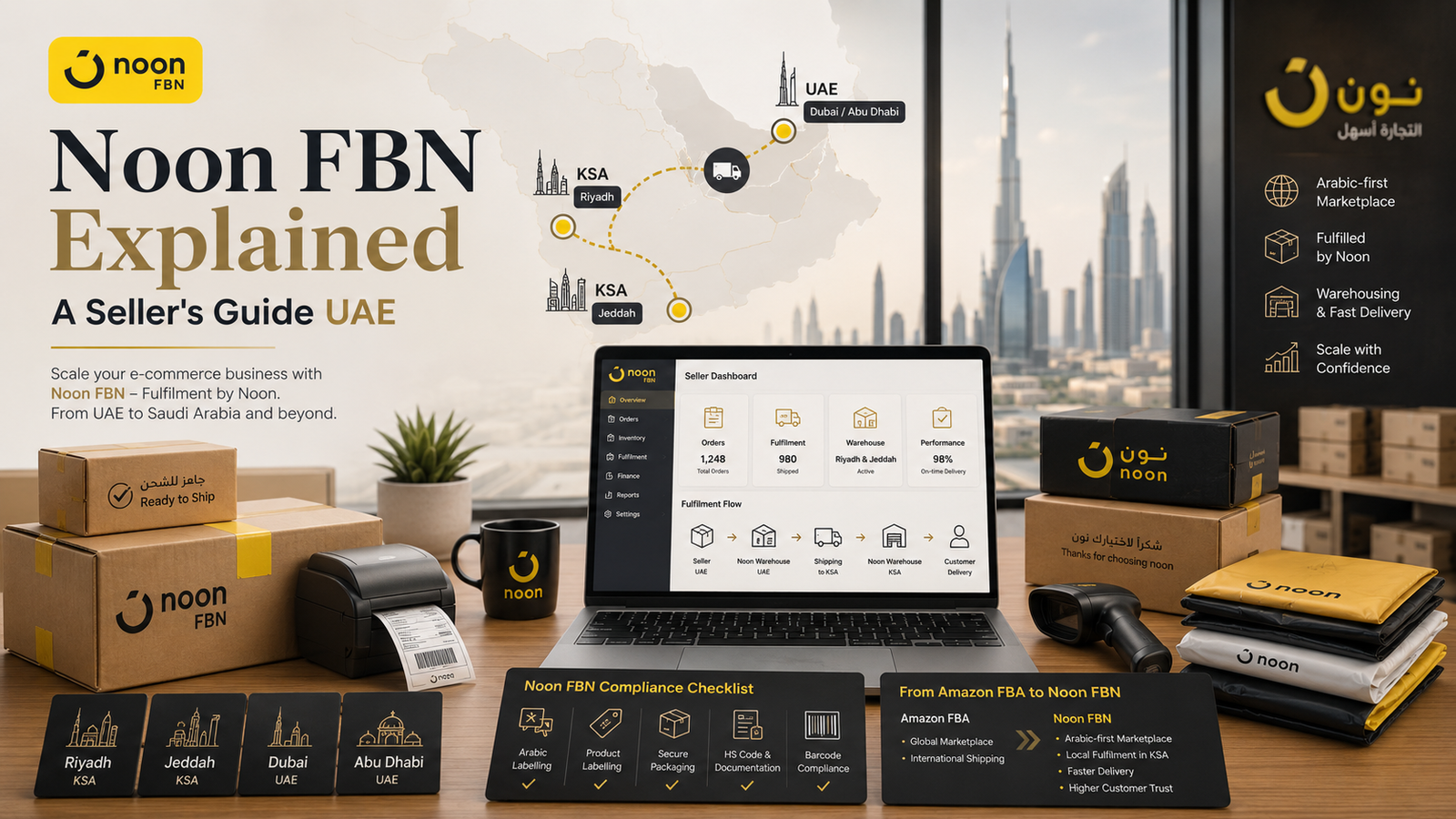
Noon FBN (Fulfilled by Noon) is Noon’s equivalent to Amazon FBA — a logistics service where sellers send inventory to Noon’s warehouses, and Noon handles storage, picking, packing, last-mile delivery, customer service, and returns. The seller retains pricing control and listing ownership; Noon owns the operational backend. Noon FBN fulfilment operates across UAE warehouses (Dubai, Abu Dhabi, Sharjah) and KSA warehouses (Riyadh, Jeddah, Dammam), with cross-border logistics handled inside the platform.
The key difference from Amazon FBA: Noon’s KSA warehousing is a major asset. Saudi customers buying from Noon-stocked sellers receive 1-day or 2-day delivery, while UAE-fulfilled FBA listings ship across border with 3–5 day timelines. For sellers with serious KSA sales potential, Noon FBN is the only practical way to compete on delivery speed.
How FBN Works — The Operational Flow
Step 1: Product approval
Each SKU goes through Noon’s approval process — the listing must include bilingual EN+AR title, bullet points, and description; product images must meet Noon’s specifications; product category must match Noon’s taxonomy. Approval takes 3–7 days for new SKUs.
Step 2: Inbound shipment
Approved SKUs are sent to Noon’s warehouse via Noon’s Inbound Shipment system. Each unit must carry a Noon barcode label (separate from your manufacturer barcode). Shipment is booked through the seller portal with a specified arrival window.
Step 3: Receipt and storage
Noon receives the shipment, scans units, and stores them in the warehouse. Storage fees apply per cubic metre per month. Inventory becomes live and orderable typically within 2–5 days of receipt.
Step 4: Order fulfilment
Customer orders trigger automatic picking, packing, and dispatch from the nearest Noon warehouse with stock. Saudi customers get Riyadh/Jeddah-fulfilled orders; UAE customers get Dubai/Abu Dhabi/Sharjah-fulfilled orders. Cross-border movement is handled by Noon when warehouse stock requires it.
Step 5: Customer service and returns
Noon handles all customer-facing operations — chat support, returns processing, refund decisions. Sellers see resolved cases in the dashboard.
FBN vs FBA vs Self-Fulfilment
Noon FBN
Best for: KSA sales acceleration, Arabic-speaking customer base, products with clear Noon search demand. Strengths: KSA domestic warehousing, faster Saudi delivery, strong Arabic UX. Weaknesses: smaller UAE customer base than Amazon, stricter product approval, lower-volume categories.
Amazon FBA UAE
Best for: UAE-domestic high-volume sales, English-speaking expat demographics, broad category presence. Strengths: largest UAE customer base, mature logistics, deep Prime member base. Weaknesses: cross-border to KSA is slower than Noon’s domestic, higher competition in mature categories.
Self-fulfilment
Best for: low-volume premium products, custom/personalised products that cannot be pre-stocked, brands testing demand. Strengths: full margin retention, full inventory control, no warehousing fees. Weaknesses: slower delivery times kill conversion, higher CS overhead, no Prime/FBN tag visibility.
Most serious UAE sellers run all three in parallel: Amazon FBA for UAE bulk, Noon FBN for KSA acceleration, self-fulfilment for high-margin custom items. For broader context on platform-spanning seller strategy, see print-on-demand for Amazon and Noon.
Costs and Fees
Noon FBN charges three fee categories: a referral fee (percentage of sale, varies by category), a fulfilment fee (flat per-unit, varies by size and weight), and storage fees (per cubic metre per month). For most sub-AED-100 personalised gift items, total Noon fees land at 18–28% of sale price — broadly comparable to Amazon FBA UAE economics. KSA sales fulfilled from Riyadh/Jeddah warehouses incur slightly higher fulfilment fees but no cross-border surcharge.
Best Products for Noon FBN
Noon’s customer base over-indexes for: bilingual or Arabic-first products, KSA-targeted seasonal items (Saudi National Day, Ramadan-specific products, Eid hampers), kids and family categories, and premium-tier home and lifestyle items. Personalised gifts perform well when paired with strong Arabic-language listings and bilingual product imagery. Categories where Noon underperforms Amazon: high-volume electronics, broad-category fashion, English-only content products. For private-label sellers, see private label printing in UAE.
Packaging Requirements
Noon FBN has stricter packaging than Amazon FBA UAE. Each unit must be in retail-ready packaging, with the Noon barcode label clearly visible (not under shrink-wrap or plastic that obscures scanning). Multi-pack bundles require an outer wrapper with a single Noon barcode for the bundle. Fragile items require tested packaging — Noon will reject inbound shipments where items arrived damaged due to inadequate packaging. Custom retail packaging with Arabic + English text on the box is heavily rewarded by Saudi customers and is the cheapest single intervention to lift KSA conversion rates.
Common FBN Onboarding Mistakes
Four mistakes recur on first FBN setups and are all avoidable:
English-only listings
Noon’s KSA customer base searches in Arabic at far higher rates than Amazon UAE’s customer base. Listings with English titles and Arabic afterthoughts (or worse, Google-translated Arabic) get half the impressions of listings with native bilingual copy. Hire a native Arabic copywriter or work with a translator who understands product-listing SEO; do not rely on machine translation for the title and bullet points.
Sending too much initial inventory
Noon storage fees compound on slow-moving inventory faster than Amazon’s. The instinct from FBA experience — send 200+ units to test — kills cash flow on a Noon test. 50–100 units per SKU for the first 4–8 weeks gives enough conversion data to decide on scaling.
Skipping retail-ready packaging
Items arriving at Noon warehouses in poly-bags get rejected or charged a re-pack fee. Each unit must be in retail-ready packaging with the Noon barcode visible without removing wrap.
Treating Noon as Amazon’s clone
Customer behaviour, search habits, conversion patterns, and seasonal peaks differ. Saudi National Day, Saudi Founding Day, and Ramadan-prep windows drive traffic on Noon that Amazon UAE simply does not see at the same scale. Build a Noon-specific seasonal calendar; do not just copy your Amazon promotional plan over.
Going from FBA-Only to Adding FBN
The cleanest sequence: (1) Get 2–3 high-converting SKUs approved on Noon first; (2) Send a small inbound shipment of 50–100 units per SKU to test the Noon flow; (3) Optimise listings against Noon’s Arabic-search-heavy customer behaviour; (4) Scale inventory after 4–8 weeks of conversion data. Avoid sending large initial shipments — Noon’s storage fees compound on slow-moving inventory faster than Amazon’s, so testing volume should be small. Same-day Dubai delivery is available if you need to ship inbound packaging materials (boxes, labels, void fill) for FBN preparation, with an 11am cut-off for ceramic and fabric items and 12pm for UV-printed pieces.
Order Yours Today
Set up your Noon FBN listings to compete on KSA delivery speed.
Bilingual EN+AR listings, retail-ready packaging with Noon barcodes, and packaging materials produced in Dubai with same-day delivery for inbound shipment prep.
Same-day Dubai delivery for orders placed before 11am (12pm for UV-printed items). UAE-wide delivery 1–3 business days. GCC cross-border 7–14 days. Order via WhatsApp or our online form.
Frequently Asked Questions About Noon FBN Guide
What is Noon FBN?
Noon FBN (Fulfilled by Noon) is Noon’s logistics service where sellers send inventory to Noon’s warehouses and Noon handles storage, picking, packing, delivery, customer service, and returns. It is Noon’s equivalent of Amazon FBA, with strong KSA domestic warehousing in Riyadh, Jeddah, and Dammam.
Should I use Noon FBN or Amazon FBA for UAE selling?
Most serious sellers use both. Amazon FBA is stronger for UAE-domestic high-volume sales and English-speaking customers. Noon FBN is stronger for KSA sales and Arabic-speaking customer demographics. The two platforms are complementary, not substitutes.
How long does Noon FBN approval take?
New SKU approval typically takes 3–7 days. Approval requires bilingual EN+AR titles and descriptions, compliant images, and correct category mapping.
What fees does Noon FBN charge?
Three fee categories: a referral fee (percentage of sale, varies by category), a fulfilment fee (flat per-unit, varies by size and weight), and storage fees (per cubic metre per month). Total fees typically land at 18–28% of sale price for sub-AED-100 items — broadly comparable to Amazon FBA UAE economics.
Does Noon FBN offer KSA delivery from Saudi warehouses?
Yes — Noon operates KSA warehouses in Riyadh, Jeddah, and Dammam. Saudi customers buying from Noon-stocked listings receive 1–2 day delivery, vs the 3–5 days typical for cross-border UAE-fulfilled orders.
What products perform best on Noon FBN?
Bilingual or Arabic-first products, KSA-targeted seasonal items (Saudi National Day, Ramadan, Eid), kids and family categories, and premium home and lifestyle items. Custom retail packaging with bilingual Arabic + English text on the box lifts KSA conversion meaningfully.
Can I use the same packaging for both Amazon FBA and Noon FBN?
Mostly yes — but Noon requires retail-ready packaging with the Noon barcode clearly visible (not under shrink-wrap that obscures scanning). Multi-pack bundles need a single Noon barcode for the outer wrapper. Test packaging for fragile items; Noon rejects inbound shipments where items arrived damaged.
How much initial inventory should I send to Noon FBN?
Small — 50–100 units per SKU as a test shipment. Storage fees compound on slow-moving inventory, so test conversion for 4–8 weeks before scaling. Avoid sending large initial shipments while you are still optimising Arabic listing copy.