Cross-Border E-commerce UAE to KSA: Packaging and Labelling
UAE e-commerce sellers shipping cross-border into Saudi Arabia in 2026 face a packaging-and-labelling compliance landscape that is materially stricter than UAE-domestic shipping. SASO (Saudi Standards, Metrology and Quality Organization) labelling requirements, Arabic-language mandate, customs documentation, and product-category-specific rules combine into procedural overhead that catches first-time UAE-to-KSA sellers off-guard. The shipments that arrive cleanly are the ones where the packaging and labelling were designed for KSA compliance from the start; the shipments that get held at the border are the ones that tried to use UAE-domestic packaging across an international boundary. This guide covers what actually has to happen on the packaging and labelling side for UAE-to-KSA e-commerce in 2026.
The Three Compliance Layers
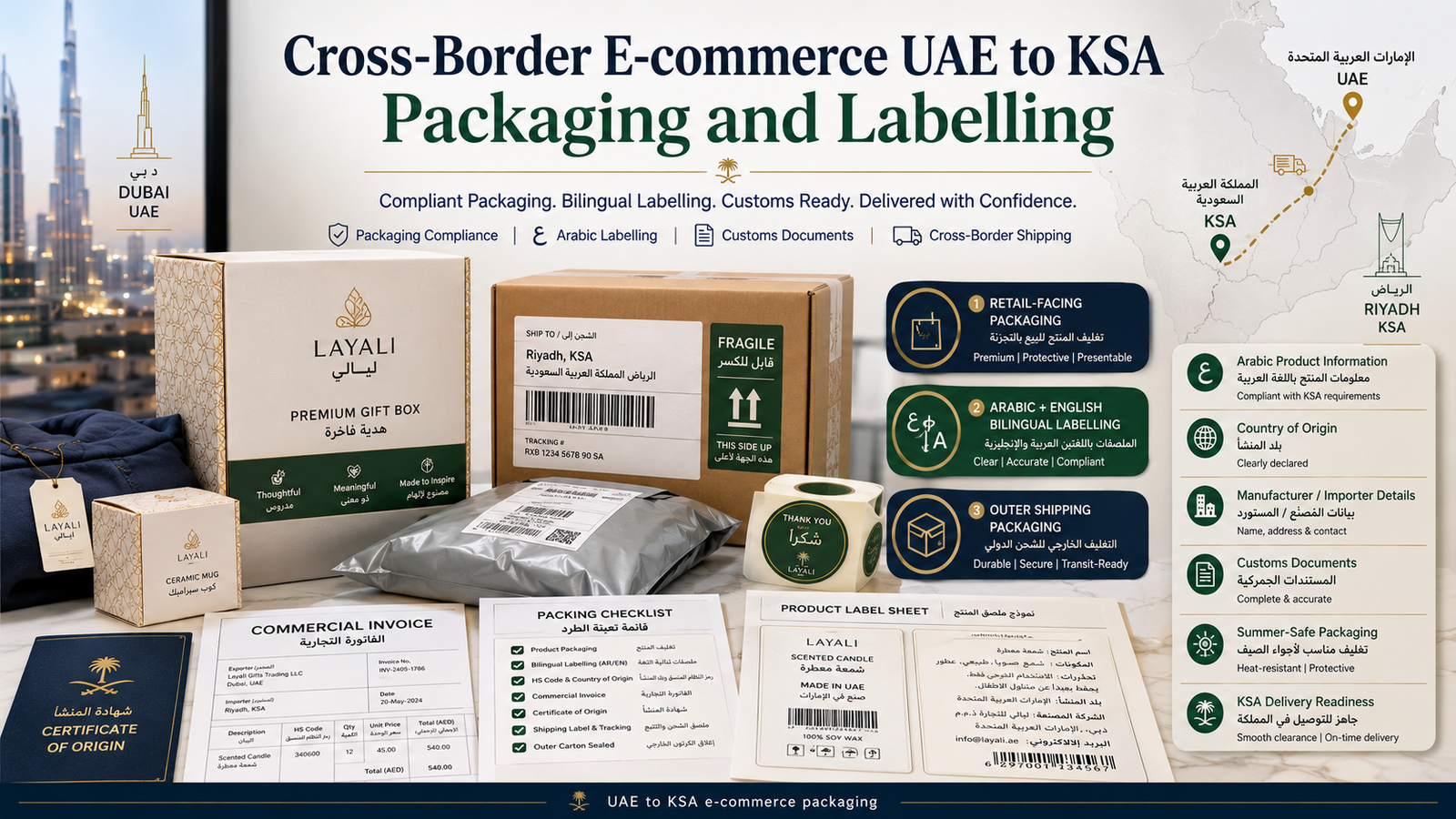
Cross-border UAE-to-KSA e-commerce packaging compliance breaks into three layers. Customs documentation (commercial invoice, packing list, certificate of origin) — required at the courier/freight layer. Product labelling (Arabic-language product information, ingredient/material lists, country of origin, manufacturer/importer details) — required on the retail-facing packaging visible to the end consumer. Outer shipping packaging (the courier-handled box or polymailer) — fewer mandatory requirements but practical considerations for transit survival across the GCC. This guide focuses primarily on layers 2 and 3, with brief notes on layer 1.
Arabic-Language Labelling Requirements
SASO requires Arabic-language product information on the retail-facing packaging for the majority of consumer product categories sold in KSA. The Arabic information typically must include: product name, product description (including key features and intended use), country of manufacture, manufacturer or importer name and address, net weight or content quantity, ingredient or material list (for food, cosmetics, textiles, electronics), and any safety warnings or usage instructions. The Arabic text can be alongside English (bilingual EN+AR is the cleanest approach) but Arabic cannot be omitted. For cosmetics, food, and electronics specifically, the Arabic compliance bar is stricter; for general merchandise, bilingual labelling is typically sufficient.
Designing Retail-Facing Packaging for KSA
Packaging that ships into KSA should be designed bilingual EN+AR from the artwork stage rather than retrofit afterwards. Three design considerations matter. Allocate equal visual weight to English and Arabic text where possible — Arabic-dominant or balanced layouts often perform better with KSA consumers than English-dominant equivalents. Use Naskh or Modern Arabic for body text — these styles are the most-readable for product information; Diwani and Thuluth are display styles, not body text. Right-to-left layout flow — Arabic reads right-to-left; design layouts should accommodate the directional difference rather than just translating English-LTR into Arabic-words-in-LTR-grids. Custom packaging printing workflows handle the bilingual artwork production at the same per-piece cost as English-only.
Outer Shipping Packaging — Transit Survival
The courier-handled outer packaging for UAE-to-KSA e-commerce shipments faces three practical challenges. GCC summer heat: trucks crossing the Al Batha or Salwa border into KSA in summer reach internal temperatures above 50°C. Polymailers and lightweight boxes can soften, deform, or fail seal-strip adhesion. Use 3.0+ mil polymailers and 200+ECT corrugated boxes for summer cross-border. Border-crossing handling: packages are often unloaded and reloaded multiple times during customs inspection. Reinforced corner packaging and adequate void fill prevent damage. Multi-week transit on some routes: while standard GCC cross-border is 7–14 days, complex shipments (cosmetics requiring inspection, electronics requiring conformity verification) can extend to 21+ days. Packaging needs to survive the longer transit time.
Outer Box Specifications
For UAE-to-KSA e-commerce, outer shipping boxes should specify: 200ECT (or higher) corrugated for items under 5kg; 275ECT for 5–15kg shipments; double-wall corrugated for 15kg+ or fragile items. Tape-sealed with H-pattern paper tape (water-resistant); avoid pressure-sensitive plastic tape that can fail in humidity. Branded outer boxes should carry the brand on top and side panels for retail-tier presentation; couriers handle branded boxes more carefully than plain. Standard size range: most UAE-to-KSA e-commerce shipments fit 25×20×15cm to 40×30×20cm boxes; larger items use custom-sized boxes.
Customs Documentation Basics
Three customs documents accompany each UAE-to-KSA cross-border e-commerce shipment. Commercial invoice: itemised list of contents, declared value, currency, seller and buyer details. Packing list: piece-by-piece breakdown of what’s in each box. Certificate of origin: indicating UAE as country of origin (for items manufactured in UAE) or country of original manufacture for items transiting through UAE. Couriers typically handle these documents on the seller’s behalf for D2C parcels but require accurate seller-supplied content. Errors at the customs documentation layer produce border holds that the packaging compliance cannot rescue.
Category-Specific Considerations
Food and consumables
Strictest compliance bar. Arabic ingredient lists, expiry dating in Arabic-readable format, halal certification on relevant products, manufacturer details. Cross-border food shipments often require pre-clearance with Saudi Food and Drug Authority (SFDA).
Cosmetics and personal care
Similar strictness to food. SFDA cosmetics registration may be required for the seller before cross-border shipment is allowed. Arabic ingredient lists and full safety information.
Electronics
SASO conformity certificate requirements. Specific labelling on power ratings, frequencies, and certification markings. Lithium-battery products have separate regulations.
General merchandise (gifts, apparel, accessories)
The most-permissive category. Bilingual product labelling, country of origin, and standard customs documentation are typically sufficient. The bulk of UAE-to-KSA personalised gift e-commerce falls in this category.
Personalised Gifts UAE-to-KSA
Personalised gifts shipped from UAE to KSA face the general-merchandise compliance bar — the friendliest cross-border category. Bilingual EN+AR personalisation already on the gift item meets KSA expectation; outer packaging needs to identify contents in both English and Arabic for customs. Standard cross-border timeline 7–14 days; lock orders 4 weeks ahead of intended delivery for occasion-anchored gifts.
Common Cross-Border Mistakes
Four mistakes recur. English-only retail packaging: non-compliant for most consumer categories; gets held at customs. Under-spec outer packaging for summer transit: 1.8 mil polymailers fail in summer GCC heat; use 3.0+ mil. Inaccurate commercial invoice values: declaring AED 50 on a clearly-AED-300 personalised gift hamper triggers customs inspection and delay. Customs inspectors regularly cross-reference declared values against item images and known retail pricing; mismatches add 3–7 days. Plastic shrink-wrap on outer packaging: can fail in transit heat and may signal inadequate packaging to customs inspectors who interpret it as fragile-item indicator triggering additional inspection.
Order Yours Today
Ship UAE-to-KSA without packaging holds at the border.
Bilingual EN+AR retail packaging designed from the artwork stage, 200ECT+ corrugated outer boxes, summer-grade polymailers, accurate customs documentation — standard 7–14 day GCC cross-border.
Same-day Dubai delivery for orders placed before 11am (12pm for UV-printed items). UAE-wide delivery 1–3 business days. GCC cross-border 7–14 days. Order via WhatsApp or our online form.
Frequently Asked Questions About UAE To KSA Ecommerce
What Arabic-language requirements apply to UAE-to-KSA e-commerce packaging?
SASO requires Arabic-language product information on retail-facing packaging for most consumer product categories sold in KSA — product name, description, country of manufacture, manufacturer/importer details, weight/content, ingredient or material lists, and safety warnings. Bilingual EN+AR is the cleanest compliance approach; Arabic-only or Arabic-dominant layouts work but English-only does not.
Should I design my packaging bilingual EN+AR from the start or retrofit Arabic later?
Design bilingual from the artwork stage. Retrofitted Arabic on packaging artwork built around an English layout often produces visual hierarchy issues and right-to-left flow problems. Equal visual weight to English and Arabic, Naskh or Modern Arabic for body text, and proper RTL layout flow are easier to design from the start than to retrofit.
What outer shipping packaging spec works for UAE-to-KSA cross-border?
200ECT corrugated for items under 5kg; 275ECT for 5–15kg; double-wall corrugated for 15kg+ or fragile items. 3.0+ mil polymailers for summer transit (lighter polymailers can fail in GCC summer heat). H-pattern paper tape rather than pressure-sensitive plastic. Branded outer boxes get more careful courier handling than plain.
How long does UAE-to-KSA cross-border shipping take?
Standard 7–14 days for general merchandise. Complex shipments (cosmetics requiring SFDA inspection, electronics requiring SASO conformity verification) can extend to 21+ days. Lock orders 4 weeks before intended delivery for occasion-anchored gifts to maintain margin against customs windows.
What customs documents are required for UAE-to-KSA e-commerce?
Three documents per shipment: commercial invoice (itemised contents, declared value, seller and buyer details), packing list (piece-by-piece breakdown per box), and certificate of origin (UAE for UAE-manufactured items). Couriers handle these for D2C parcels but require accurate seller-supplied content.
Are personalised gifts subject to the same cross-border rules as commercial goods?
Personalised gifts shipped UAE-to-KSA fall in the general-merchandise compliance category — the friendliest cross-border tier. Bilingual EN+AR personalisation on the gift already meets KSA expectation; outer packaging needs to identify contents in English and Arabic for customs. Standard 7–14 day timeline.
What happens if my UAE packaging has only English text when shipping to KSA?
English-only retail packaging is non-compliant for most consumer product categories under SASO requirements and can be held at customs until the seller arranges Arabic re-labelling or accepts return. The cleanest approach is to design packaging bilingual EN+AR from the start; retrofitting Arabic stickers at the border is operationally awkward and can damage product presentation.
What special requirements apply to food, cosmetics, or electronics shipping UAE-to-KSA?
Food and cosmetics: SFDA pre-clearance often required, full Arabic ingredient lists, halal certification where applicable. Electronics: SASO conformity certificates, specific labelling on power ratings and certification markings, lithium-battery products have separate regulations. General merchandise (gifts, apparel) faces the lightest compliance bar.