Aqiqah Gift Hampers UAE: Complete Guide
Aqiqah is one of the most-celebrated newborn moments in Muslim UAE households — a traditional welcome and naming ceremony held on the seventh day after a baby’s birth, accompanied by gifts, sweets, and the sharing of food with family, friends, and the community. The aqiqah gift register has its own conventions distinct from Western baby-shower gifting and from the also-related tasmiya naming ceremony. UAE Muslim families increasingly send personalised aqiqah hampers to family and friends as part of the celebration, and the broader friend network often sends personalised gifts to the new parents and baby. This guide covers what aqiqah is, the gift categories that work, and the personalisation realities specific to this moment.
What Aqiqah Is
Aqiqah is a traditional Islamic celebration marking the birth of a baby, typically held on the seventh day after birth (though it can be held on the 14th or 21st day if circumstances delay the original date). The ceremony involves several elements depending on family tradition: announcing the baby’s name, the traditional sacrifice of an animal with the meat distributed to family, friends, and those in need, the shaving of the baby’s hair (in some traditions), and the gathering of family and close friends for celebration and du’a (prayer). The gift-exchange element of aqiqah is increasingly elaborate in UAE 2026, particularly among middle-class and upper-middle-class Muslim families, with personalised hampers becoming the standard gift register.
Aqiqah Gift Categories
Personalised aqiqah hamper
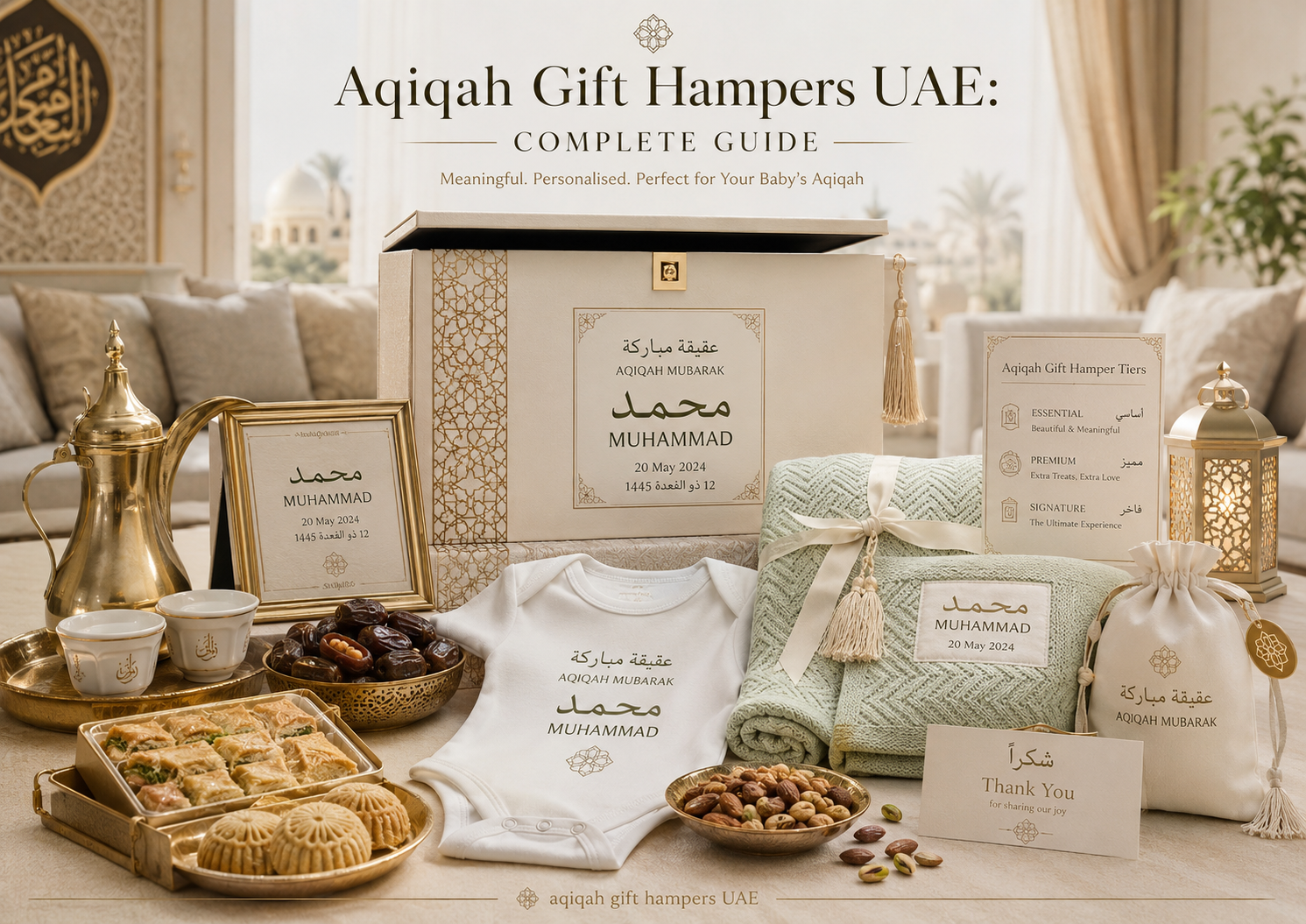
The dominant aqiqah gift category in UAE 2026. A curated hamper combining: premium dates (Sukkari or Mejdoul), Arabic sweets (ma’amoul, baklava), dry fruits, a small personalised baby item (photo frame with the baby’s name in bilingual EN+AR, personalised mini blanket or onesie), and traditional touches like Arabic coffee. Packaged in custom-printed gift box with the baby’s name and aqiqah date in Naskh-style Arabic calligraphy. AED 250–600 per hamper depending on tier. Aqiqah gift options range from broad-friend-network tier to close-family premium tier.
Personalised baby items
Photo frames with the baby’s name in bilingual EN+AR, personalised baby blankets, soft toys with embroidered names, mini onesies with name printing. Gifts for baby cover the broader range. AED 80–250 per piece for the lighter-register options; AED 250–500 for premium personalised pieces.
Traditional sweets and dates
For broader friend-network gifts, premium dates boxes or Arabic sweets boxes with brief personalisation (the baby’s name on the box lid, the aqiqah date) work as appropriate, restrained gifts. AED 80–200 per piece.
Du’a or blessing-themed gifts
Gifts with culturally-resonant blessings, name plaques with the baby’s name in calligraphic Arabic alongside English, framed pieces with traditional welcome blessings. Reserved for closer family members where the religious-cultural register is appropriate. AED 200–500 per piece.
Aqiqah vs Tasmiya — A Brief Distinction
Aqiqah and tasmiya (the formal naming ceremony) are sometimes held together as a single celebration on the seventh day, sometimes held separately. When held separately, tasmiya is typically a smaller, more-formal naming-focused gathering; aqiqah is the broader celebration with the gift-exchange element. In UAE practice, the two ceremonies are often combined for efficiency, and gifts often cover both moments. The gift-giving conventions are similar across both; aqiqah typically draws a wider gift circle than tasmiya.
Bilingual EN+AR Personalisation for Aqiqah
Aqiqah gifts are predominantly bilingual EN+AR, with the Arabic component carrying meaningful cultural and religious weight. Naskh is the most-used Arabic style for aqiqah gifts because of its dignified, traditional, religious-context-appropriate character. Diwani works for ceremonial pieces (premium hampers, framed name pieces) where the celebratory register is the focus. Thuluth on the largest premium pieces (wall plaques, hand-bound photo books) given by close family. Modern Arabic is generally too casual for aqiqah register; reserve for everyday gifts. Avoid Kufic for aqiqah personalisation (too design-forward for the religious register). Every Arabic layout is reviewed by a typography specialist before production.
What to Avoid on Aqiqah Gifts
Three categories to handle carefully on aqiqah gifts. Western baby-shower aesthetics: pastel-pink-and-blue gender-reveal-style gifts read as out-of-register for aqiqah, which has its own distinct cultural character. Use bilingual personalisation and traditional touches rather than Western baby-shower iconography. Quranic verses on gifts going to non-immediate-family recipients: Quranic content on aqiqah gifts is appropriate within close family but should be approached carefully on broader friend-network gifts. Use general blessings or culturally-warm wording rather than specific Quranic verses for the broader gift circle. Inappropriate animal imagery: while sheep are central to traditional aqiqah celebration (the sacrificial animal), printed sheep imagery on gift packaging is generally not used; the sacrifice is a separate component from the gift-exchange element.
Bulk Aqiqah Hamper Production
For families ordering aqiqah hampers in volume — common when the broader family network is large and the celebration includes 30–80 hamper recipients — bulk production runs typically take 7–10 working days for 30–80 piece runs. Each hamper carries the same baby’s name and aqiqah date personalisation; per-piece variation is typically minimal. Bulk pricing applies from 25 pieces; meaningful per-piece compression at 50+ pieces. Lock the order 3 weeks before the seventh-day ceremony date to maintain margin.
Cross-Border for Family Across the GCC
Aqiqah hampers shipping from UAE to family in KSA, Oman, Kuwait, or Bahrain take 7–14 days GCC cross-border. For aqiqah celebrations on a fixed seventh-day timeline, lock cross-border orders at least 3 weeks ahead of the ceremony date. International shipping (to family back in Pakistan, Egypt, or other origin countries) takes 14–21 days; lock 4 weeks ahead. The fresh-produce element of dates and sweets requires production timing close to the delivery date rather than far-ahead bulk production.
Same-Day Dubai for Last-Minute Aqiqah Gifts
For UAE friends and family receiving aqiqah celebration invitations on short notice, same-day Dubai delivery handles last-minute aqiqah gifts with an 11am cut-off for sublimated and fabric items (personalised blankets, photo frames in fabric coverings) and a 12pm cut-off for UV-printed pieces (premium dates boxes with personalised lids, photo frames, name plaques). There is no minimum order; UAE-wide is 1–3 business days; GCC cross-border 7–14 days.
Order Yours Today
Mark the aqiqah moment with hampers that honour the celebration.
Personalised hampers with premium dates, Arabic sweets, dry fruits, and small personalised baby items in custom-printed gift boxes with bilingual EN+AR Naskh calligraphy — bulk runs from 25 pieces.
Same-day Dubai delivery for orders placed before 11am (12pm for UV-printed items). UAE-wide delivery 1–3 business days. GCC cross-border 7–14 days. Order via WhatsApp or our online form.
Frequently Asked Questions About Aqiqah Hampers UAE
What is aqiqah and when is it held?
Aqiqah is a traditional Islamic celebration marking the birth of a baby, typically held on the seventh day after birth (though it can be held on the 14th or 21st day if circumstances delay it). The ceremony involves announcing the baby’s name, traditional sacrifice of an animal with meat distributed to family and those in need, the shaving of the baby’s hair in some traditions, and a gathering of family and close friends.
What is the most-given aqiqah gift in UAE 2026?
The personalised aqiqah hamper — a curated hamper combining premium dates (Sukkari or Mejdoul), Arabic sweets (ma’amoul, baklava), dry fruits, a small personalised baby item, and traditional touches like Arabic coffee. Packaged in custom-printed gift box with the baby’s name and aqiqah date in Naskh-style Arabic calligraphy. AED 250–600 per hamper depending on tier.
What is the difference between aqiqah and tasmiya?
Aqiqah is the broader celebration on the seventh day with gift exchange and food sharing. Tasmiya is the formal naming ceremony, sometimes held with aqiqah as a single celebration and sometimes separately. When separate, tasmiya is typically smaller and more naming-focused; aqiqah draws a wider gift circle. Gift conventions are similar across both.
What Arabic style works best for aqiqah personalisation?
Naskh — its dignified, traditional, religious-context-appropriate character matches the aqiqah register. Diwani for ceremonial premium pieces; Thuluth on the largest pieces given by close family. Modern Arabic is generally too casual for aqiqah; Kufic too design-forward. Every Arabic layout is reviewed by a typography specialist before production.
Can I gift Western-style baby-shower items for aqiqah?
Generally no — Western baby-shower aesthetics (pastel-pink-and-blue gender-reveal-style gifts) read as out-of-register for aqiqah. Use bilingual personalisation and traditional touches rather than Western baby-shower iconography. The aqiqah celebration has its own distinct cultural character that personalised hampers and traditional gift categories serve better.
Should aqiqah gifts include Quranic verses?
Quranic content on aqiqah gifts is appropriate within close family but should be approached carefully on broader friend-network gifts. Use general blessings or culturally-warm wording rather than specific Quranic verses for the broader gift circle. The typography specialist review process can advise on appropriate text registers.
How long does production take for bulk aqiqah hampers?
7–10 working days for 30–80 piece runs. Bulk pricing applies from 25 pieces with meaningful per-piece compression at 50+ pieces. Lock the order 3 weeks before the seventh-day ceremony date to maintain margin against production and (for cross-border) customs windows.
Can aqiqah hampers be sent from UAE to family abroad?
Yes — GCC cross-border to KSA, Oman, Kuwait, Bahrain takes 7–14 days; lock orders 3 weeks before the ceremony. International shipping to family in Pakistan, Egypt, or other origin countries takes 14–21 days; lock 4 weeks ahead. The fresh-produce element of dates and sweets requires timing production close to delivery rather than far-ahead bulk production.