Personalised Wedding Favours UAE: 2026 Trends
The UAE wedding favours market in 2026 has shifted meaningfully from where it sat three years ago. Bilingual EN+AR personalisation is now the default rather than an upgrade. Sustainable packaging has crossed from claim to production reality. Edible favours have premium-tiered. Same-day production for late-add guests has become a baseline expectation. And couples are spending less per favour but more per favour-design — investing in better design with restrained per-piece spend rather than the older pattern of generic items in larger quantities. This roundup covers the seven trends shaping UAE wedding favours in 2026, what they mean for couples planning weddings, and what is coming for 2027.
Trend 1 — Bilingual EN+AR as the Default Layout
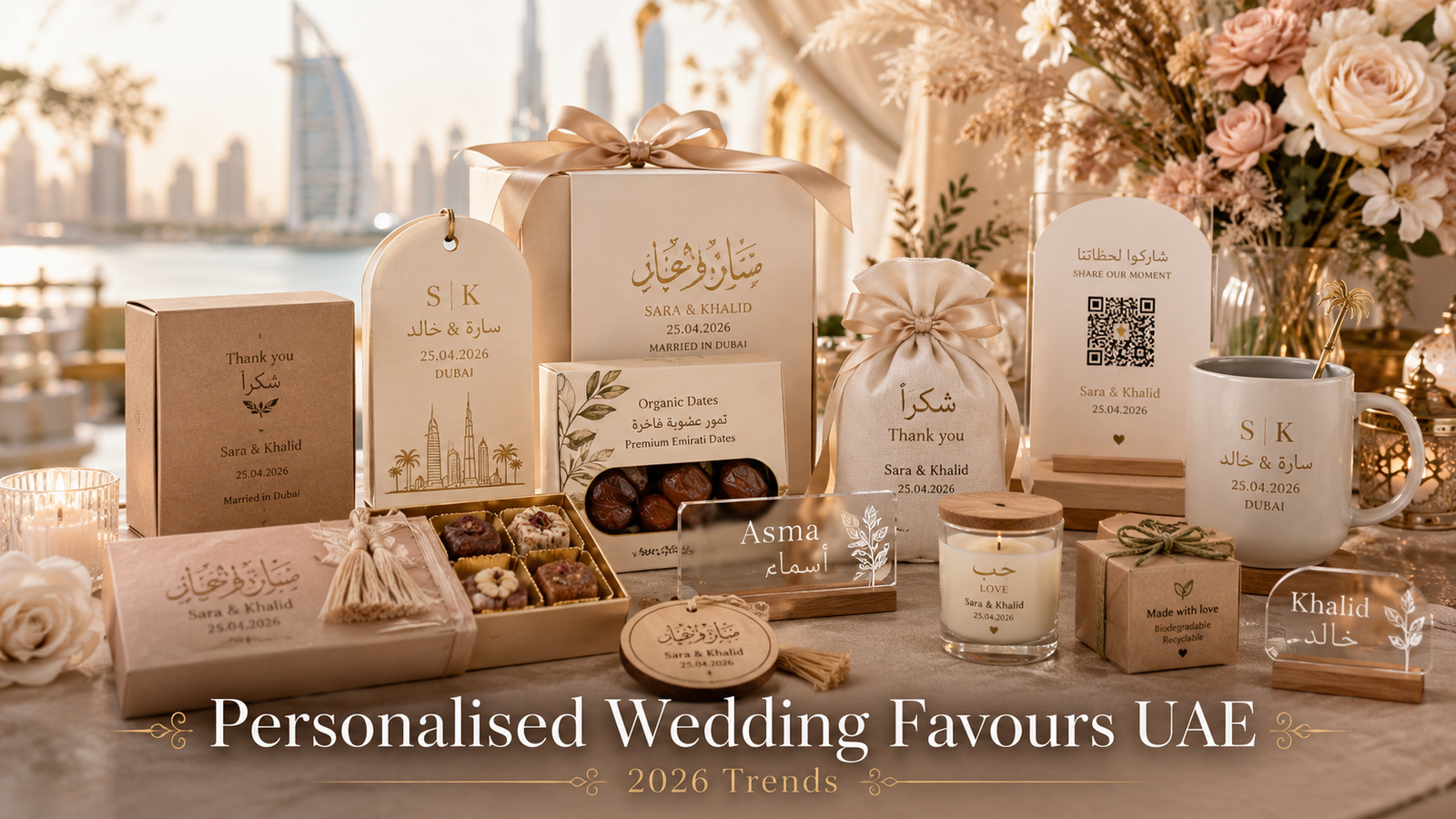
The single most consistent shift across UAE wedding favour orders in 2026: bilingual EN+AR personalisation has shifted from upgrade to default. Three years ago, adding the couple’s names in Arabic alongside English was a decision priced as a premium; in 2026 it is included at no premium across virtually every favour category. Diwani is the standard Arabic style for couple’s names on wedding favours — its flowing, ceremonial character matches the wedding register. Modern Arabic for contemporary couples; Naskh for traditional households. Every Arabic layout is reviewed by a typography specialist before production. The shift reflects the demographic reality that UAE wedding guest lists are bilingual or Arabic-dominant in a meaningful share of cases.
Trend 2 — Sustainable Packaging Crosses to Production Reality
Sustainable wedding favour packaging has moved from marketing claim to actual production specification. Recycled corrugated, FSC-certified tissue paper, kraft paper void fill, and paper tape are all available within 5–10% of conventional packaging unit costs. Plastic-free packaging (no shrink-wrap, no cellophane, no plastic ribbon) is achievable at a 15–20% premium. Couples planning 2026 weddings increasingly request sustainable specifications by default; the cost gap has compressed enough that the question is no longer “can we afford sustainable packaging” but “do we want to specify it.”
Trend 3 — Edible Favours Going Premium
Generic chocolate boxes and standard sweets are out; premium tiered edible favours are in. Three categories dominate: premium dates boxes (Sukkari, Mejdoul, Ajwa) in personalised gift boxes with the couple’s bilingual names — the highest-volume edible favour in 2026 UAE weddings; artisan kunafa and ma’amoul boxes from named bakers, again with personalised packaging; and regional treat curations matching the couple’s heritage — Filipino-style polvoron for Filipino-UAE couples, Indian mithai assortments for Indian-UAE couples, etc. Edible favours land particularly well at Saudi-attended weddings where dates carry strong cultural meaning.
Trend 4 — UV-Printed Personalised Pieces Replacing Traditional Engraving
Traditional engraving on wedding favours (engraved keychains, engraved coasters, engraved metal plaques) was the standard through 2022. By 2026, UV printing has taken meaningful share of the engraved-look territory because UV produces full-colour photographic detail at lower per-piece cost on the same surfaces — wood, leather, acrylic, metal — with finishes that compete visually with engraving at viewing distance. Engraving still leads on metal and ultimate-durability requirements; UV leads on full-colour designs (couple’s monograms in brand-tone metallic colours, photographic favours with the couple’s portrait). Most 2026 UAE weddings use a mix.
Trend 5 — Interactive Elements: QR Codes and AR Triggers
A small but growing share of UAE wedding favours in 2026 carry interactive elements — typically a small QR code printed on the favour or its packaging that links to the couple’s wedding video, a thank-you message, a song they want to share, or an AR experience. The interactive element extends the favour’s life beyond the day-of moment; guests typically scan within the first week and return weeks later for nostalgia. Production-side, the QR codes are simply UV-printed alongside the rest of the design. Couples should set the linked content to remain stable for at least 5 years; expired links on physical favours undermine the whole point.
Trend 6 — Destination-Specific Touches
UAE weddings increasingly carry destination markers — references to specific Dubai, Abu Dhabi, or other emirate locations the couple celebrates at, or references to the couple’s hometown for couples who married in UAE but come from elsewhere. A favour with the date plus “Married in Dubai” plus the couple’s bilingual names lands harder than a generic personalised favour because it anchors the wedding to a specific place. Wedding gifts for the bridal party often carry these destination markers more prominently than the general guest favours.
Trend 7 — Guest-Personalised vs Couple-Personalised
Two patterns now compete in UAE wedding favours. Couple-personalised: each favour carries the couple’s names and the wedding date, identical across all guests. Lower coordination overhead, cleaner production. Guest-personalised: each favour carries the individual guest’s name plus the couple’s monogram. Higher coordination overhead (requires a confirmed guest list with correct spellings 7+ days before the wedding), but lands harder on the recipient. Guest-personalised has grown from roughly 10% of UAE wedding favours in 2023 to roughly 30% in 2026, particularly at smaller weddings (50–150 guests) where the coordination is operationally manageable.
Bilingual Personalisation Considerations
Across all seven trends, bilingual EN+AR is the layout default. Diwani for the couple’s names in ceremonial register; Modern Arabic for contemporary aesthetics; Naskh for traditional households. Personalised wedding favour mugs are produced via sublimation; UV-printed favours hold all five Arabic styles cleanly. For mixed-cultural weddings (Arab-Filipino, Arab-Indian, Western-Emirati), bilingual personalisation can extend to a third language alongside Arabic and English on request.
Production Lead Times for Wedding Favour Runs
Lead times for personalised wedding favours scale with run size. 50–100 piece runs: 5–7 working days. 100–300 piece runs: 7–10 working days. 300–500 piece runs: 10–14 working days. Larger runs (500+) at 14–21 days. For guest-personalised favours, add 2–3 days for the guest-list reconciliation and proof step. Same-day Dubai handles small-volume rush (up to 25 pieces) at the standard 11am (sublimated/fabric) or 12pm (UV) cut-offs — useful for last-minute add-on favours when guest count grows past the original order.
What’s Coming for 2027
Three trends are forming for 2027. AI-assisted favour design: couples generate favour mockups in real time during planning, reducing the design-phase timeline from weeks to days. Cross-GCC same-day for major Saudi weddings: UAE-produced favours arriving same-day at Saudi wedding venues via the maturing partner-network logistics. Plastic-free becoming the procurement-tier baseline rather than a premium option, driven by GCC ESG reporting requirements maturing.
Same-Day Dubai and Cross-Border
Same-day Dubai applies for small-volume rush wedding favours with the 11am (sublimated/fabric) and 12pm (UV-printed) cut-offs. There is no minimum order; UAE-wide is 1–3 business days; GCC cross-border 7–14 days for wedding favours destined for Saudi Arabia, Oman, Kuwait, or Bahrain weddings. For Saudi-destination wedding favours, lock the order 4 weeks before the wedding date to maintain customs-clearance margin.
Order Yours Today
Mark your wedding with favours that match the 2026 UAE register.
Bilingual EN+AR personalisation, sustainable packaging, premium edible options, UV-printed pieces, guest-personalised favours — bulk runs from 50 pieces, typography specialist review on every Arabic layout.
Same-day Dubai delivery for orders placed before 11am (12pm for UV-printed items). UAE-wide delivery 1–3 business days. GCC cross-border 7–14 days. Order via WhatsApp or our online form.
Frequently Asked Questions About Wedding Favours UAE 2026
What is the most important wedding favour trend in UAE in 2026?
Bilingual EN+AR personalisation has shifted from upgrade to default. Three years ago it was a priced premium; in 2026 it is included at no premium across virtually every favour category. Diwani is the standard Arabic style for couple’s names; Modern Arabic for contemporary couples; Naskh for traditional households.
How much do personalised wedding favours cost per guest in UAE in 2026?
Standard personalised favours (mugs, photo frames, small UV-printed pieces) AED 30–80 per guest. Premium edible favours (artisan dates, bakery boxes) AED 50–150 per guest. Premium UV-printed pieces with bilingual calligraphy AED 80–200 per guest. Couples are spending less per favour but more per favour-design than three years ago.
What is the difference between guest-personalised and couple-personalised wedding favours?
Couple-personalised: each favour carries the couple’s names and wedding date, identical across guests. Lower coordination, cleaner production. Guest-personalised: each favour carries the individual guest’s name plus the couple’s monogram. Higher coordination (confirmed guest list 7+ days ahead) but lands harder on the recipient. Guest-personalised has grown to ~30% of UAE wedding favours in 2026.
What is the best Arabic font for wedding favours?
Diwani — it is the standard wedding Arabic style. Its flowing, ceremonial character matches the wedding register. Modern Arabic works for contemporary couples; Naskh for traditional households. Avoid Kufic for couple’s names (too design-forward) and Thuluth (too monumental for small favour surfaces).
Is there a minimum order for personalised wedding favours?
No — single-piece favours are produced at the same Dubai facility as bulk runs. Bulk pricing applies from 50 pieces. Most UAE wedding favour runs land in the 100–300 piece band.
Are sustainable wedding favour packaging options available without major cost premium?
Yes — recycled corrugated, FSC-certified tissue paper, kraft paper void fill, and paper tape sit within 5–10% of conventional packaging unit costs. Plastic-free packaging is achievable at a 15–20% premium. The cost gap has compressed enough that sustainable specifications are routine in 2026 UAE wedding planning.
How long does production take for 200 personalised wedding favours?
7–10 working days for 100–300 piece runs. Add 2–3 days for guest-personalised favours (which require guest-list reconciliation and a proof step). Same-day Dubai handles rush add-on favours up to 25 pieces at the standard 11am or 12pm cut-offs.
Can wedding favours be produced in UAE and shipped to a Saudi wedding venue?
Yes — GCC cross-border delivery to KSA is 7–14 days. Lock the order 4 weeks before the wedding date to maintain customs-clearance margin. Riyadh, Jeddah, and Dammam are the most-frequent Saudi wedding destinations for UAE-produced favours.
What are interactive QR-code wedding favours?
A growing trend in 2026 — favours with a UV-printed QR code linking to the couple’s wedding video, a thank-you message, a shared song, or an AR experience. Extends the favour’s life beyond the wedding day; guests typically scan within the first week and return for nostalgia later. Set the linked content to remain stable for 5+ years.