Quranic Verse Printing: Typography Care and Ligature Handling
Printing Quranic verses on personalised gifts and religious pieces requires the highest level of typography care in UAE production work. The Quran’s text is sacred to Muslim communities; mishandled rendering — incorrect ligatures, missing diacritical marks (tashkeel), inaccurate verse references, or inappropriate placement on commercial gifts — produces material that ranges from disappointing to deeply offensive depending on the specific issue. This guide is for production teams, gift-design professionals, and procurement specialists working on legitimate Quranic-content gift programmes — religious gift commissions, mosque gift items, gifts to religiously-observant recipients in religious-context, and educational religious materials. The guide covers when Quranic content is appropriate, the typography care requirements, the handling considerations, and the verification process that protects both the production quality and the religious appropriateness of the work.
When Quranic Verse Printing Is Appropriate
Quranic content on printed gifts and pieces is appropriate in three specific contexts. Religious gift commissions: gifts specifically commissioned for religious moments — Quran covers for Hajj or Umrah pilgrimage, religious calligraphy pieces commissioned for mosque or madrasa contexts, gifts for Islamic religious teachers and clerics. Religious-context family gifts: gifts within close family for religious moments — gifts marking a child’s first Quran completion, gifts for religiously-observant family members during religious observances, religious-themed wedding gifts within Muslim family contexts. Educational religious materials: printed materials for religious education contexts — madrasa learning materials, religious-school personalised pieces, Islamic-education gift programmes. Quranic verse printing programmes specifically serve these legitimate religious-context applications.
When Quranic Verse Printing Is Not Appropriate
Three contexts where Quranic content on printed gifts is inappropriate regardless of intent. Commercial or casual corporate gifts: Quranic content on a corporate-tier mug, an everyday-tier gift, or a casual hospitality gift creates the risk of the verse being subjected to disrespectful handling — the gift being thrown away, used inappropriately, or treated casually. The commercial gift register doesn’t match the Quranic content’s religious weight. Gifts going to non-Muslim recipients: Quranic content on a gift going to non-Muslim recipients is inappropriate; the religious framing doesn’t translate and may produce confusion or offence. Decorative-only contexts without religious framing: using Quranic content as decorative element without the religious-context framing risks treating sacred text as decoration. The framing matters as much as the content.
Typography Care Requirements
Naskh as the primary appropriate Arabic style
Naskh is the primary Arabic style for Quranic verse printing — its dignified classical character is the established Arabic style for Quran-printing across the Islamic world. The Madina Mushaf (the most-recognised printed Quran style) uses a specific Naskh variant. For Quranic verse printing in UAE, Naskh is the safe default. Thuluth appears on traditional mosque calligraphy and large-format premium pieces (calligraphic wall pieces, premium ceremonial Qurans); used on the largest premium pieces where the monumental character is appropriate. Diwani is generally not used for Quranic content — the ornate flowing character isn’t traditional for Quran printing. Modern Arabic and casual styles are not used for Quranic content; the contemporary character mismatches the sacred text’s register.
Ligature preservation
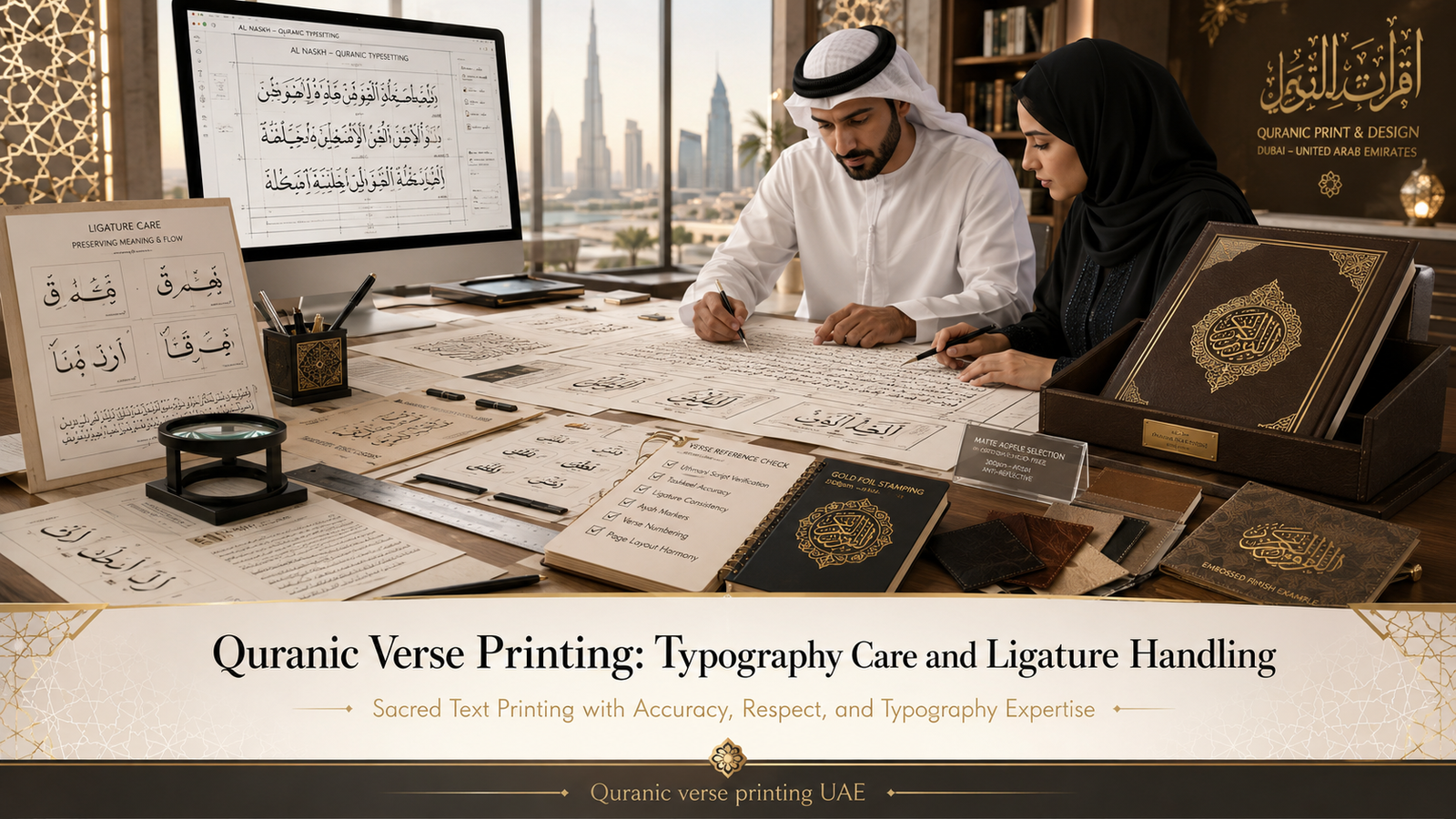
Arabic typography has specific ligatures (visual combinations of multiple letters) that good Arabic typography preserves. Quranic Arabic has additional traditional ligatures specific to Quran printing — particularly compound forms that appear in specific verses. Production must preserve these ligatures rather than breaking them into separate letters; lower-quality production that breaks ligatures produces visibly-incorrect Quranic text. The typography specialist review process specifically checks for ligature preservation on Quranic content.
Diacritical marks (tashkeel)
Quranic Arabic includes tashkeel — diacritical marks indicating short vowel sounds, gemination, and other pronunciation guides. Tashkeel is essential for Quranic accuracy because the same Arabic letters can carry different meanings depending on the vowel marks. Quranic verse printing must include the correct tashkeel for the specific verse; missing or incorrect tashkeel produces inaccurate religious text. The tashkeel rendering is one of the most-frequent quality issues in non-specialist Arabic typography production; specialist review is essential.
Verse-reference accuracy
Quranic verses are referenced by surah (chapter) and ayah (verse number) — for example, “Al-Baqarah 2:255” references the specific verse “Ayat al-Kursi”. Verse-reference accuracy requires verifying both that the printed text matches the referenced verse and that the surah and ayah numbers are correct. Errors in verse references can produce material that’s both incorrect text and incorrect attribution. The verification process should include cross-referencing the printed text against authoritative Quran sources before production.
Production Materials and Finishes
Quranic content production requires materials and finishes appropriate to the religious register. Premium leather (cow, calf, or quality synthetic — never pigskin): for Quran covers, religious-leather pieces, premium Qurans. Personalised Quran gifts use premium leather appropriate to the religious context. Quality paper for printed Qurans: 80gsm+ paper with good opacity for printed Quran pages; cheaper paper with show-through is inappropriate. Premium acrylic or hardwood for calligraphic pieces: matte-finish premium materials for Quranic calligraphy wall pieces; avoid glossy finishes that read as decorative-only rather than religious. Foil stamping with respectful colour choices: gold foil for premium religious pieces (consistent with traditional Quran covers); avoid metallic colours that read as decorative-only. Premium textile for prayer-context pieces: Personalised prayer mats and prayer-context items use premium textile materials with appropriate Quranic content placement; the prayer-mat context is one of the established religious-context applications where Quranic content is appropriate.
Disposal and Handling Considerations
Production teams working on Quranic content should understand the broader handling considerations that affect Quranic-printed materials. Quranic-printed materials should not be discarded as regular waste: traditional Islamic practice considers respectful disposal of religious materials important. Production-stage trim and waste from Quranic printing should be handled appropriately — typically through dedicated religious-material disposal processes rather than regular waste streams. Print quality testing should not damage acceptable production: proof testing and quality control on Quranic content should not produce damaged or marked acceptable production that would then need disposal. Customer guidance on care: for retail Quranic-content gifts, brief care guidance accompanying the gift helps recipients handle the material appropriately. The handling considerations are part of the production team’s responsibility.
The Verification Process
Quranic verse production requires a multi-step verification process beyond standard typography review. 1. Source verification: the verse text and reference are verified against authoritative Quran sources before any production-stage work begins. Multiple authoritative sources cross-checked. 2. Typography specialist review: the proof piece is reviewed by an Arabic-language design professional with specific Quranic typography experience for ligature preservation, tashkeel accuracy, and overall rendering. 3. Religious-context review (where applicable): for substantive Quranic-content commissions, religious-context review by a religiously-qualified reviewer (an imam, religious teacher, or appropriate religious authority) confirms the text and context appropriateness. 4. Physical proof on production material: physical proof piece on the actual production material catches issues that surface only in physical printing. 5. Final pre-bulk verification: before bulk production, all verification steps complete with documented sign-off.
Bilingual Considerations for Quranic Pieces
For Quranic-content pieces with bilingual EN+AR content, the Arabic Quranic verse is the primary content; English translation accompanying serves as supporting reference rather than equal-weight content. Translation source matters: English translations of Quranic verses vary across translators (Sahih International, Yusuf Ali, Pickthall, etc.); the choice of translation should be appropriate to the religious context and consistent with established religious practice in the recipient’s tradition. Layout hierarchy: Arabic Quranic verse occupies the primary position (typically top or centre); English translation in supporting position (smaller, often below the Arabic). Translation accuracy verification: the English translation should be verified against the chosen translation source; mistranslations or paraphrasing of Quranic text are inappropriate.
Working with Specialist Suppliers
Quranic verse printing should be handled by production teams with specific Quranic typography experience rather than generalist printing suppliers. The verification process and typography care requirements add overhead that non-specialist suppliers don’t carry; lower-cost generalist production typically produces ligature failures, tashkeel errors, and verse-reference issues that compromise the work’s religious appropriateness. UAE-based suppliers with established Quranic typography processes — including dedicated typography specialists, established religious-context review relationships, and material-handling protocols — produce work that meets the religious register’s quality requirements.
Order Yours Today
Quranic verse printing handled with the typography care and religious appropriateness the content requires.
Naskh and Thuluth Arabic styles, tashkeel rendering accuracy, ligature preservation, source verification, typography specialist plus religious-context review — premium leather, quality paper, dignified materials, respectful handling.
Same-day Dubai delivery for orders placed before 11am (12pm for UV-printed items). UAE-wide delivery 1–3 business days. GCC cross-border 7–14 days. Order via WhatsApp or our online form.
Frequently Asked Questions About Quranic Verse Printing
When is Quranic verse printing appropriate on gifts?
Three appropriate contexts: religious gift commissions (Quran covers for Hajj/Umrah pilgrimage, religious calligraphy for mosque/madrasa contexts, gifts for religious teachers), religious-context family gifts (Quran completion gifts, religiously-observant family members during religious observances), and educational religious materials (madrasa learning materials, religious-school programmes). Inappropriate on commercial corporate gifts, gifts to non-Muslim recipients, or decorative-only contexts.
What Arabic style is appropriate for Quranic verse printing?
Naskh is the primary appropriate Arabic style — its dignified classical character is the established style for Quran-printing across the Islamic world. The Madina Mushaf (the most-recognised printed Quran style) uses a specific Naskh variant. Thuluth appears on traditional mosque calligraphy and large-format premium pieces. Diwani is generally not used for Quranic content; Modern Arabic and casual styles are not used.
What are tashkeel and why do they matter for Quranic printing?
Tashkeel are diacritical marks indicating short vowel sounds, gemination, and other pronunciation guides in Arabic. Tashkeel is essential for Quranic accuracy because the same Arabic letters can carry different meanings depending on the vowel marks. Quranic verse printing must include the correct tashkeel for the specific verse; missing or incorrect tashkeel produces inaccurate religious text. Tashkeel rendering is one of the most-frequent quality issues in non-specialist Arabic typography production.
How is Quranic content verified before production?
Multi-step verification: source verification (verse text and reference verified against authoritative Quran sources, multiple sources cross-checked), typography specialist review (Arabic-language design professional with Quranic typography experience reviews proof for ligature preservation, tashkeel accuracy, overall rendering), religious-context review for substantive commissions (religiously-qualified reviewer confirms text and context appropriateness), physical proof on production material, and final pre-bulk verification with documented sign-off.
What materials are appropriate for Quranic content production?
Premium leather (cow, calf, or quality synthetic — never pigskin) for Quran covers and religious-leather pieces. Quality paper (80gsm+ with good opacity) for printed Qurans. Premium acrylic or hardwood with matte finish for calligraphic wall pieces. Gold foil stamping for premium religious pieces (consistent with traditional Quran covers). Avoid glossy finishes and metallic colours that read as decorative-only rather than religious.
Should Quranic content on gifts include English translation?
For bilingual Quranic-content pieces, the Arabic Quranic verse is the primary content; English translation accompanying serves as supporting reference. Translation source matters (Sahih International, Yusuf Ali, Pickthall, etc.); choice should be appropriate to religious context. Layout hierarchy: Arabic verse in primary position, English translation in supporting position. Translation accuracy must be verified against the chosen translation source.
How should Quranic-printed materials be handled and disposed of?
Quranic-printed materials should not be discarded as regular waste — traditional Islamic practice considers respectful disposal of religious materials important. Production-stage trim and waste should be handled through dedicated religious-material disposal processes rather than regular waste streams. For retail Quranic-content gifts, brief care guidance accompanying the gift helps recipients handle the material appropriately.
Should I work with a generalist printer or a Quranic-typography specialist for Quranic content?
Specialist Quranic-typography suppliers — the verification process and typography care requirements add overhead that non-specialist suppliers don’t carry. Lower-cost generalist production typically produces ligature failures, tashkeel errors, and verse-reference issues that compromise the work’s religious appropriateness. UAE-based suppliers with established Quranic typography processes (dedicated typography specialists, established religious-context review relationships, material-handling protocols) produce work that meets the religious register’s quality requirements.