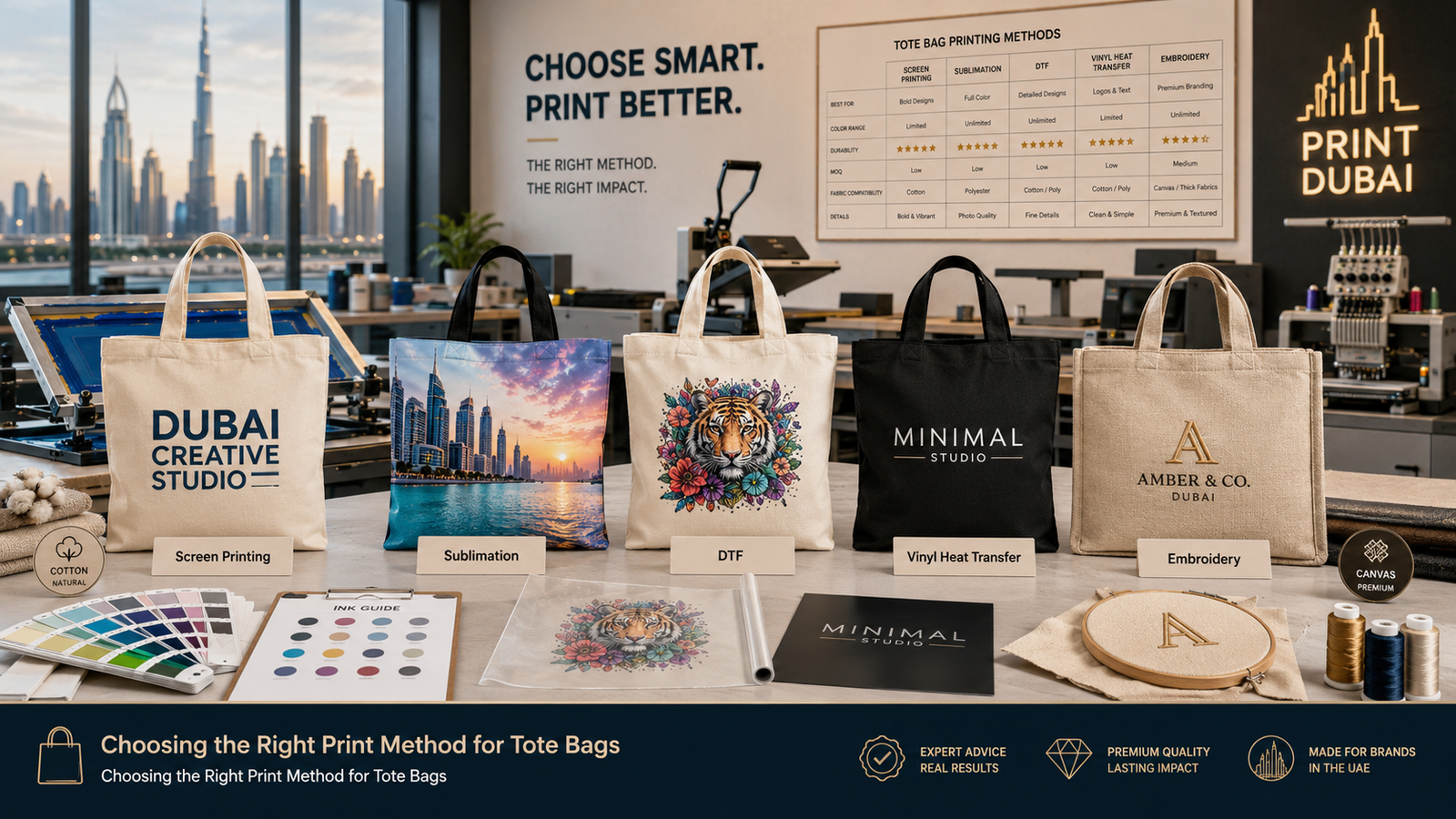
Choosing the Right Print Method for Tote Bags
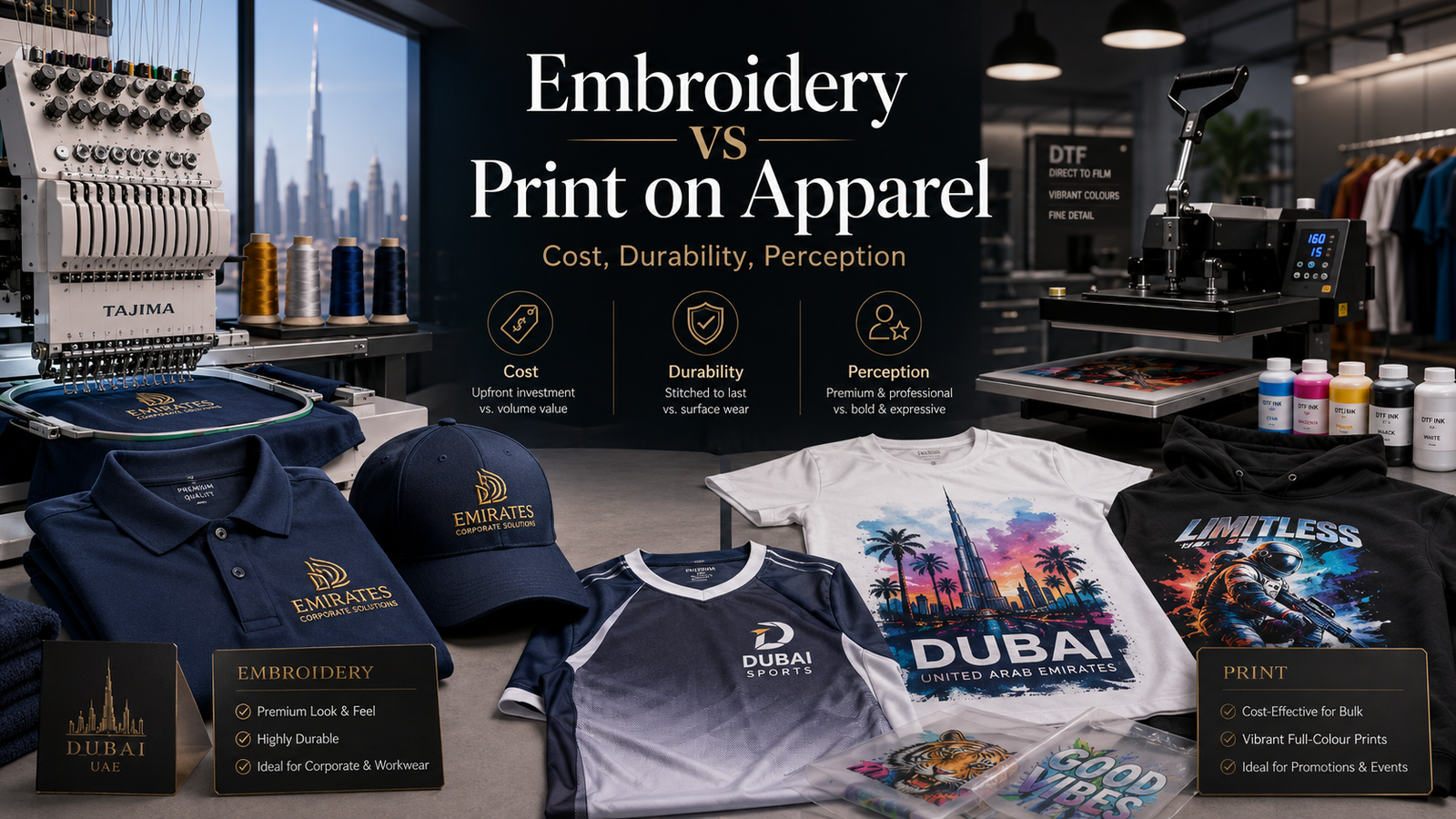
Tote bag print method selection is one of the most-frequently miscalibrated decisions in UAE corporate apparel and event-merchandise procurement. The same tote bag base can be printed via screen printing, sublimation, DTF, vinyl heat transfer, or embroidery — each with distinct cost structures, design capabilities, durability profiles, and minimum order quantities. Picking the right print method depends on the tote material, design complexity, run volume, and intended durability. This guide covers the practical decision framework for tote bag print methods in UAE 2026, with cost comparisons at typical volumes and the specific scenarios where each method clearly outperforms.
The Five Print Method Options
Screen printing
Ink applied through screen mesh onto the tote fabric, one screen per design colour. Most economical at 200+ pieces for solid-colour designs (1–4 colours typically). Setup-heavy at low volumes; setup amortises across larger runs. Most-used method for high-volume promotional totes with corporate logos. AED 12–25 per piece including printing on standard cotton totes at 500-piece volumes.
Sublimation
Dye-sublimation transfer producing full-colour photographic detail on polyester totes. The dye becomes part of the polyester fibre — zero-feel finish with high wash durability. Restricted to polyester fabric; cotton totes cannot be sublimated. AED 18–35 per piece on polyester totes at 200-piece volumes.
DTF (Direct-to-Film) printing
Full-colour design printed onto PET film with CMYK + white ink, heat-pressed onto the tote. Works on any fabric (cotton, polyester, blends), supports photographic detail, MOQ-friendly with no setup penalty. DTF printing is the dominant choice for low-to-mid volume tote runs (1–200 pieces) where flexibility matters. AED 25–55 per piece including printing at 100-piece volumes.
Vinyl heat transfer
Pre-cut vinyl shapes heat-pressed onto the tote. Suitable for simple text and logo designs at very low volumes (1–50 pieces). Each colour requires a separate vinyl layer; multi-colour designs add complexity. Lower per-piece cost at small runs but limited to simple designs. AED 20–40 per piece at 50-piece volumes.
Embroidery
Thread stitched into the tote fabric using programmed embroidery. Premium register, very high durability, limited colour range and fine-detail capability. Most-used for senior-tier corporate totes and brand-premium positioning. AED 30–55 per piece including embroidery at 100-piece volumes.
The Decision Framework
By volume — when does each method’s cost structure win?
At 1–50 pieces: DTF wins on cost — no setup penalty, MOQ-friendly. Vinyl heat transfer competitive for simple designs. At 100–200 pieces: DTF still cost-effective; screen printing becomes competitive for solid-colour designs as setup amortises. At 200–500 pieces: screen printing dominates on cost for solid-colour designs; DTF retains advantage for full-colour photographic content. At 500+ pieces: screen printing’s setup cost is negligible per-piece; the dominant method for high-volume corporate tote runs.
By design complexity — when does each method clearly win?
Solid-colour 1–3 colour designs: screen printing or vinyl heat transfer for cost economy. Full-colour photographic designs: DTF on cotton, sublimation on polyester. Fine detail and small text: DTF or sublimation handle fine detail better than screen printing. Photographic gradient designs: sublimation produces the cleanest gradient reproduction; DTF as second choice. Single-colour solid logos with premium register: embroidery for the senior register; screen printing for the standard register.
By tote fabric — fabric determines method options
Standard cotton totes (100% cotton, cotton-canvas blend): screen printing, DTF, vinyl heat transfer, embroidery. Cannot be sublimated (sublimation requires polyester fibre). Polyester totes (100% polyester, polyester-cotton blend with high polyester content): sublimation, DTF, screen printing. Heavy canvas totes (12oz+ canvas): screen printing for high volume, DTF for low-to-mid volume, embroidery for premium register. Recycled or sustainable totes (recycled cotton, jute, hemp): screen printing and DTF work; some materials require print-method testing on the specific fabric. Personalised tote bags programmes support the full range of fabric and print method combinations.
By durability requirement
For totes intended for short-term promotional use (event distribution, single-event use): screen printing and DTF are appropriate. For totes intended for daily use over months or years (corporate uniform totes, premium gift totes): screen printing (with proper ink), sublimation (on polyester), or embroidery. Cheap DTF can degrade after 50 wash cycles; premium DTF lasts 100+ cycles. Embroidery: 500+ wash cycles with the design remaining visible. Sublimation on polyester: 1000+ wash cycles (effectively the tote’s useful life).
Cost Comparisons at Typical Volumes
Indicative all-in pricing (heavy-canvas tote + printing) for typical UAE corporate tote programmes.
50-piece run, simple corporate logo (1–2 colours): DTF AED 35–55 per piece; screen printing AED 30–55 (setup-heavy at this volume); vinyl heat transfer AED 20–40 (for very simple designs).
200-piece run, simple corporate logo: DTF AED 25–45 per piece; screen printing AED 22–40 (setup amortises); embroidered logo AED 35–55 per piece.
500-piece run, simple corporate logo: DTF AED 18–35 per piece; screen printing AED 15–30 (volume compression); embroidered logo AED 30–50.
1000-piece run, simple corporate logo: screen printing AED 12–22 per piece (dominant); DTF AED 15–28; embroidery AED 25–45.
Bilingual EN+AR on Tote Bags
For UAE corporate tote bags with bilingual EN+AR personalisation, all print methods support bilingual layouts but with method-specific considerations. Screen printing handles bilingual single-colour text cleanly at moderate sizes; DTF handles fine bilingual detail and full-colour bilingual designs better. Sublimation reproduces bilingual gradient effects cleanly. Embroidery handles bilingual single-colour text at large sizes; fine bilingual text below the embroidery minimum size produces character-connection issues. Modern Arabic and Naskh are the most-used Arabic styles for corporate tote bags; Diwani for ceremonial event totes. Every Arabic layout is reviewed by a typography specialist before production. Custom logo printing workflows handle bilingual corporate tote programmes at scale across all print methods.
Common Tote Bag Print Method Mistakes
Four mistakes recur. Screen printing 50-piece runs: screen printing’s setup cost makes 50-piece runs uneconomical compared to DTF. Use DTF for low-volume tote runs. DTF on heavy-laundry workwear totes: for daily-use workwear totes facing heavy washing, screen printing or embroidery outperforms DTF on durability. Sublimation on cotton totes: sublimation requires polyester fibre — attempts on cotton produce no result. Verify tote fabric before specifying sublimation. Embroidered full-colour designs: embroidery cannot reproduce photographic content; use DTF or sublimation for full-colour designs and reserve embroidery for solid-colour logo applications.
Order Yours Today
Specify the right print method for UAE branded tote bags.
Screen printing for high volume, DTF for low-to-mid volume and full colour, sublimation for polyester photographic, embroidery for premium register — bilingual EN+AR with Modern Arabic and Naskh, all volumes from 1 to 1000+ pieces.
Same-day Dubai delivery for orders placed before 11am (12pm for UV-printed items). UAE-wide delivery 1–3 business days. GCC cross-border 7–14 days. Order via WhatsApp or our online form.
Frequently Asked Questions About Tote Bag Print Method
What is the best print method for tote bag corporate gifts?
Depends on volume and design. At 1–50 pieces: DTF for cost flexibility (no setup penalty). At 100–200 pieces: DTF or screen printing depending on design (DTF for full-colour, screen printing for solid-colour as setup amortises). At 200–500 pieces: screen printing dominates on cost for solid-colour designs; DTF retains advantage for full-colour. At 500+ pieces: screen printing dominant for high-volume corporate runs.
Can I sublimate cotton tote bags?
No — sublimation requires polyester fibre. Cotton totes cannot be sublimated; the dye-sublimation process needs polyester to bond into. For cotton totes, use screen printing, DTF, vinyl heat transfer, or embroidery instead. For full-colour photographic designs on totes, switch to polyester-content totes for sublimation, or use DTF on cotton for similar full-colour capability.
How do tote bag print methods compare on durability?
Sublimation on polyester: 1000+ wash cycles (effectively the tote’s useful life). Embroidery: 500+ wash cycles with the design remaining visible. Screen printing with quality ink: 100–300 wash cycles. Premium DTF: 100+ wash cycles; cheap DTF can degrade after 50 cycles. Vinyl heat transfer: 30–80 wash cycles depending on adhesion quality. Match method to durability requirement.
What is the cost difference between screen printing and DTF tote bags?
At 50 pieces: DTF AED 35–55 per piece; screen printing AED 30–55 (setup-heavy, similar cost). At 200 pieces: DTF AED 25–45; screen printing AED 22–40 (setup amortises). At 500 pieces: DTF AED 18–35; screen printing AED 15–30 (volume compression dominates). At 1000+ pieces: screen printing AED 12–22 per piece (clearly economical); DTF AED 15–28.
Should I embroider corporate tote bags?
For senior-tier corporate totes and brand-premium positioning, yes — embroidery’s premium register justifies the AED 30–55 per piece cost. For standard corporate totes and event distribution, screen printing or DTF works at lower cost without missing the register. Reserve embroidery for premium tier where the tactile premium quality lifts the gift.
Can DTF reproduce full-colour photographic designs on tote bags?
Yes — DTF supports CMYK + white ink underlay producing full-colour photographic detail with high colour accuracy. The white-ink underlay enables vivid colour reproduction even on dark tote bases. For photographic content on cotton totes, DTF is the dominant choice; sublimation handles photographic content on polyester totes.
Should bilingual EN+AR text on totes be printed via screen or DTF?
DTF for fine bilingual detail and full-colour bilingual designs — supports the typography specialist review’s rendering preferences cleanly. Screen printing for bilingual single-colour text at moderate sizes — economical for high volume. Embroidery for bilingual single-colour text at large sizes (avoid below the embroidery minimum size due to character-connection issues). Modern Arabic and Naskh are the most-used Arabic styles for corporate totes.
What tote bag fabric is best for branded corporate gift programmes?
Heavy canvas (12oz+ cotton or cotton-blend) for premium-tier branded totes — substantial construction, supports embroidery and screen printing cleanly, lasts daily-use over years. Standard cotton (8–10oz) for mid-tier totes. Polyester or polyester-blend for sublimation-printed full-colour designs. Recycled cotton, jute, or hemp for ESG-conscious brands at 5–15% premium over standard cotton equivalents.