Unboxing Experience Design: Making the Moment Memorable
Unboxing experience design is the most-underestimated brand lever for UAE D2C brands and premium gift programmes. The unboxing moment captures the customer at peak positive engagement with the brand — what happens between the package arriving and the product being revealed determines whether that engagement converts into reviews, repeat purchases, social shares, and word-of-mouth referrals. Most UAE brands treat the package as a transport vessel; the brands that design unboxing as a deliberate brand experience outperform on the metrics that matter. This guide covers the framework, component layers, material specifications, sensory considerations, and bilingual EN+AR register for UAE-context unboxing programmes.
Why Unboxing Design Disproportionately Matters
Three reasons unboxing experience is high-impact relative to cost. Maximum emotional engagement: the customer’s emotional state at the unboxing moment is at peak positive engagement — anticipation, curiosity, satisfaction at the product’s arrival. Brand impressions formed here carry disproportionate weight. Social-media-native: the moment is inherently shareable; Instagram, TikTok, and YouTube unboxing content drives discovery for brands that design experiences worth filming. Per-unit marginal cost: thoughtful design typically adds AED 5–25 per unit — a fraction of D2C customer acquisition cost. ROI per unit invested is consistently positive within the first repeat-purchase cycle.
The Five Component Layers of Unboxing Design
Layer 1 — Outer shipping packaging
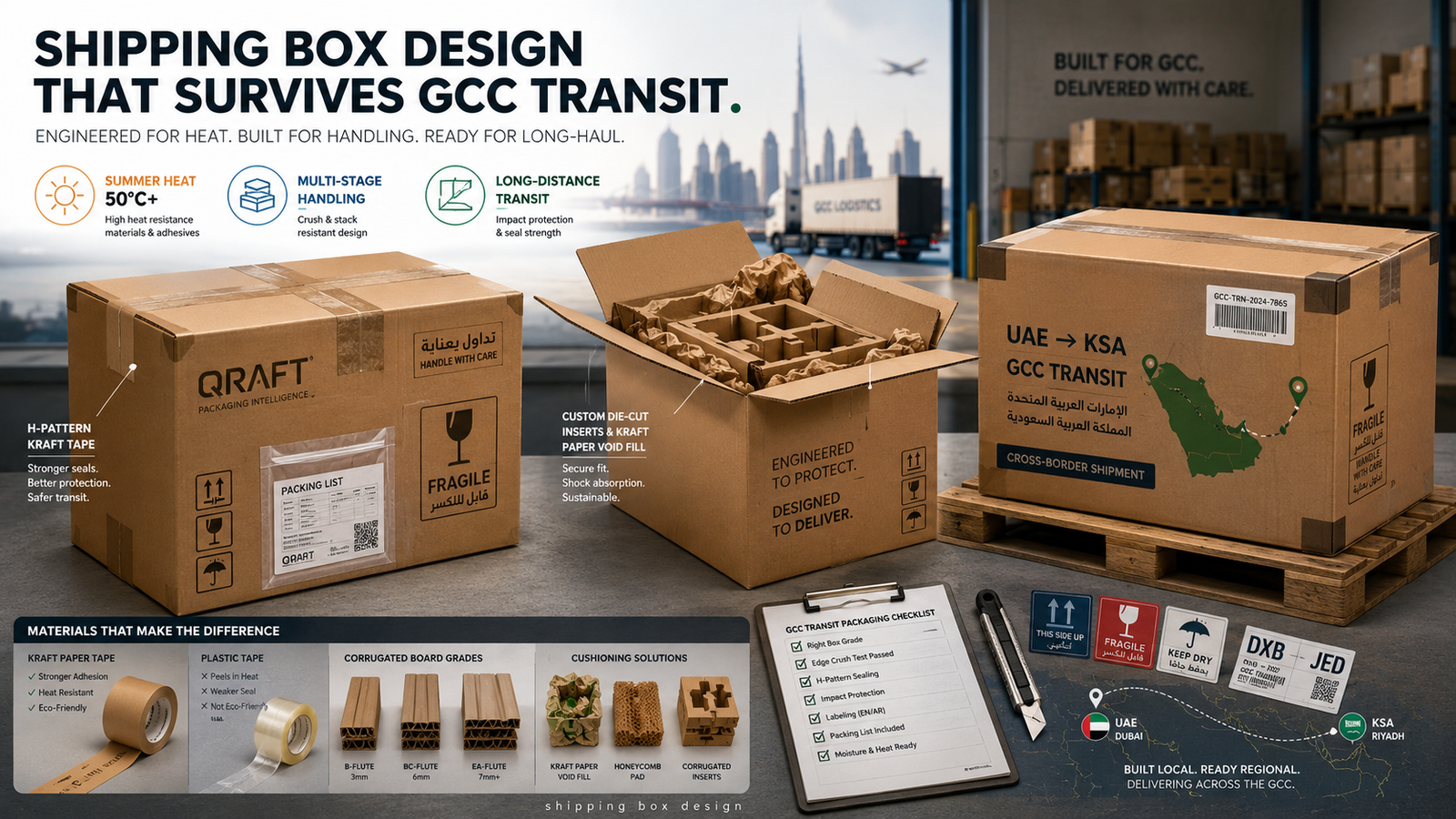
The first impression — what the customer sees at the door. Branded shipping boxes with the company logo, brand colours, and tasteful design treatment elevate the moment-of-arrival. Generic brown corrugate boxes signal commodity transactions; branded outer packaging signals premium brand intentionality. Shipping box printing workflows handle branded outer packaging at scale across volume tiers from 500 to 50,000+ pieces.
Layer 2 — Box opening reveal
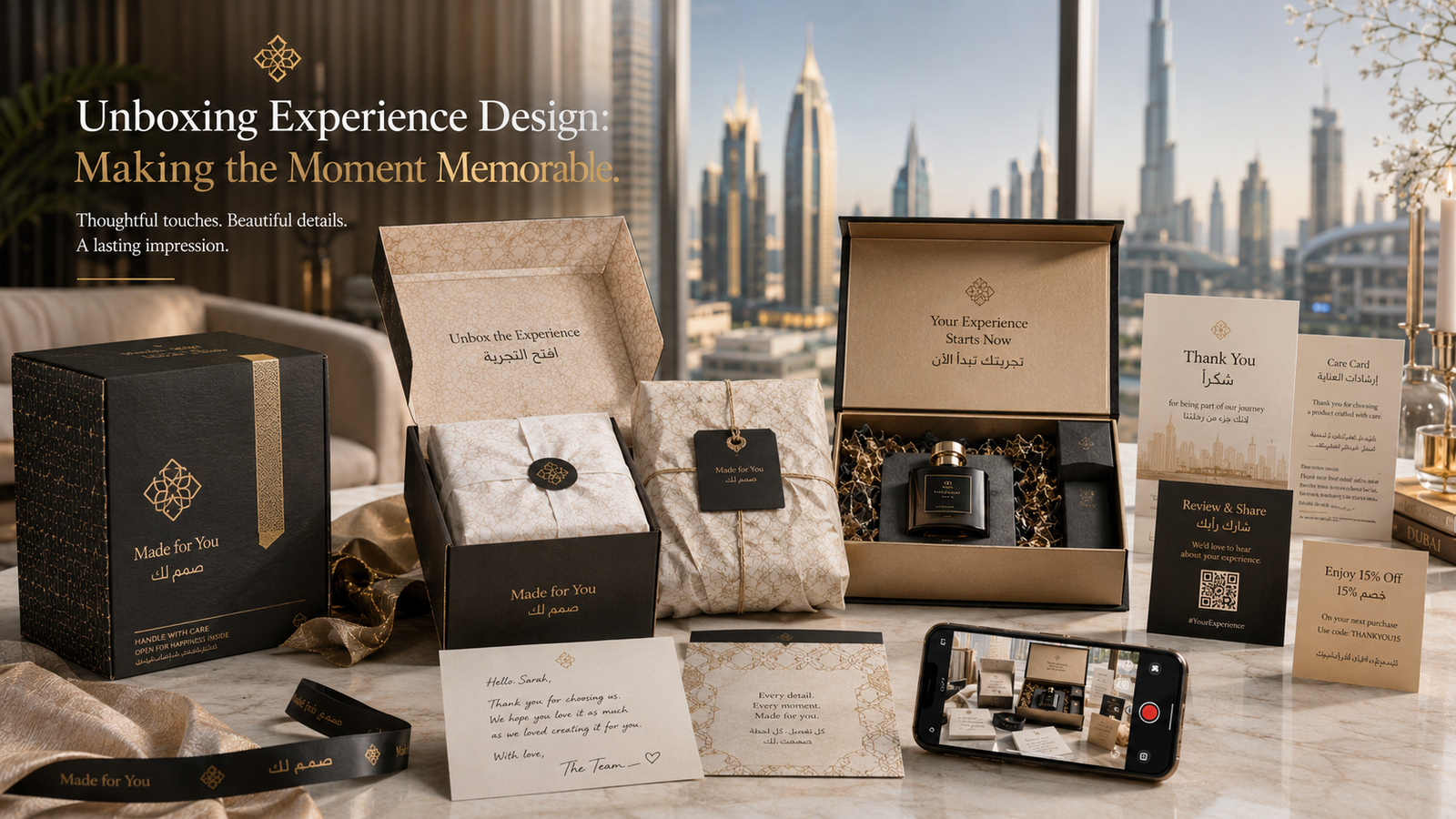
The first internal moment — what the customer sees as they open the box. Tissue paper, custom-printed inner liner, branded sticker seal, or printed tape running across the box opening creates a deliberate reveal moment. The customer’s eye is drawn to the first internal element before they reach the product itself; this layer sets the brand register for everything that follows.
Layer 3 — Custom wrapping
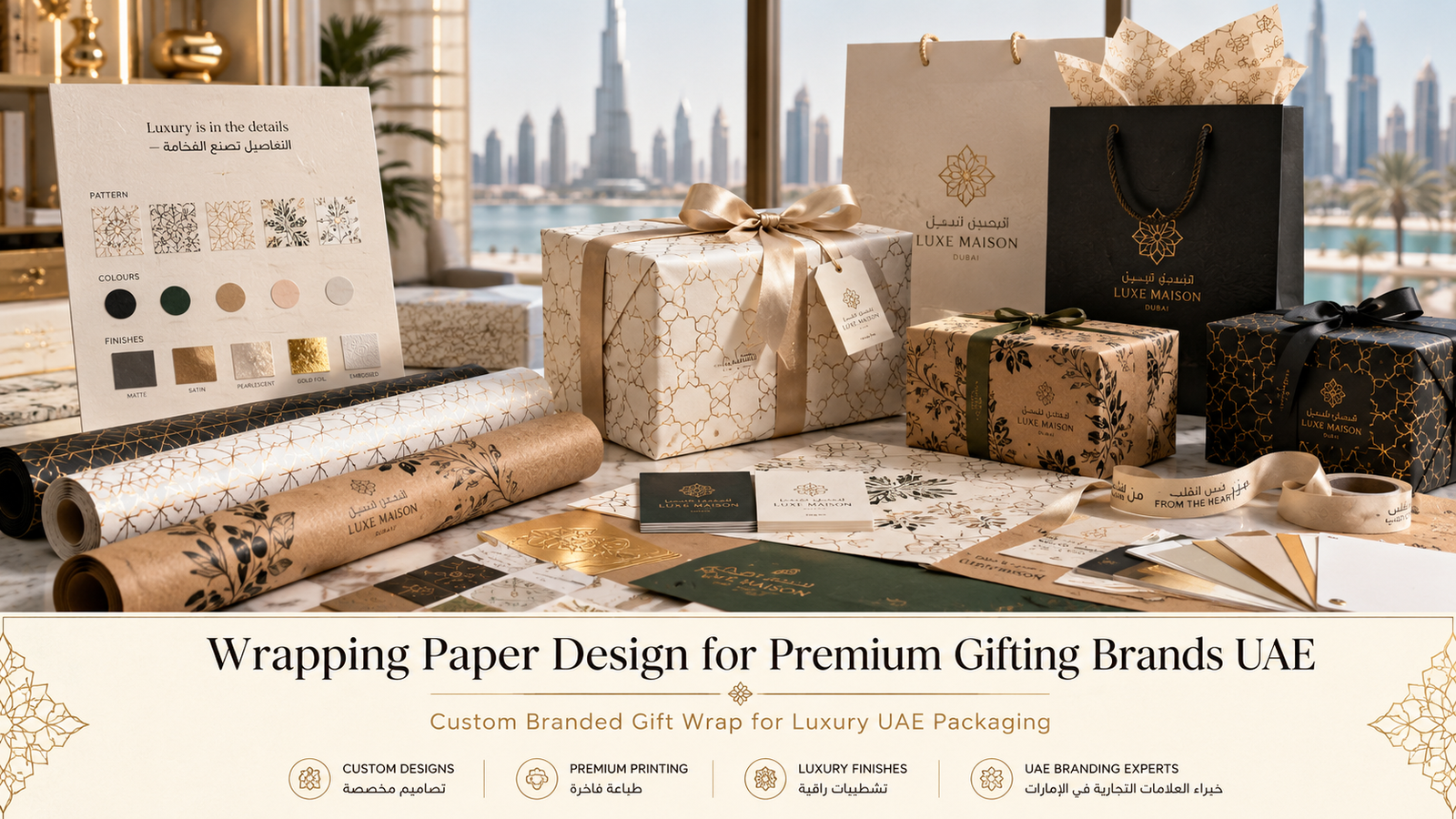
The product wrapping layer — branded tissue paper, custom-printed wrapping paper, branded wax-paper, or sustainable kraft wrapping with the brand’s pattern or messaging. The wrapping handles the practical function of protecting the product while reinforcing the brand identity at the layer the customer interacts with most directly. Custom wrapping paper printing workflows handle branded wrapping production across volumes and material options.
Layer 4 — Inserts and personalisation
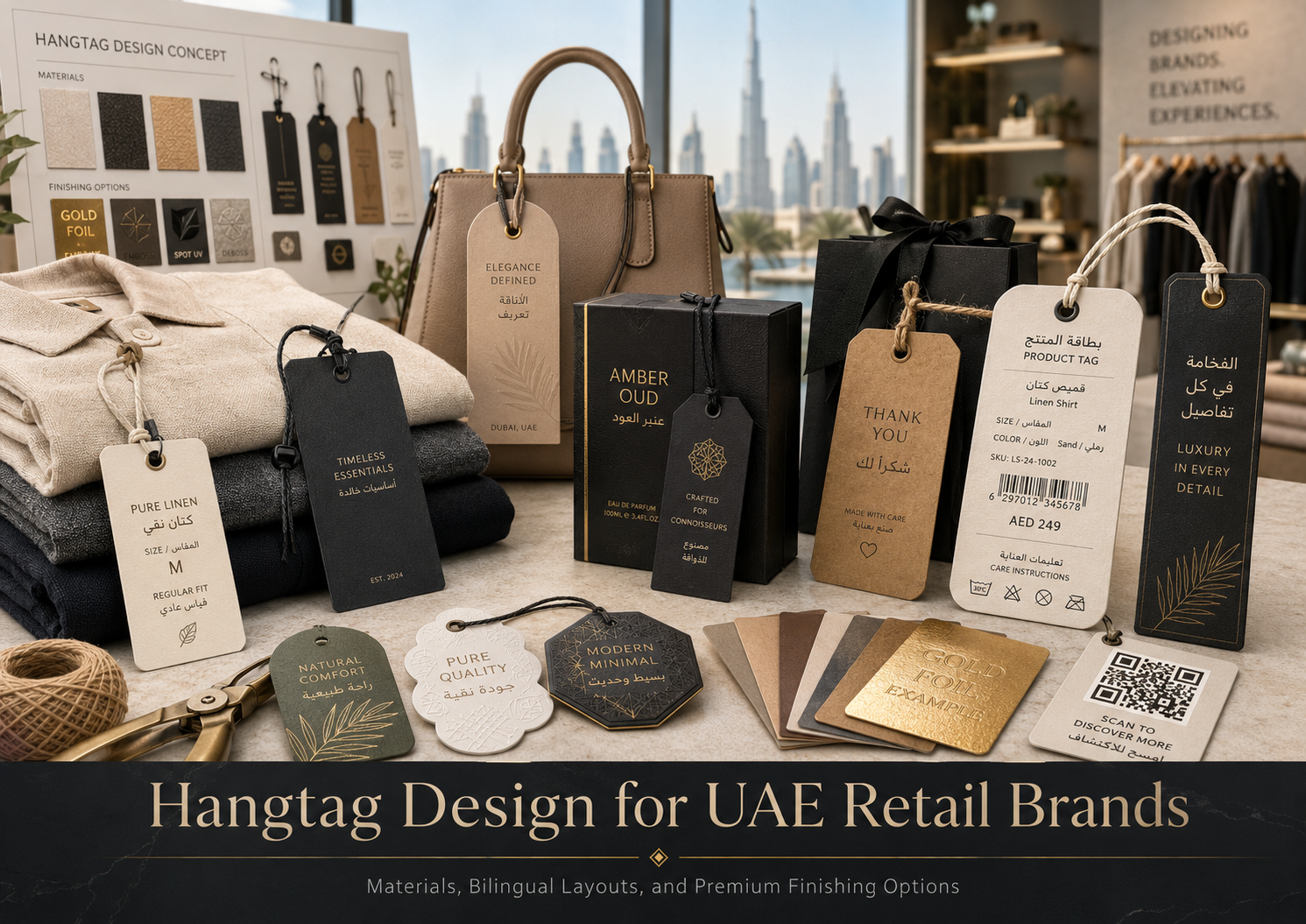
The brand-voice moment — thank-you cards, personalised notes with the customer’s first name, product care cards, review-request cards, social-follow cards, discount codes for next purchase. The insert layer is where the brand speaks to the customer directly; this is the highest-ROI single brand-building investment in unboxing design.
Layer 5 — Product presentation
The product reveal itself — the way the product sits within the package, the protective elements (custom foam inserts, recycled paper void fill, sustainable bubble wrap alternatives), and the final presentation register. Premium brands invest in product-shaped inserts that present the product like a curated display rather than packing it like a commodity.
Material Selection for UAE Unboxing Programmes
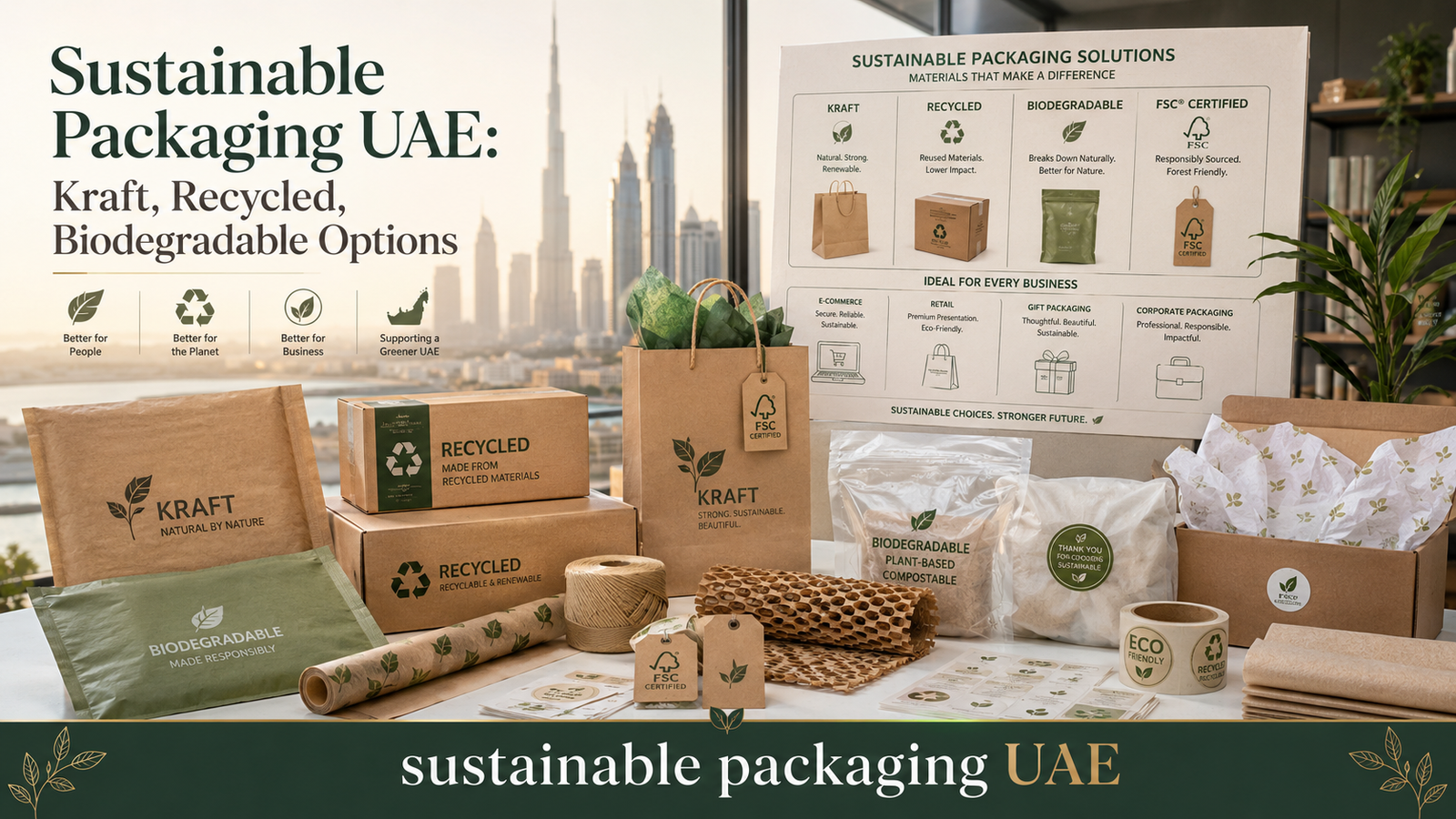
UAE unboxing programmes select materials across four register tiers. Premium tier: rigid box construction, magnetic closures, premium textured papers, embossed and foil-stamped detailing, luxe tissue paper interleaving. Per-unit cost AED 25–80+. Reserved for premium D2C brands, luxury gifts, and senior corporate gift programmes where the unboxing register matches the product premium. Premium-mid tier: high-quality corrugate or rigid construction with quality printing, custom tissue, branded inserts, premium tape or seal. Per-unit cost AED 10–25. The dominant tier for serious UAE D2C brands. Standard tier: branded corrugate boxes with one-colour or two-colour print, basic tissue interleaving, simple branded insert. Per-unit cost AED 4–10. Suitable for high-volume D2C programmes where unit economics constrain premium investment. Sustainable tier: kraft paper, recycled corrugate, sustainable inks, biodegradable void fill, FSC-certified materials. Per-unit cost AED 8–20. For ESG-positioned brands where sustainability is part of the brand identity. The custom packaging printing workflows handle all four tiers at production scale across UAE-domestic and GCC cross-border programmes.
Sensory Design Beyond Visual
Premium unboxing design considers four sensory dimensions, not just visual. Tactile: the materials feel — textured papers, soft-touch coatings, embossed surfaces, premium card stocks. The hand-feel of premium packaging communicates brand quality before the customer registers the visual register consciously. Auditory: the sound of opening — the satisfying tear of premium tape, the gentle rustle of quality tissue, the soft thump of a rigid box opening. Cheap packaging makes cheap sounds; premium packaging design considers the auditory register. Olfactory: some premium brands integrate subtle scent — light perfumed inserts, scented tissue paper, or product-relevant fragrance integration (rose petals for beauty brands, subtle cedar for premium leather goods). Restraint matters — overpowering scent reads as performative. Kinesthetic: the motion of unboxing — the deliberate sequence of unwrapping, the layers that reveal progressively. Well-designed unboxing extends the engagement moment from 5 seconds (rip open, grab product) to 30–60 seconds (deliberate sequential reveal).
Bilingual EN+AR Considerations for UAE Unboxing
UAE D2C brands serving regional customers integrate bilingual EN+AR thoughtfully across the unboxing layers. Outer packaging: brand name often bilingual EN+AR if the brand identity is locally rooted; or English-dominant for cosmopolitan-positioned brands. Inserts: bilingual EN+AR thank-you messages and care instructions reach the full UAE customer base. Modern Arabic and Naskh are the most-used Arabic styles for D2C inserts (professional and contemporary); Diwani too ornate for everyday D2C. Cross-cultural acknowledgment: for UAE’s diverse customer base (Emirati, expat Arab, Indian, Pakistani, Filipino, Western expat), unboxing design that acknowledges the diversity through tasteful design — without trying to be everything to everyone — works. Every Arabic layout is reviewed by a typography specialist before production.
Instagram and TikTok-Optimised Unboxing
Brands designing for social-media-native unboxing optimise across three dimensions. Visual contrast: packaging that’s visually distinctive at low resolution (the way it renders on a phone screen, not just in studio photography) — high-contrast typography, recognizable brand colours, distinctive shape proportions. Reveal pacing: the unboxing should reveal the brand identity progressively rather than all at once — the outer box hint, the inner reveal, the product moment. This produces the 60–90 second unboxing video arc that performs on social. “Worth filming” register: the design quality threshold below which customers don’t film. Generic packaging doesn’t get filmed; premium packaging with distinctive design quality does. The line is reasonably specific — investment matters at the right register.
Common Unboxing Design Mistakes
Four mistakes recur in first-iteration unboxing programmes. Over-investing in outer at the expense of inner: branded shipping boxes with generic plain interior misses the layered reveal. The interior register matters more than the exterior for the customer’s emotional registration. Information density on inserts: cramming too much copy onto small insert surfaces. Restraint produces stronger inserts than information density. Brand-voice mismatch: packaging design that feels disconnected from the brand’s website, product, and marketing register. Unboxing should reinforce the broader brand identity coherently, not introduce a new register at the package layer. Single-iteration design: launching the first unboxing design without planning for iteration based on customer response. The first version should be designed for measurement — review feedback, social-media sharing rates, repeat-purchase data — with iteration informed by what the data shows.
UAE Cross-Border Considerations for Unboxing
For UAE D2C brands shipping cross-border to GCC, additional considerations apply. Customs durability: packaging must survive customs handling including inspection that may involve opening and resealing. Tamper-evident seals can signal a brand quality issue if resealing shows; design for re-sealability and inspection-friendly access. Shipping cost: volumetric weight matters disproportionately on cross-border lanes; premium rigid boxes generate high volumetric weight, so balance unboxing premium against shipping unit economics. GCC register variations: Saudi expectations sit slightly more traditional than UAE; Bahrain and Kuwait closer to UAE; Oman marginally more traditional. Brands operating regionally may need register variations across markets.
Order Yours Today
Design UAE unboxing experiences that drive review rate, social sharing, and brand loyalty measurably.
Five-layer unboxing programmes (outer shipping, reveal, wrapping, inserts, product presentation), premium-to-sustainable material tiers, sensory design beyond visual, Instagram/TikTok-optimised reveals, bilingual EN+AR inserts — UAE-domestic and GCC cross-border production at scale.
Same-day Dubai delivery for orders placed before 11am (12pm for UV-printed items). UAE-wide delivery 1–3 business days. GCC cross-border 7–14 days. Order via WhatsApp or our online form.
Frequently Asked Questions About Unboxing Experience Design
What are the five component layers of unboxing experience design?
Layer 1 (outer shipping packaging) — branded shipping boxes with logo and brand identity. Layer 2 (box opening reveal) — tissue paper, custom inner liner, branded sticker seal, or printed tape creating a deliberate reveal moment. Layer 3 (custom wrapping) — branded tissue, custom wrapping paper, or sustainable kraft wrapping for the product. Layer 4 (inserts and personalisation) — thank-you cards, personalised notes, product care, review-request, social-follow cards. Layer 5 (product presentation) — how the product sits within the package, protective inserts, the final reveal register.
How much should I invest per unit in unboxing design?
Premium tier (rigid boxes, premium materials, foil stamping): AED 25–80+ per unit, reserved for luxury and senior corporate gift programmes. Premium-mid tier (high-quality corrugate, custom tissue, branded inserts): AED 10–25 per unit, the dominant tier for serious UAE D2C brands. Standard tier (branded corrugate with simple print, basic tissue): AED 4–10 per unit, suitable for high-volume D2C. Sustainable tier (kraft, recycled, FSC materials): AED 8–20 per unit for ESG-positioned brands.
Does unboxing design actually drive measurable business outcomes?
Yes. Thoughtful unboxing drives review rate (often 2–3× the rate of generic packaging), repeat-purchase rate, social-media sharing rate, and word-of-mouth referrals measurably. The unboxing moment is the peak positive emotional engagement with the brand — impressions formed at this moment carry disproportionate weight. Per-unit marginal cost of AED 5–25 typically delivers positive ROI within the first repeat-purchase cycle for D2C brands.
Should UAE unboxing use bilingual EN+AR personalisation?
Yes for UAE D2C brands serving regional customers, integrated thoughtfully across the unboxing layers. Bilingual EN+AR thank-you messages and care instructions on inserts reach the full UAE customer base. Brand name often bilingual EN+AR if locally rooted; English-dominant for cosmopolitan-positioned brands. Modern Arabic and Naskh are the most-used Arabic styles for D2C inserts (professional and contemporary); Diwani too ornate for everyday D2C contexts. Every Arabic layout reviewed by typography specialist.
How do I design unboxing for Instagram and TikTok?
Three optimisation dimensions. Visual contrast: packaging visually distinctive at low resolution (phone screen, not studio photography) — high-contrast typography, recognizable brand colours, distinctive shape proportions. Reveal pacing: the unboxing reveals brand identity progressively rather than all at once — outer box hint, inner reveal, product moment, producing the 60–90 second unboxing video arc that performs on social. ‘Worth filming’ register: design quality threshold above which customers actually film and share.
What are the most common unboxing design mistakes to avoid?
Four recur. Over-investing in outer at the expense of inner — branded shipping boxes with generic plain interior misses the layered reveal. Information density on inserts — cramming too much copy onto small surfaces; restraint produces stronger inserts. Brand-voice mismatch — packaging design feels disconnected from website, product, and marketing register. Single-iteration design — launching the first version without planning for iteration based on review feedback, social-sharing data, and repeat-purchase metrics.
Should I include sensory considerations beyond visual in unboxing design?
Yes, premium unboxing considers four sensory dimensions. Tactile: textured papers, soft-touch coatings, embossed surfaces communicate quality before visual register registers consciously. Auditory: the sound of opening — premium tape tear, quality tissue rustle, rigid box thump. Olfactory: subtle scent integration in some categories (light perfumed inserts, scented tissue) with restraint. Kinesthetic: the motion of unboxing — deliberate sequence of unwrapping extending engagement from 5 seconds to 30–60 seconds.
What changes for cross-border GCC unboxing programmes?
Three considerations. Customs durability: packaging must survive customs handling including potential inspection opening and resealing; tamper-evident seals can signal brand quality issues if the package shows resealing. Cross-border shipping costs: volumetric weight matters disproportionately on GCC cross-border lanes; premium rigid boxes generate high volumetric weight. GCC market register variations: Saudi register sits slightly more traditional than UAE; Bahrain and Kuwait closer to UAE; Oman tilts marginally more traditional. Brands operating regionally may need register variations across markets.