Wedding Personalisation: Choosing Fonts, Colours, and Layouts
Wedding personalisation design — the choice of fonts, colour palettes, and layout principles that shape wedding favours, wedding gifts, wedding signage, and broader wedding stationery — sits at the substantive intersection of cultural-context register, couple-personal preference, and venue-and-theme coherence. UAE wedding personalisation programmes navigate substantially distinct cultural-context registers: Khaleeji and Arab Muslim weddings with Arabic-primary calligraphic register, Filipino Catholic weddings with substantial family-celebration design register, Indian weddings across Hindu, Sikh, Christian, and Muslim sub-community contexts each with distinct cultural design language, Western weddings with broader cosmopolitan design conventions. This guide covers font selection principles across cultural contexts, colour palette frameworks for wedding contexts, layout principles that anchor effective wedding personalisation, bilingual EN+AR design conventions, and the practical UAE production considerations across each design dimension.
Font Selection Principles
Khaleeji and Arab Muslim wedding contexts
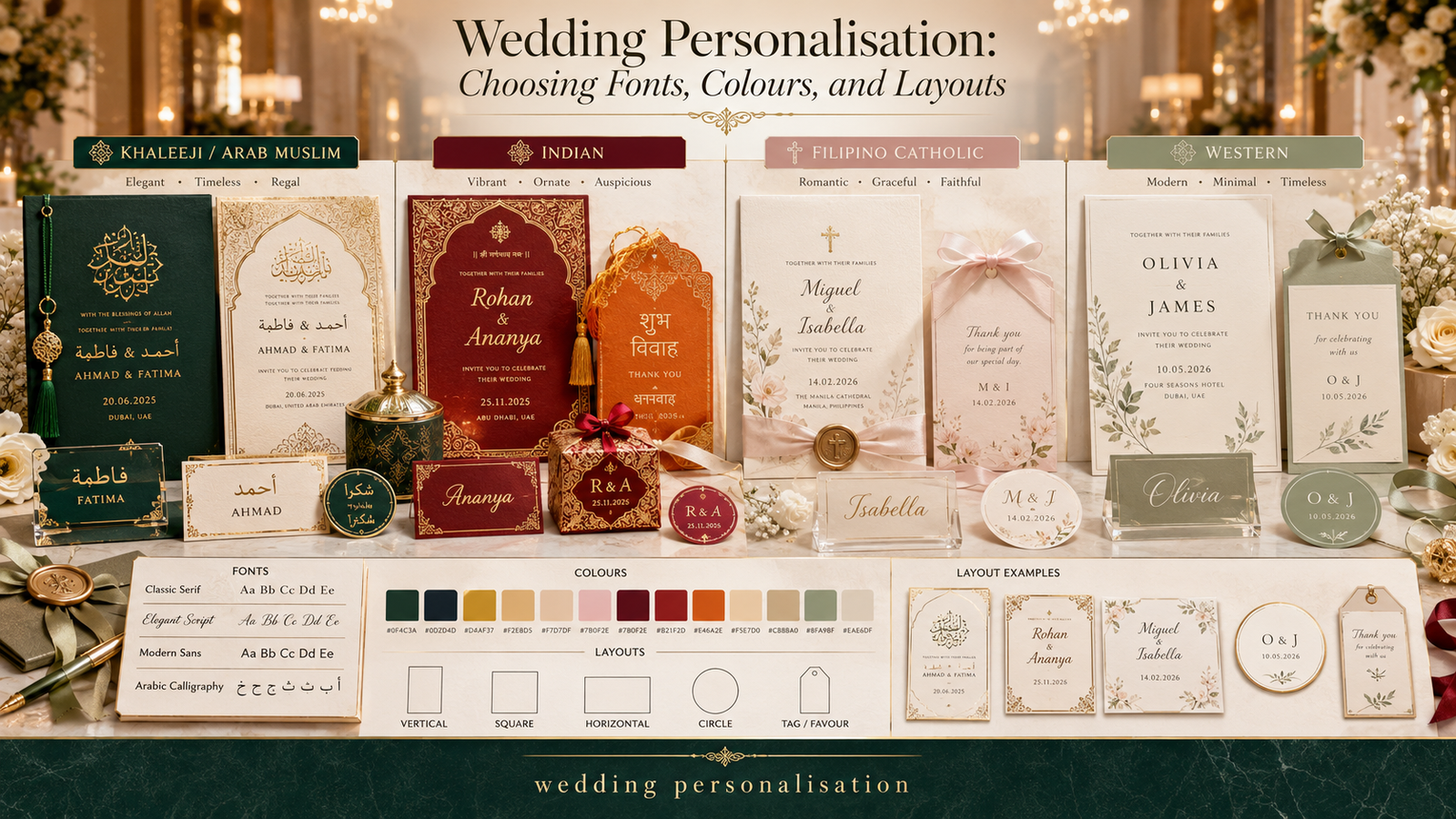
Arabic typography sits at the substantive personalisation register for Khaleeji weddings. Diwani: the ornate flowing calligraphic style — earns selection for senior-recipient, ceremonial, and substantive celebration-register favours and gifts. The script’s ornate flourishes carry substantive cultural depth matching the gravitas of senior-family Khaleeji weddings. Thuluth: the historic-classical calligraphic style — reserved for heirloom-tier and substantively-religious gifts where the historic-calligraphic register adds substantive cultural depth (milcha gifts particularly). Naskh: the everyday Arabic typography style — works across everyday wedding favour personalisation, broader wedding stationery, and contemporary Khaleeji wedding contexts where Diwani’s ornate register isn’t appropriate. Modern Arabic fonts: contemporary Arabic display typography (Tajawal, Cairo, Dubai Font in some contexts) for cosmopolitan modern-Khaleeji wedding contexts where the design integrates contemporary Arab cultural register rather than traditional calligraphic register.
Filipino Catholic wedding contexts
Filipino Catholic wedding font selection emphasises elegant family-celebration design register. Classical serif fonts: traditional serif typography (Garamond, Baskerville, Cormorant) for traditional family-celebration register. Elegant script fonts: elegant calligraphic-style scripts (Allura, Great Vibes, Pinyon Script, Lobster) for romantic celebration register on wedding favours and stationery. Modern sans-serif: contemporary sans-serif typography (Montserrat, Playfair Display headings, modern wedding-stationery sans-serif) for contemporary Filipino-Catholic wedding contexts.
Indian wedding contexts (across sub-communities)
Indian wedding font selection varies substantially by sub-community context. Devanagari (for Hindu wedding contexts): traditional Devanagari typography for Hindu wedding personalisation incorporating Sanskrit-tradition design register; modern Devanagari for contemporary Hindu wedding contexts. Gurmukhi (for Sikh wedding contexts): traditional Gurmukhi typography for Sikh wedding personalisation. Tamil, Telugu, Malayalam, Kannada, Bengali (for regional South Indian and East Indian contexts): regional script typography for regional-tradition wedding personalisation. English typography: Indian-cultural English typography (Mukta, Hind, Poppins for everyday register; Cinzel, Cormorant for traditional ceremonial register) for English-language elements alongside regional scripts.
Western wedding contexts
Western wedding font selection emphasises broader cosmopolitan wedding design conventions. Classical serif and script combinations: the traditional Western wedding stationery convention pairing an elegant serif (Cormorant, Playfair Display, Garamond) with an elegant script (Allura, Great Vibes, Pinyon Script) for romantic register. Modern minimalist typography: contemporary sans-serif typography (Inter, Montserrat, modern sans-serif weighted hierarchically) for contemporary minimalist Western wedding contexts. Vintage and themed typography: themed typography matching specific wedding themes (vintage Art Deco, rustic farmhouse, contemporary luxury) for themed Western wedding programmes. The wedding favours UAE range covers favour categories across all four cultural-context contexts.
Colour Palette Frameworks
Three frameworks anchor wedding colour palette selection. Cultural-register-anchored palettes: traditional Khaleeji wedding palettes emphasise gold, deep blue, emerald green, and traditional Arab cultural-register palette colours; traditional Hindu wedding palettes emphasise red, orange, gold, and traditional Indian-cultural palette colours; traditional Filipino Catholic wedding palettes emphasise white-and-ivory with accent colours (often blush pink, soft blue, or champagne gold); traditional Western wedding palettes vary widely across white-and-blush, sage green, navy blue, burgundy, terracotta, and broader contemporary palette directions. Venue-coherent palettes: wedding personalisation palettes coordinate with venue design — premium UAE venue contexts (Burj Al Arab, Atlantis, Madinat Jumeirah, Ritz Carlton, Bvlgari, Address) each have distinct architectural-and-design register that the wedding personalisation palette should complement. Couple-personal palettes: couple-personal palette preferences override cultural-and-venue defaults where the couple has substantive design preferences — wedding personalisation reflects the couple’s substantive personality rather than imposing cultural-default palettes onto couples preferring distinct directions.
Layout Principles for Wedding Personalisation
Five layout principles anchor effective wedding personalisation design. Hierarchy: couple names and wedding date as primary visual elements, secondary elements (venue name, time, additional details) as clear secondary hierarchy, decorative elements as tertiary. Bilingual layout coordination: for bilingual EN+AR wedding personalisation, the Arabic and English elements coordinate hierarchically — Arabic-primary contexts place Arabic as the substantive hierarchical primary with English secondary; English-primary contexts reverse the relationship. Whitespace and breathing room: premium wedding personalisation uses generous whitespace and breathing room around primary elements — design density compromises the substantive premium register of wedding personalisation. Decorative element restraint: decorative motifs (floral elements, geometric patterns, cultural-tradition design language) integrate as supporting elements rather than competing with primary information. Production-format awareness: layout principles adapt to production format — square photo print, vertical place card, horizontal wedding favour, circular sticker each warrant distinct layout treatment matching the format substrate.
Bilingual EN+AR Design Conventions
UAE wedding personalisation programmes frequently integrate bilingual EN+AR design. Reading direction coordination: Arabic reads right-to-left, English reads left-to-right — bilingual layouts coordinate so each language reads naturally in its reading direction without forced reversal. Hierarchical primary selection: Khaleeji wedding contexts default to Arabic-primary hierarchy; cosmopolitan UAE wedding contexts may operate at English-primary with Arabic secondary; couple-personal preference overrides default. Typography coordination: the Arabic and English typography selections coordinate visually — Diwani Arabic paired with classical English serif; modern Arabic paired with contemporary English sans-serif; traditional Naskh paired with classical English typography. Date format coordination: Gregorian date in English, Hijri date in Arabic alongside or as alternative — couple preference shapes the decision. The wedding favours Saudi Arabia programmes operate at Arabic-primary register; broader UAE wedding programmes operate at English-primary or balanced bilingual register depending on couple context.
Production Considerations
Wedding personalisation design anticipates production constraints. Print method limitations: digital UV printing handles full-colour designs with photo-realistic reproduction including fine typography; offset printing handles substantial volumes economically but warrants design-for-offset considerations (pantone colour limits, fine-detail considerations); screen printing handles 1-3 colour designs at substantial volumes; foil stamping adds metallic elements at premium register. Substrate considerations: wedding favour substrates (premium card stock, premium paper, premium fabric, premium ceramic, premium wood) each receive ink differently and warrant substrate-specific design treatment. Minimum production sizes: typography below 6-8pt warrants production-method consideration for legibility; complex decorative elements warrant print-resolution consideration. Cultural-register production review: Arabic typography layouts undergo cultural-register review by typography specialists with relevant cultural-context awareness before production. The wedding gifts UAE broader range integrates wedding personalisation across favour and gift production.
Order Yours Today
Design UAE wedding personalisation programmes with the right fonts, colours, and layouts for cultural-context, venue, and couple register.
Khaleeji (Diwani, Thuluth, Naskh, modern Arabic), Filipino Catholic (classical serif, elegant script, modern sans-serif), Indian (Devanagari, Gurmukhi, regional scripts), Western (serif and script pairings, modern minimalist, themed typography), cultural and venue-coherent colour palettes, hierarchical layout principles, bilingual EN+AR design conventions, production-aware design decisions.
Same-day Dubai delivery for orders placed before 11am (12pm for UV-printed items). UAE-wide delivery 1–3 business days. GCC cross-border 7–14 days. Order via WhatsApp or our online form.
Frequently Asked Questions About Wedding Personalisation Guide
What Arabic fonts work best for Khaleeji wedding personalisation?
Arabic typography sits at substantive personalisation register for Khaleeji weddings. Diwani for senior-recipient, ceremonial, and substantive celebration-register favours and gifts — the ornate flowing calligraphic style carries cultural depth matching senior-family weddings. Thuluth for heirloom-tier and substantively-religious gifts (milcha gifts particularly) where the historic-calligraphic register adds depth. Naskh for everyday wedding favour personalisation, broader wedding stationery, and contemporary Khaleeji wedding contexts. Modern Arabic fonts (Tajawal, Cairo, Dubai Font) for cosmopolitan modern-Khaleeji wedding contexts integrating contemporary register rather than traditional calligraphic register.
How should colour palettes be selected for UAE multicultural weddings?
Three frameworks anchor selection. Cultural-register-anchored palettes draw from cultural tradition: Khaleeji palettes (gold, deep blue, emerald green, traditional Arab register), Hindu palettes (red, orange, gold, Indian-cultural register), Filipino Catholic palettes (white-ivory with blush pink, soft blue, or champagne gold accents), Western palettes (white-and-blush, sage green, navy, burgundy, terracotta, broader contemporary directions). Venue-coherent palettes coordinate with venue design — premium UAE venues each have distinct architectural register that personalisation should complement. Couple-personal palettes override cultural-and-venue defaults where couples have substantive design preferences.
What layout principles work for wedding favour personalisation?
Five principles anchor wedding personalisation design. Hierarchy: couple names and wedding date as primary visual elements, secondary elements (venue, time, additional details) as clear secondary hierarchy, decorative elements tertiary. Bilingual layout coordination for EN+AR personalisation places one language as substantive hierarchical primary. Whitespace and breathing room around primary elements support premium register. Decorative element restraint integrates motifs as supporting elements rather than competing with primary information. Production-format awareness adapts layout to format (square print, vertical place card, horizontal favour, circular sticker each warrant distinct treatment).
Should wedding personalisation use Hijri or Gregorian dates?
Both can work — selection varies by couple preference and cultural-context. For substantively-traditional Khaleeji weddings (senior-family weddings, religious-traditional family contexts, traditional Bedouin-heritage family contexts), Hijri Islamic calendar date sits at substantive cultural-respect register. For cosmopolitan UAE-Khaleeji wedding contexts and broader-cultural wedding contexts, Gregorian calendar dates work at standard register. Some wedding personalisation integrates both — Hijri date primary with Gregorian secondary in coordinated layouts, or Gregorian primary with Hijri secondary. The decision varies by family preference; senior-family Khaleeji contexts often favour Hijri primary.
How should bilingual EN+AR wedding personalisation be designed?
Four conventions anchor bilingual EN+AR wedding design. Reading direction coordination: Arabic reads right-to-left, English reads left-to-right — bilingual layouts coordinate so each language reads naturally in its reading direction. Hierarchical primary selection: Khaleeji contexts default to Arabic-primary hierarchy; cosmopolitan UAE contexts may operate at English-primary with Arabic secondary; couple preference overrides default. Typography coordination: Arabic and English selections coordinate visually (Diwani paired with classical English serif; modern Arabic paired with contemporary sans-serif). Date format coordination: Gregorian English alongside or as alternative to Hijri Arabic, couple preference shaping the decision.
What font styles work for Filipino Catholic weddings in UAE?
Three font categories work for Filipino Catholic weddings. Classical serif fonts (Garamond, Baskerville, Cormorant) for traditional family-celebration register. Elegant script fonts (Allura, Great Vibes, Pinyon Script, Lobster) for romantic celebration register on wedding favours and stationery. Modern sans-serif typography (Montserrat, Playfair Display headings, modern wedding-stationery sans-serif) for contemporary Filipino-Catholic wedding contexts. The font selection coordinates with the wedding theme — traditional family-celebration weddings favour classical serif with elegant script; contemporary weddings favour modern sans-serif paired with selective elegant script for couple names and headings.
How do Indian wedding personalisation fonts vary by sub-community?
Indian wedding font selection varies substantially by sub-community context. Devanagari typography for Hindu wedding personalisation incorporating Sanskrit-tradition design register (traditional Devanagari for traditional contexts; modern Devanagari for contemporary contexts). Gurmukhi typography for Sikh wedding personalisation. Tamil, Telugu, Malayalam, Kannada, Bengali typography for regional South Indian and East Indian contexts. English typography alongside regional scripts: Indian-cultural English typography (Mukta, Hind, Poppins for everyday register; Cinzel, Cormorant for traditional ceremonial register). Each sub-community wedding warrants script-and-typography selection appropriate to the cultural-context register.
What production considerations should wedding personalisation design account for?
Four production considerations anchor wedding personalisation design. Print method limitations: UV digital handles full-colour photo-realistic reproduction including fine typography; offset prints substantial volumes economically with design-for-offset considerations; screen printing handles 1-3 colour designs at substantial volumes; foil stamping adds metallic elements. Substrate considerations: premium card stock, paper, fabric, ceramic, wood each receive ink differently and warrant substrate-specific design treatment. Minimum production sizes: typography below 6-8pt warrants production-method consideration; complex decorative elements warrant print-resolution consideration. Cultural-register production review: Arabic typography layouts undergo cultural-register review before production.