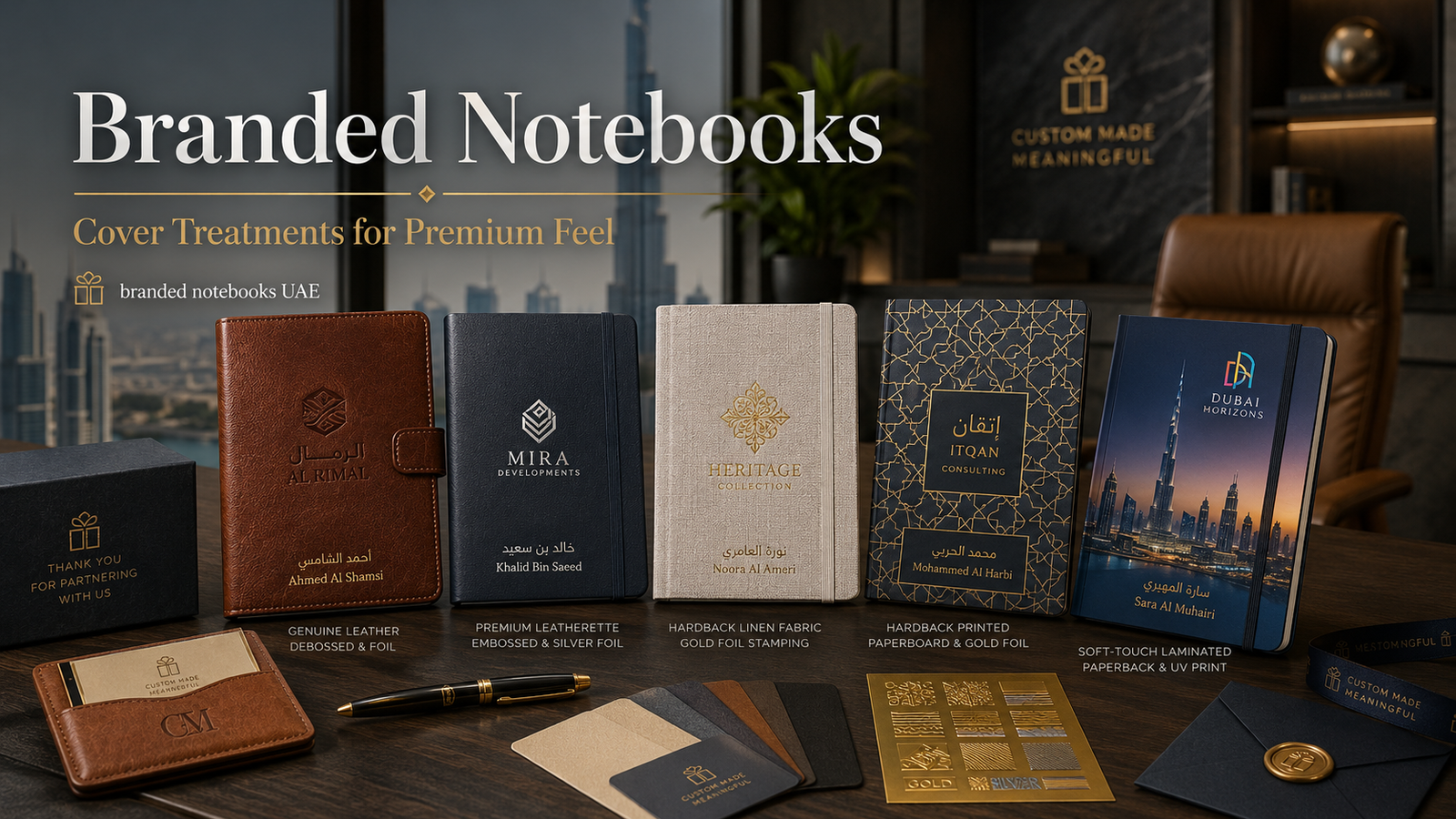
Branded Notebooks: Cover Treatments for Premium Feel
The branded notebook is the workhorse of UAE corporate gifting — a piece that survives the drawer test better than 90% of promotional categories because it slots into a routine the recipient already has. But the gap between a forgettable AED 25 branded notebook and a premium AED 200 piece that gets used daily for a year is almost entirely in the cover. Print quality on the inside pages is broadly the same across price tiers; the cover treatment is what signals quality, what determines whether the notebook gets carried into client meetings, and what justifies a per-piece spend that returns brand impressions for twelve months. This guide covers the cover treatments available in 2026, how each is produced, and which fits which corporate context.
Why Cover Treatment Matters More Than You Think
A branded notebook spends 95% of its life closed — on a desk, in a bag, in a meeting. The recipient sees the cover dozens of times a day; the inside pages get used but not visually evaluated. The cover, therefore, is the entire brand-impression surface. A leather-cover notebook with restrained embossing reads as senior-tier even when the inside paper is ordinary. A laminated paperback cover reads as procurement-tier even when the inside paper is premium 100gsm. Choose the cover treatment to match the recipient’s context, not the budget remaining after inside-page costs.
Cover Treatment Options
Leather (or premium leatherette)
Genuine leather covers with embossed or debossed branding sit at the top of the corporate notebook tier. Real leather develops a patina with daily use that adds rather than detracts. Leatherette (high-grade synthetic leather) achieves 80% of the visual effect at 40% of the cost and is the practical workhorse for most corporate runs. Both take embossing, debossing, and UV print cleanly. Bulk minimum 25 pieces. Price tier AED 80–250 per piece at bulk.
Hardback fabric (linen, cotton, canvas)
Premium hardback covers wrapped in fabric — linen, cotton blend, or heavyweight canvas — read as design-conscious and craft-aware. Particularly effective for creative-industry recipients (agencies, design firms, architecture practices). Foil-stamped or screen-printed branding works best on fabric covers; UV print also works on tighter-weave fabrics. Bulk minimum 25 pieces. Price tier AED 60–180 per piece.
Hardback printed paperboard
Full-cover printed hardback notebooks where the cover graphic wraps the entire surface. Highest visual impact for branded campaigns where the cover artwork is part of the gift. Best for product launches, recognition programs, and event swag where the brand statement is the point. Bulk minimum 50 pieces. Price tier AED 40–120 per piece.
Soft-touch laminated paperback
Standard paperback covers with soft-touch lamination give a tactile, slightly velvety finish that lifts perceived quality. Cost-effective for high-volume runs where leather or fabric is outside budget but procurement-tier impressions are unacceptable. Bulk minimum 100 pieces. Price tier AED 18–40 per piece.
Branding Methods on Cover Treatments
Embossed (raised) and debossed (recessed) branding
Both are pressure-and-die treatments — embossing pushes the design out of the surface, debossing presses it in. Both signal premium without colour. Pairs naturally with leather, leatherette, and fabric covers. Standard for senior-tier corporate runs. Setup is per-design rather than per-piece, so unit cost compresses heavily on runs above 50 pieces.
Foil stamping
Heat-pressed metallic foil — gold, silver, rose gold, copper, or matte coloured foils — applied to the cover. Lifts brand-colour fidelity meaningfully on dark covers where ink can disappear. Most associated with anniversary editions, awards ceremonies, and senior recognition pieces.
UV print
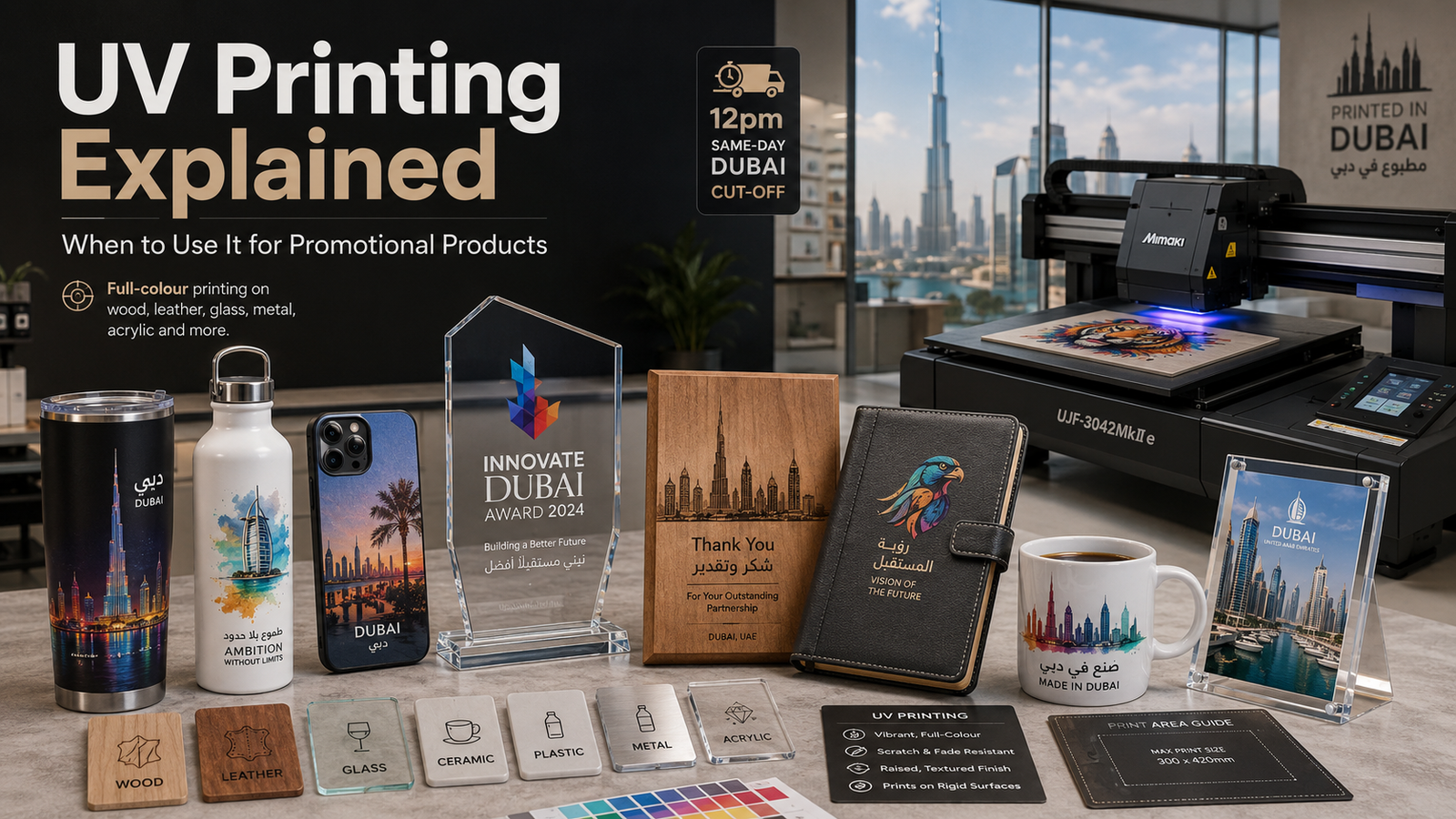
UV printing on notebook covers handles full-colour photographic detail and works on hardback paperboard, leatherette, and tight-weave fabric. Particularly useful for cover-wrap branding where the design is the cover rather than a small applied logo. Standard for product-launch and event-swag runs.
Screen print
Screen printing handles spot-colour branding on fabric and paperboard covers economically at high volumes. Less premium-feeling than embossing or foil but cost-effective for 200+ piece runs. Standard for conference and event giveaways.
Bilingual Name Embossing — The Detail That Lifts Personalised Notebooks
Adding the recipient’s name to a corporate notebook cover — bilingual EN+AR, embossed or UV-printed — is the cheapest single intervention to lift survival rates. Personalised notebooks are 3–4× more likely to be used daily than logo-only equivalents. The personalised notebook range supports embossed bilingual names on leather and leatherette covers, with Naskh and Modern Arabic as the most-picked Arabic styles for corporate registers. Diwani for ceremonial pieces (long-service awards, milestone recognition); Naskh for traditional registers; Modern Arabic for contemporary. Every Arabic layout is reviewed by a typography specialist before production.
Inside Page Choices That Actually Matter
While covers carry most of the impression, three inside-page choices noticeably affect daily-use quality. Paper weight: 100gsm is the floor for premium; 80gsm is acceptable for mid-tier; below 80gsm bleeds with most pens. Ruling: dot grid is increasingly preferred over lined for design-aware recipients; lined remains the default for general corporate. Binding: sewn binding lays flat without breaking the spine; perfect-bound is acceptable for thinner notebooks; spiral is a different category entirely. For the broader stationery range, see office stationery printing.
Specifying By Recipient Role
The cover treatment that fits depends on who is receiving the notebook. Senior executives and C-suite recipients: embossed leather or leatherette is the default, with foil-stamped name on the cover for premium recognition pieces. AED 180–280 per piece. Senior managers and team leads: hardback fabric with embossed bilingual name, or leatherette with debossed name, in the AED 80–180 tier. Junior team and conference attendees: soft-touch laminated paperback with screen-printed branding works at the AED 18–40 tier without reading as cheap. Client gifts (cross-tier): default to leather or leatherette regardless of the client’s seniority — client gifts get visible attention from the entire receiving team, so the cover should anchor at the senior tier.
Same-Day Dubai and Production Lead Times
Lead times for branded notebooks vary by treatment. Embossed leather/leatherette runs of 50–200 pieces: 7–10 working days. Foil-stamped hardback runs of 50–200 pieces: 5–7 working days. UV-printed hardback runs: 3–5 working days. Soft-touch laminated paperback runs: 5–7 working days. Same-day Dubai delivery is available for stock notebooks with screen-printed or UV-printed branding (12pm cut-off for UV) when the cover treatment is already prepared and only the branding needs application. There is no minimum order for sample pieces; bulk pricing applies from 25 pieces (leather/leatherette/fabric), 50 pieces (hardback paperboard), and 100 pieces (soft-touch paperback). UAE-wide delivery 1–3 business days; GCC cross-border 7–14 days.
Order Yours Today
Pick the cover treatment that matches the recipient — and the brand impression you want to make.
Leather, leatherette, hardback fabric, foil stamping, UV print, embossed bilingual names — bulk runs from 25 pieces with no setup penalty for personalisation.
Same-day Dubai delivery for orders placed before 11am (12pm for UV-printed items). UAE-wide delivery 1–3 business days. GCC cross-border 7–14 days. Order via WhatsApp or our online form.
Frequently Asked Questions About Branded Notebooks UAE
What is the most premium cover treatment for a branded notebook?
Genuine leather with embossed branding sits at the top tier. Leatherette (premium synthetic leather) achieves around 80% of the visual effect at roughly 40% of the cost and is the practical choice for most corporate runs of 25–200 pieces. Both take embossing, debossing, and UV print cleanly.
What is the difference between embossing and debossing?
Both are pressure-and-die treatments. Embossing pushes the design out of the surface (raised); debossing presses it in (recessed). Both signal premium without using colour. Debossing is slightly more contemporary; embossing is more traditional. Both pair naturally with leather, leatherette, and fabric covers.
Can I add the recipient’s name to each branded notebook?
Yes — variable-data personalisation places each recipient’s name on each cover (embossed or UV-printed) without setup penalty for runs above 25 pieces. Personalised notebooks are 3–4× more likely to be used daily than logo-only equivalents.
What is the bulk minimum for branded notebooks?
25 pieces for leather, leatherette, and fabric covers. 50 pieces for hardback printed paperboard. 100 pieces for soft-touch laminated paperback. Sample-tier single pieces are produced at standard rates without setup penalty.
How long does production take for 100 branded notebooks?
7–10 working days for embossed leather/leatherette. 5–7 days for foil-stamped hardback. 3–5 days for UV-printed hardback. 5–7 days for soft-touch laminated paperback.
Can I get bilingual EN+AR names on notebook covers?
Yes — bilingual EN+AR name embossing is the default offering. Naskh and Modern Arabic are the most-picked Arabic styles for corporate notebook covers; Diwani for ceremonial pieces. Every Arabic layout is reviewed by a typography specialist before production.
What paper weight should I specify for premium branded notebooks?
100gsm is the floor for premium; 80gsm is acceptable for mid-tier. Below 80gsm, most pens bleed through. Sewn binding is preferred over perfect-bound for premium notebooks because it lays flat without breaking the spine.
Is foil stamping more durable than UV print on notebook covers?
Foil stamping is heat-bonded and extremely durable on leather, leatherette, fabric, and paperboard. UV print is more flexible (full colour, photographic detail) but slightly less abrasion-resistant. For long-life premium pieces, foil leads on durability; for full-colour artwork, UV leads on flexibility.