Why Personalised Arabic Name Printing Matters in UAE
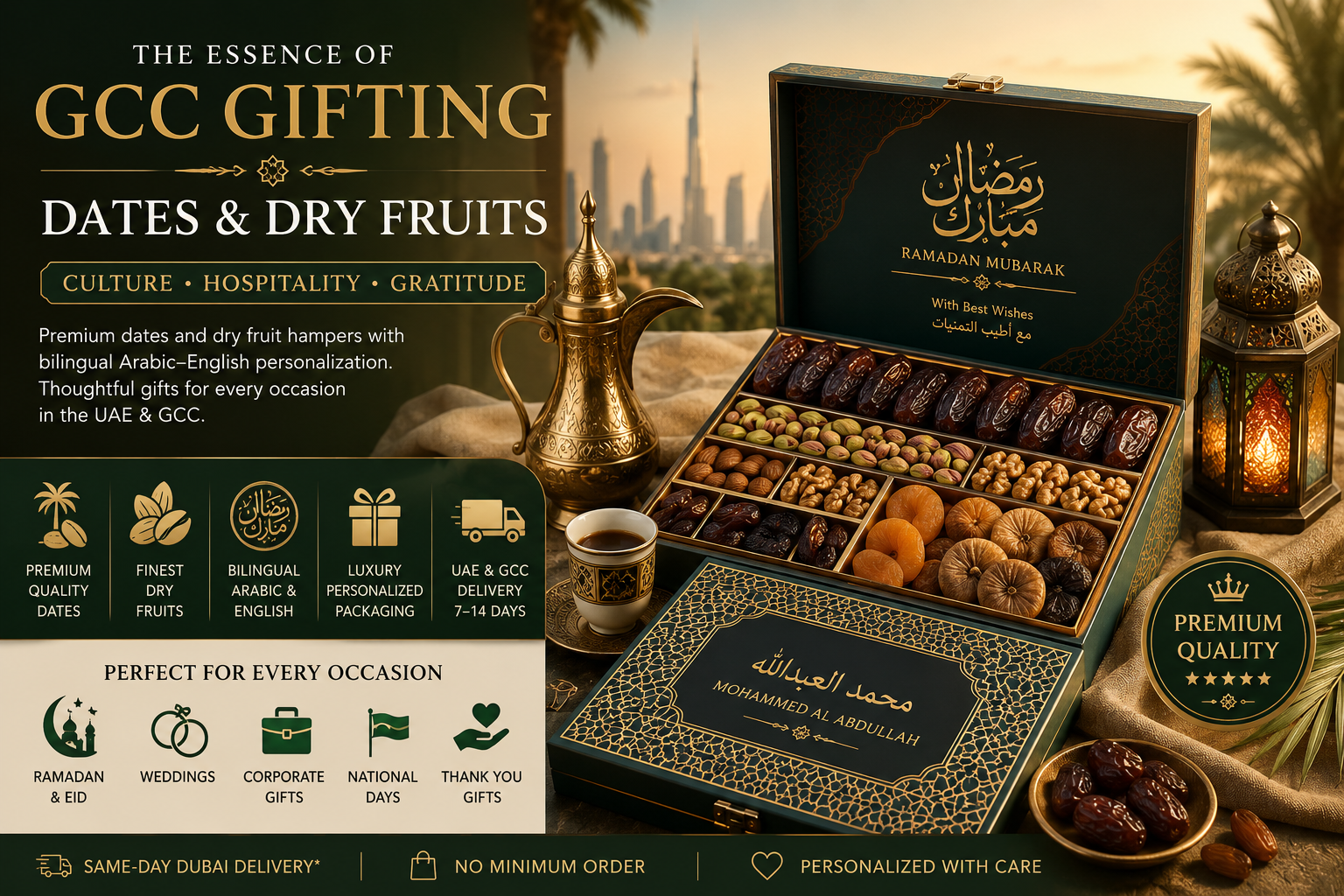
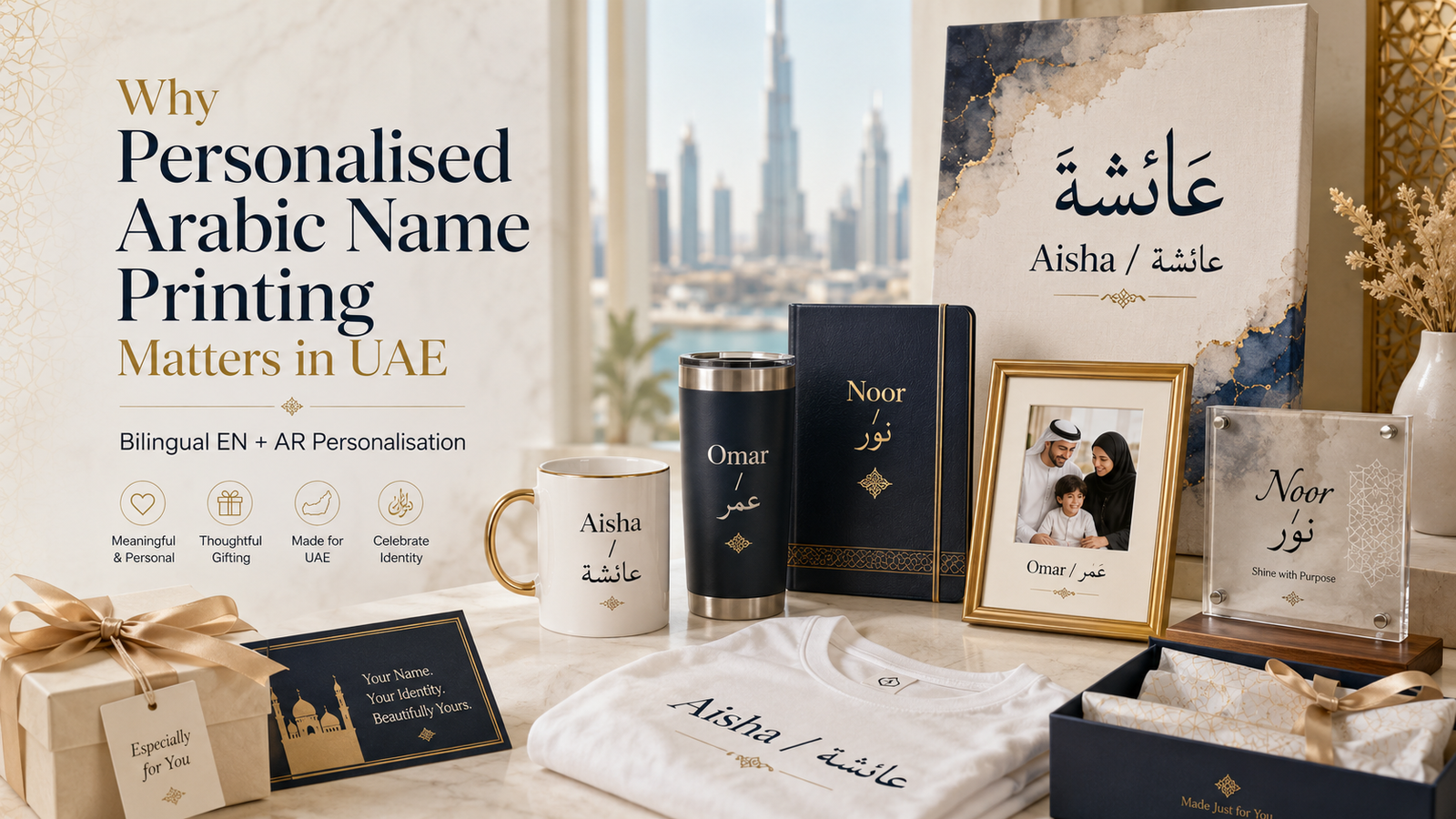
Adding the recipient’s name in Arabic alongside English on a personalised gift is the single highest-impact, lowest-cost intervention in UAE personalised gifting. The unit cost premium is essentially zero. The signal it sends — that the giver recognised the recipient as a specific bilingual or Arabic-dominant person rather than a generic English-speaking expat — is meaningful. And in 2026 it has become the default rather than the upgrade across most UAE personalisation contexts. This guide covers why bilingual Arabic name printing matters, how it has shifted, what to get right, and what to avoid.
The UAE Demographic Reality That Drives Bilingual Personalisation
UAE recipients of personalised gifts are bilingual or Arabic-dominant in a meaningful share of cases. Emirati nationals (citizens of UAE) typically read Arabic as their primary language and English as their professional/secondary. Saudi nationals (frequent recipients of UAE-produced gifts via cross-border) are similarly Arabic-primary. Many expats from Egypt, Jordan, Lebanon, Syria, Iraq, Morocco, Tunisia, Algeria, Sudan, and across the Arab world are also Arabic-primary. Even within the broadly English-speaking expat pool — South Asian, Filipino, Western — most have built family and professional networks where bilingual gifts cross over to Arabic-speaking colleagues, spouses, and in-laws. English-only personalisation makes a recipient choice that overlooks this demographic mix.
Why Arabic Name Printing Has Shifted From Upgrade to Default
Three factors compressed the gap between English-only and bilingual personalisation between 2020 and 2026. First, production maturity — modern personalisation systems handle Arabic typography natively, with five distinct calligraphic styles available (Naskh, Diwani, Kufic, Modern Arabic, Thuluth) rather than the rough English-with-different-characters that bilingual gifts looked like in 2018. Second, typography specialist review became standard — every Arabic layout is now reviewed before production, eliminating the “why is the dot in the wrong place” mistakes that made early bilingual gifts feel amateur. Third, customer expectations rose — UAE recipients in 2026 notice when a personalised gift is English-only and read it as expat-bubble-ish rather than thoughtful. The bilingual name printing service now treats bilingual EN+AR as the default specification across all gift categories.
What Bilingual Personalisation Looks Like in Practice
On mugs
Vertical stacking — English name on top, Arabic name below, both centred — works cleanest on the curved mug surface. Or two-side split — English on one side of the handle, Arabic on the other. Naskh and Modern Arabic are the most-picked styles for mugs because they hold up best at small sizes on curved surfaces. Diwani works at slightly larger letter sizes.
On t-shirts and apparel
Personalised t-shirts typically carry bilingual names with the English on top and Arabic below, both centred on the chest. Modern Arabic is the most-picked style for apparel because it pairs cleanly with contemporary English sans-serifs. Naskh works for traditional registers.
On photo frames
Photo frames hold all five Arabic styles cleanly because the print area is flat and large. Diwani for romantic and wedding contexts; Naskh for religious and traditional contexts; Modern Arabic for everyday family photos; Thuluth for premium ceremonial pieces; Kufic for design-forward recipients.
On wall canvases
Large-format canvases hold Thuluth dramatically (the tall vertical letters benefit from scale), Diwani ornately, and the other styles cleanly. Bilingual layouts with the family name in Arabic and the wedding date in English are the most-given premium wall canvas configuration.
The Five Arabic Styles — Quick Reference
Naskh: Classical, dignified, the safest default. Use for religious contexts, older recipients, traditional households, professional registers, and any context where you are unsure.
Diwani: Royal, romantic, ceremonial. Use for weddings, anniversaries, romantic gifts, and ceremonial pieces. Avoid for religious passages and contemporary corporate contexts.
Kufic: Geometric, architectural, modern. Use for design-forward recipients, contemporary nursery names, and graphic-design-aware gifts. Avoid for traditional and religious contexts.
Modern Arabic: Clean, contemporary, the everyday default. Use for casual personal gifts, contemporary corporate, friendship gifts, and any “now” register.
Thuluth: Tall, formal, monumental. Use for large-format pieces (wall canvases, premium plaques, framed Quranic verses). Avoid on small surfaces (mugs, coasters).
Common Bilingual Personalisation Mistakes
Wrong style for context
Diwani for a Quranic verse, Kufic for a traditional grandparent’s gift, or Thuluth on a curved mug surface — all read as wrong to Arabic-literate viewers even when the typography is technically correct. The typography specialist review process catches these mismatches before production.
Mismatched optical weight
A thin English typeface paired with a heavy Arabic style (or vice versa) reads as unbalanced. Match the visual weight: classic English serifs with Naskh; modern English sans with Modern Arabic; elegant English scripts with Diwani.
Ignoring reading direction on horizontal layouts
Arabic reads right-to-left, English left-to-right. Horizontal pairings on small items end up cramped. Vertical stacking (English on top, Arabic below) works cleaner on small surfaces.
Wrong dot placement
Arabic letters carry diacritical dots that change meaning when misplaced. Even a single dot in the wrong position can change a name’s meaning entirely. The typography specialist review catches dot-placement errors before production — never skip this step on bilingual gifts.
When to Skip Bilingual (and Why It’s Rare)
Bilingual EN+AR is the right default for almost every UAE personalised gift, but three contexts make English-only the better choice. The recipient explicitly does not read Arabic and prefers single-language clarity. A British or European expat with no Arabic-language exposure may genuinely prefer the gift uncluttered. Worth asking before assuming. Strict design constraints leave no room for two scripts. A small phone case or coaster with a complex photo and a long name may not have visual room for two languages without compression. Pick the language that matches the recipient’s primary use. The recipient is not in or connected to UAE/GCC at all. Gifts shipping internationally to recipients with no UAE context can default to single-language. For everything else — the vast majority of UAE-context gifts — bilingual remains the cleaner default.
Other Language Pairs (Beyond EN+AR)
Bilingual personalisation supports language pairs beyond English+Arabic on request. The most-volume secondary languages alongside English in UAE personalisation are: Hindi (for South Asian expat households), Tagalog (for Filipino expat households), Urdu (for Pakistani expat households), and Malayalam (for South Indian expat households). French is occasionally requested for North African expats. Each language pair follows the same workflow as bilingual EN+AR — typography review for non-Latin scripts (Hindi, Urdu, Malayalam) is conducted by language-specialist reviewers rather than the Arabic typography specialist, but the review step is part of the standard production cycle at no additional charge.
Same-Day Dubai and Production
Bilingual EN+AR personalisation adds no production-time premium. Typography specialist review is included in the standard production cycle and is completed within the same-day window for orders placed before the 11am (sublimated/fabric) or 12pm (UV-printed) cut-offs. There is no minimum order; UAE-wide is 1–3 business days; GCC cross-border 7–14 days.
Order Yours Today
Make your personalisation work for the UAE bilingual reality.
Five Arabic styles, typography specialist review on every layout, bilingual EN+AR at no premium, same-day Dubai delivery — across mugs, frames, t-shirts, canvases, and the full personalisation range.
Same-day Dubai delivery for orders placed before 11am (12pm for UV-printed items). UAE-wide delivery 1–3 business days. GCC cross-border 7–14 days. Order via WhatsApp or our online form.
Frequently Asked Questions About Arabic Name Printing UAE
Why does Arabic name printing matter in UAE?
UAE recipients of personalised gifts are bilingual or Arabic-dominant in a meaningful share of cases — Emiratis, Saudis (via cross-border gifts), and Arab expats from across the region read Arabic as their primary language. English-only personalisation overlooks this and reads as expat-bubble-ish in 2026.
Is bilingual EN+AR personalisation more expensive than English-only?
No — bilingual EN+AR adds no unit-cost premium. Typography specialist review is included in standard production. The only added step is the review itself, which happens within the same-day window for orders placed before the cut-off.
What is the most-used Arabic style for personalised gifts in UAE?
Naskh and Modern Arabic together cover roughly 70–80% of UAE personalisation contexts. Naskh for traditional, religious, professional, and older-recipient registers; Modern Arabic for contemporary, everyday, and friendship registers. Diwani for weddings and romantic; Thuluth for large-format ceremonial; Kufic for design-forward.
Can the same Arabic style be used on every gift type?
No — surface and context narrow the choice. Mugs and small curved surfaces favour Naskh and Modern Arabic; wall canvases hold Thuluth dramatically; ceremonial pieces benefit from Diwani; design-forward recipients respond to Kufic. The typography specialist review process advises on style selection per gift.
Why does dot placement matter so much in Arabic typography?
Arabic letters carry diacritical dots that change meaning when misplaced. A single dot in the wrong position can change a name’s meaning entirely or turn a word into an unrelated word. The typography specialist review catches these errors before production — it is the most important reason never to skip review on bilingual gifts.
What is a typography specialist review?
Every Arabic layout is reviewed by a typography specialist before production. The review checks dot placement, style appropriateness for context, optical balance with the English component, and surface-appropriate sizing. It is included in the standard production timeline at no additional cost.
Can other languages besides Arabic be added alongside English?
Yes — Hindi, Tagalog, Urdu, French, and other languages are supported on request. Arabic is the most-volume secondary language alongside English in UAE personalisation, but the bilingual personalisation system handles other language pairs as well.
What is the difference between Diwani and Modern Arabic?
Diwani is a flowing, ornate, ceremonial style originated in the Ottoman court — used for weddings, royal-register pieces, and romantic personalisation. Modern Arabic is a clean, contemporary, everyday-legibility category — used for casual personal gifts, contemporary corporate, and friendship gifts.
Is bilingual Arabic typography review fast enough for same-day Dubai?
Yes — typography specialist review is completed within the same-day window for orders placed before the 11am (sublimated/fabric) or 12pm (UV-printed) cut-offs. Bilingual personalisation does not extend the production timeline.