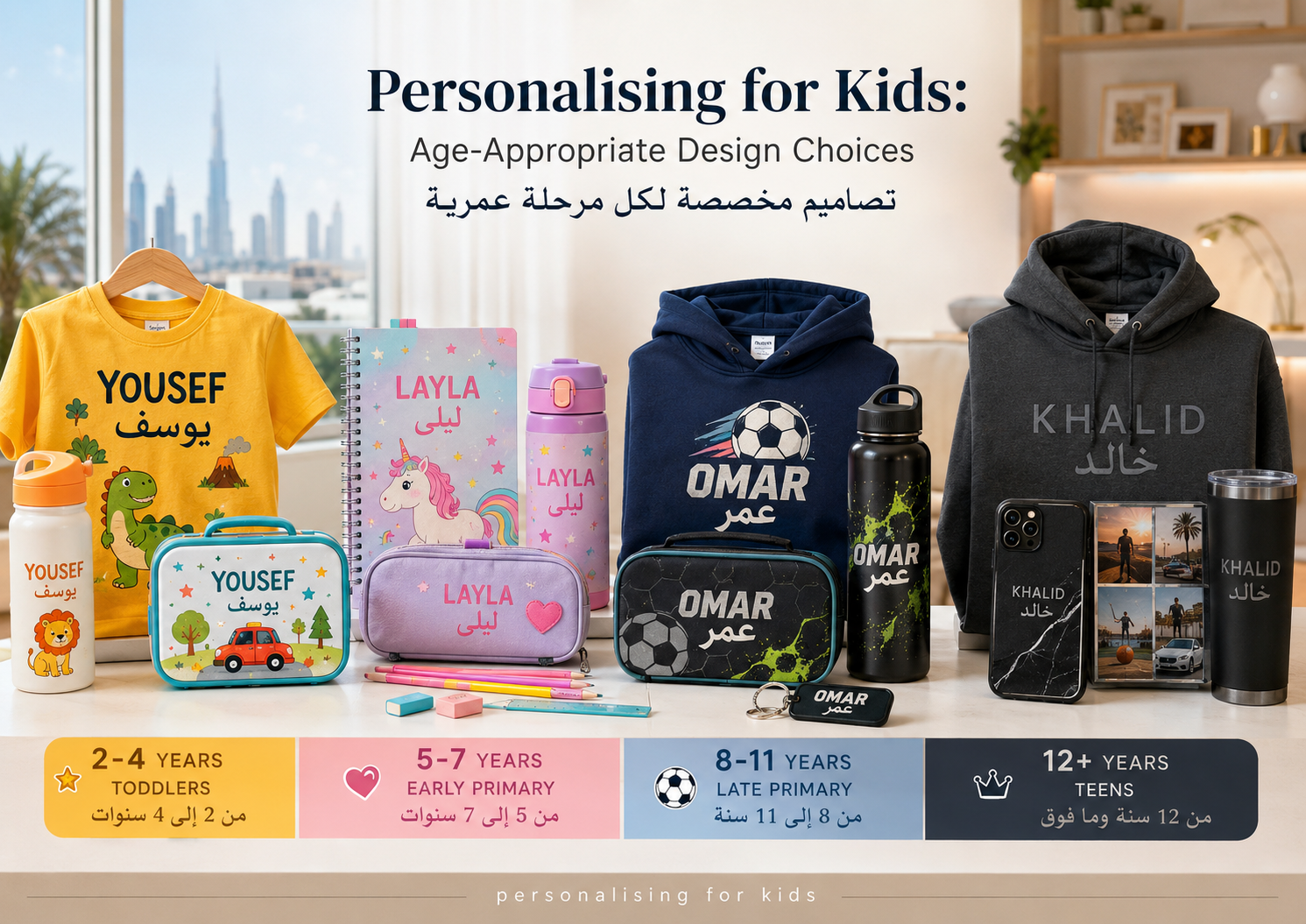
Personalising for Kids: Age-Appropriate Design Choices
Personalised gifts for children require design choices that adult-targeted personalisation never has to consider — readability for new readers, age-appropriate themes, durability against the way kids actually use things, and visual styles that match the recipient’s developmental stage rather than the giver’s adult-aesthetic preferences. This guide covers the design principles that make personalised kids’ items land with kids (rather than with the adults who buy them), organised by age range.
Why Adult Aesthetic Doesn’t Match Kids’ Reality
The Pinterest-curated minimalist neutral-tone aesthetic that adult buyers gravitate toward is often the opposite of what kids actually engage with. Kids respond to bright colour, playful typography, character-style themes, and items they can show off at school. A “tasteful” personalised water bottle in muted earth tones with a small monogram in serif typeface reads as adult to a 6-year-old; the same bottle in bright colour with the kid’s name in a friendly bold typeface reads as theirs. Design intent matters more than design restraint when the recipient is a child. The corollary: ask the child what they actually want where age permits — even a 5-year-old has clear preferences on colour and theme that the adult buyer can easily get wrong by guessing. For gifts to nieces, nephews, and family-friend kids whose preferences you don’t know, lean colourful and playful by default rather than minimalist; the worst case there is “too bright”, which kids generally don’t mind.
Design Principles by Age Range
Toddler (2–4 years)
Visual register: bright primary colours, simple shapes, bold rounded typography, recognisable everyday objects (animals, vehicles, food). Avoid: text-heavy designs (toddlers can’t read), tiny details, complex graphic compositions. Personalisation focus: the toddler’s name in a large bold child-friendly typeface, often paired with a single bold visual element. Suitable products: personalised t-shirts with name + simple animal motif, name-printed water bottles with bright patterns, name-printed lunch boxes.
Early Primary (5–7 years)
Visual register: colour-rich, friendly typography, themes the child actively chooses (favourite colour, favourite animal, favourite activity). Avoid: themes the parent picked but the child doesn’t connect with, fonts too elegant for the developmental stage. Personalisation focus: the child’s name plus a chosen-by-child theme element. Suitable products: personalised stationery sets, school-themed items, birthday party gifts.
Late Primary (8–11 years)
Visual register: bolder, more design-aware. Kids in this range are starting to develop personal style preferences. Themes shift toward sports, hobbies, music, design-conscious imagery. Avoid: too-young aesthetics that kids in this range explicitly reject (cute baby-style imagery), but also avoid premature adult aesthetics. Personalisation focus: the child’s name plus a hobby or interest reference. Suitable products: personalised hoodies, premium personalised water bottles that feel teen-tier rather than baby-tier.
Teen (12+)
Visual register: design-aware, often deliberately understated, increasingly resembling adult preferences. Themes lean toward subcultural and identity-marking (music genres, fashion, sport identity). Avoid: anything that reads as forced-cool. Personalisation focus: name often understated, with the design or photo carrying more of the gift. Suitable products: personalised hoodies (the dominant teen apparel category), phone cases, premium tumblers, photo-collage gifts. Gifts for kids cover the broader range.
Typography for Kids by Age
Toddlers (2–4): bold, rounded, friendly typefaces — extra-bold weights of fonts like Baloo, Quicksand, Comic Neue. High legibility for new readers. Letters should be obviously distinct (no condensed faces). Early primary (5–7): still rounded and friendly but slightly more grown-up — Sniglet, Fredoka, rounded sans-serifs. Some elegance but still child-readable. Late primary (8–11): contemporary sans-serifs (Inter-style, Helvetica-style). The transition fonts. Teens: adult typography with personal-style adjustments (bold display fonts for sports/music identity, minimalist sans for design-aware).
Safety and Durability for Kids’ Items
Two practical considerations beyond aesthetics. Material safety: all kids’ personalised items use BPA-free plastics, food-safe inks (sublimation dye is food-safe; UV ink on water bottles uses food-grade certification), and non-toxic finishes. Stainless-steel insulated bottles are the safest base material for water bottles. Durability: sublimation prints survive school lunch-bag chaos far better than vinyl decals or stickers. UV print on rigid plastic bottles holds up against scratching from school-bag contents. Pick durable methods over decorative-but-fragile finishes.
Bilingual EN+AR for UAE Bilingual Schools
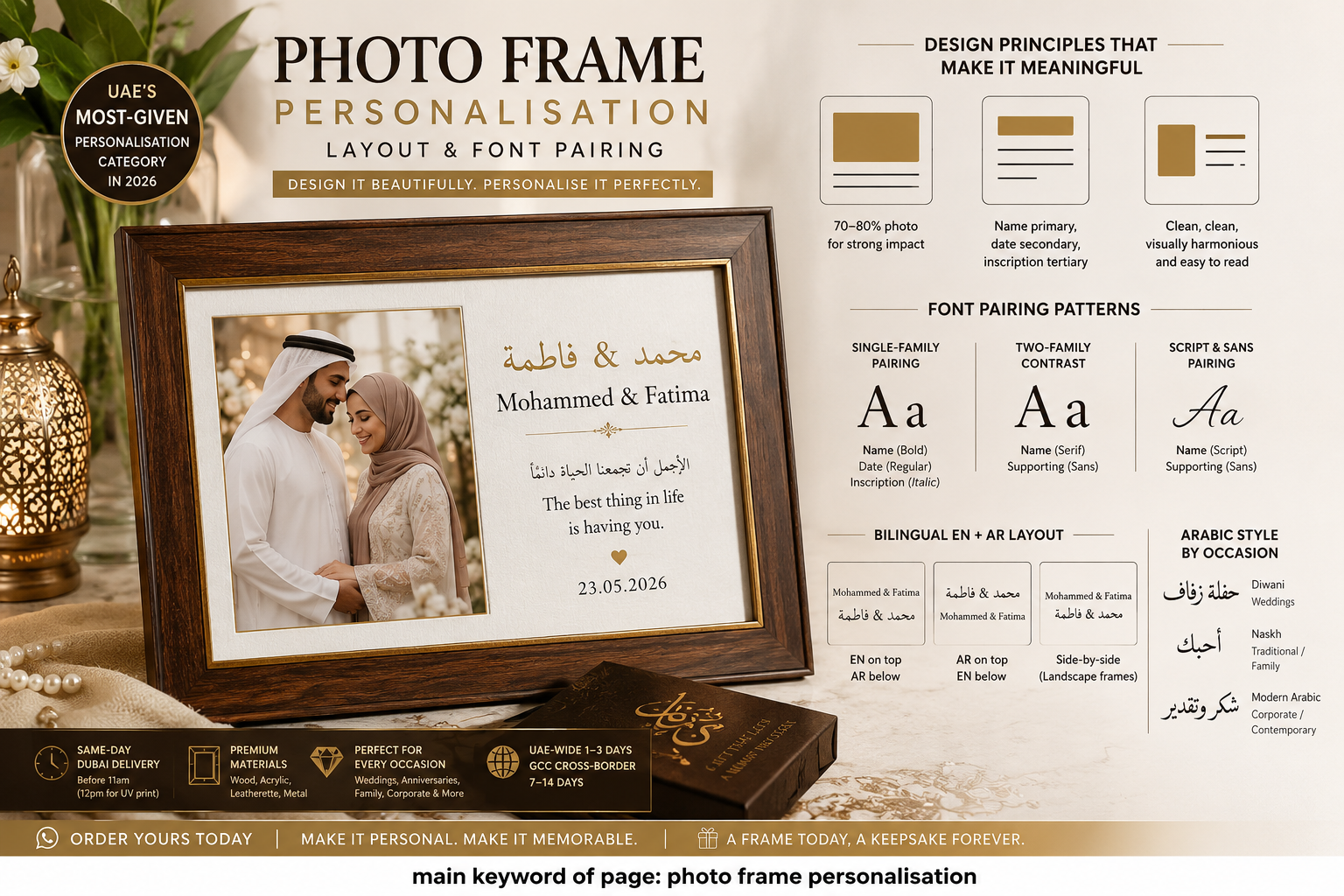
For Arabic-curriculum schools and UAE bilingual schools, kids’ personalised items with both English and Arabic names land harder than English-only equivalents. Naskh and Modern Arabic are the most-picked Arabic styles for kids’ items; Diwani is generally too ornate. Every Arabic layout is reviewed by a typography specialist before production.
School Supply Personalisation — A Distinct Category
Beyond gift-context personalisation, UAE schools generate steady demand for personalised school supplies — name-printed water bottles, lunch boxes, school bags, stationery sets, pencil cases, and uniform name tags. The use case is functional rather than gift: kids’ belongings get mixed up at school, and personalisation is the practical solution that reduces lost-item rates and parent-reported issues at the school office. School-supply personalisation differs from gift personalisation in several ways. Durability is paramount: the items will see daily school use for a full school year. Sublimation and UV print are the durability winners; HTV and stickers will not survive a school year. Visibility from a distance matters: the kid’s name should be readable from across the classroom or from the back of the bus. Larger, bolder typography wins over decorative typography. Bilingual EN+AR is particularly valuable: Arabic-curriculum schools may have Arabic-language teachers and admin staff who read Arabic faster than English; the bilingual name aids teacher identification of student belongings. Bulk orders at the school-year-start: August-September are the peak production months for school-supply personalisation in UAE. Lock orders in July if avoiding the peak-window queue matters for delivery timing.
What to Avoid on Kids’ Personalisation
Three categories to avoid. Licensed character imagery (Disney, Pixar, Marvel, Nickelodeon characters): commercial-print copying is copyright infringement and most facilities will not produce these. Use the underlying themes (princess, superhero, pirate) without specific licensed characters. Religious or political imagery: most UAE schools prohibit these on student items. Adult-aesthetic designs the kid doesn’t connect with: minimalist monograms in serif typefaces work for adult gifts; they read as adult-imposed-on-child for actual children.
Same-Day Dubai for Kids’ Personalisation
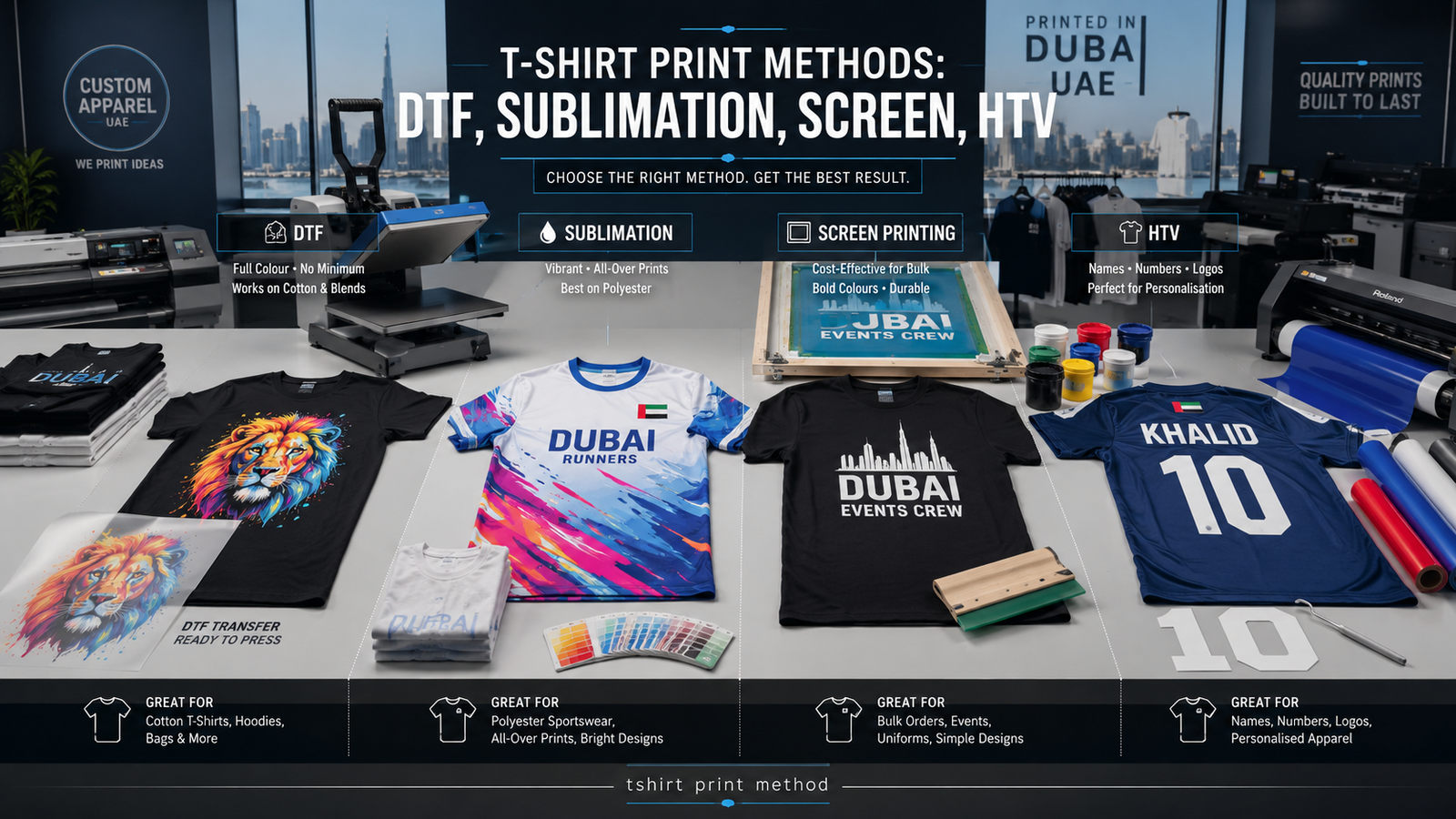
Same-day Dubai applies for sublimated and DTF items (mugs, t-shirts, lunch boxes) at the 11am cut-off, and UV-printed items (water bottles, photo frames, plaques) at the 12pm cut-off. There is no minimum order; bulk pricing applies from 25 pieces (lunch boxes, water bottles), 50 pieces (apparel). UAE-wide is 1–3 business days; GCC cross-border 7–14 days.
Order Yours Today
Personalise kids gifts in a way kids actually engage with.
Bright colours and friendly typography for toddlers, hobby-and-interest themes for primary, design-led for teens — sublimation, UV print, bilingual EN+AR, same-day Dubai for school-emergency items.
Same-day Dubai delivery for orders placed before 11am (12pm for UV-printed items). UAE-wide delivery 1–3 business days. GCC cross-border 7–14 days. Order via WhatsApp or our online form.
Frequently Asked Questions About Kids Personalised Design
What design choices work best for personalising toddler gifts (ages 2–4)?
Bright primary colours, simple shapes, bold rounded typography (Baloo, Quicksand, Comic Neue style fonts), recognisable everyday objects (animals, vehicles, food). Avoid text-heavy designs (toddlers can’t read), tiny details, and complex graphic compositions. The child’s name in a large bold child-friendly typeface plus a single bold visual element.
What is age-appropriate for early-primary kids (5–7)?
Colour-rich, friendly typography, themes the child actively chooses (favourite colour, favourite animal, favourite activity). Themes the parent picked but the child doesn’t connect with miss the recipient. Personalisation should be the child’s name plus a chosen-by-child theme element.
Should I use minimalist neutral-tone designs for kids’ gifts?
Generally no — the Pinterest-curated minimalist aesthetic adult buyers prefer is often the opposite of what kids actually engage with. Kids respond to bright colour, playful typography, and items they can show off at school. Design intent matters more than design restraint when the recipient is a child.
Can kids’ personalised items be safely used with food (water bottles, lunch boxes)?
Yes — kids’ personalised items use BPA-free plastics, food-safe inks (sublimation dye is food-safe; UV ink on water bottles uses food-grade certification), and non-toxic finishes. Stainless-steel insulated bottles are the safest base material.
Why are sublimation and UV print better than vinyl for kids’ items?
Sublimation dyes the design into the polymer coating; UV print bonds to rigid surfaces. Both survive school-bag chaos far better than vinyl decals or stickers, which peel under abrasion and heat. For items that will see daily school use, sublimation and UV are the durability winners.
Can I add Arabic to a child’s personalised item for an Arabic-curriculum school?
Yes — bilingual EN+AR is the default offering. Naskh and Modern Arabic are the most-picked Arabic styles for kids’ items in Arabic-curriculum schools; Diwani is generally too ornate. Every Arabic layout is reviewed by a typography specialist before production.
Why can’t I use Disney or Marvel characters on personalised kids’ gifts?
Licensed character imagery (Disney, Pixar, Marvel, Nickelodeon) is copyright-protected; commercial print copying is copyright infringement. Use the underlying themes (princess, superhero, pirate) without specific licensed characters. Licensed merchandise should come from official licensees.
What is the difference between gifts for late-primary kids (8–11) and teens (12+)?
Late-primary kids respond to bolder, more design-aware aesthetics with hobby or interest references (sport, gaming, music). Teens prefer deliberately understated design, often with subcultural identity-marking (music genres, fashion, sport identity). The personalisation register shifts from named-and-decorated to design-led with name often understated.