Saudi Arabia Gift-Giving Customs Every UAE Business Should Know
UAE companies doing business with Saudi clients in 2026 — and that’s most UAE B2B companies given KSA’s status as the largest GCC economy — operate in a gift-giving environment with its own conventions distinct from UAE practice. Saudi business gift customs blend Islamic cultural foundations, traditional Arabian hospitality, modern Vision-2030-era openness, and hierarchical professional norms. Getting the gift right strengthens the relationship; getting it wrong creates awkwardness that can take months to recover from. This guide covers what UAE businesses need to know about Saudi gift-giving conventions in 2026, organised across the cultural foundations, practical do’s and don’ts, and the operational realities of UAE-to-KSA cross-border gift programmes.
Cultural Foundations
Three cultural foundations shape Saudi business gift conventions. Arabian hospitality (karam): the deep cultural value placed on generous treatment of guests, including gift-giving as an expression of respect. Islamic religious framework: certain categories are prohibited (alcohol, pork-derived items, items depicting religious figures); other categories carry strong religious resonance (dates from Medina, Quranic-inscribed items in appropriate contexts). Hierarchical business culture: gifts in Saudi business contexts often track organisational hierarchy more visibly than in some Western or even UAE contexts — gifts to senior figures should match seniority register; gifts to junior staff should not eclipse gifts to their superiors.
Gifts That Work Reliably
Premium dates and dry fruit hampers
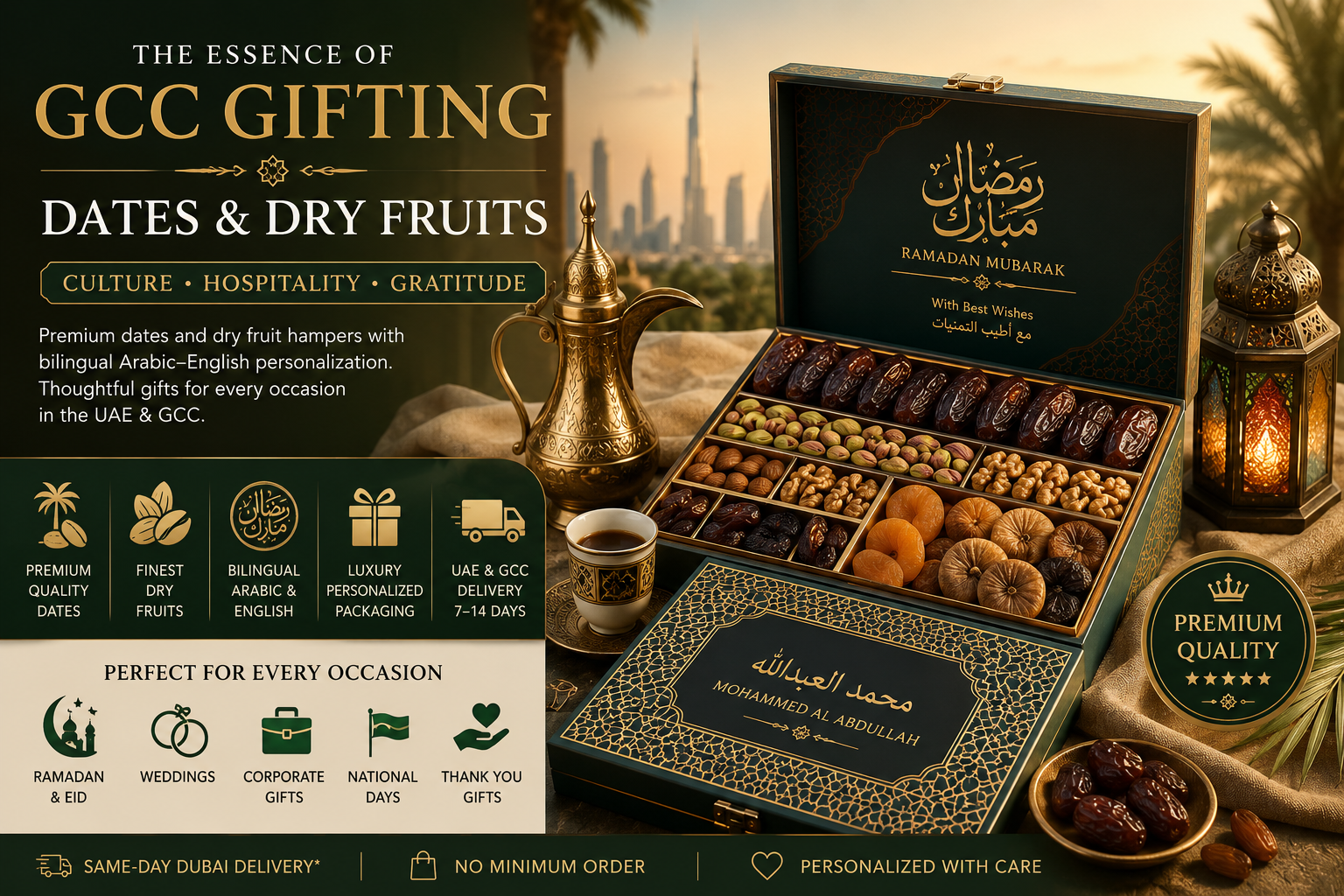
The most universally-appropriate Saudi business gift category. Premium varietals (Sukkari, Mejdoul, and for the most senior or religious-context gifts, Ajwa from Medina) in personalised gift boxes with bilingual Arabic-English calligraphy of the recipient’s name. AED 200–600 per hamper for typical client-tier; AED 800+ for senior-tier. Saudi National Day gifts and Ramadan gift programmes lean heavily on this category.
Premium leather goods
High-quality leather portfolios, briefcases, leather-bound notebooks, and document holders work as senior-tier business gifts. Avoid pigskin leather (religiously inappropriate); cow, calf, and synthetic premium leathers are appropriate. Personalised with the recipient’s name embossed in bilingual EN+AR. AED 400–1500 per piece depending on tier.
Premium oud and Arabic perfumes
Oud (agarwood) and Arabic-style perfumes carry deep regional and cultural significance in Saudi gift traditions. Premium oud blends in personalised packaging are senior-tier appropriate. AED 500–2000+ per gift depending on oud quality. Care needed: avoid alcohol-based Western perfumes; alcohol-free Arabic-style attars are the appropriate category.
Arabic coffee accessories
Premium dallah pots, finjan cup sets, and Arabic-coffee-service items in personalised packaging work as cultural-fit gifts. Particularly senior-tier and Saudi-recipient appropriate. AED 350–1000+ per set.
Premium personalised drinkware and stationery
For broader client-tier gifts, premium personalised tumblers, leather notebooks with embossed bilingual names, and cross-border gift hampers combining drinkware + dates + accessories work at AED 200–500 per piece.
Categories to Avoid
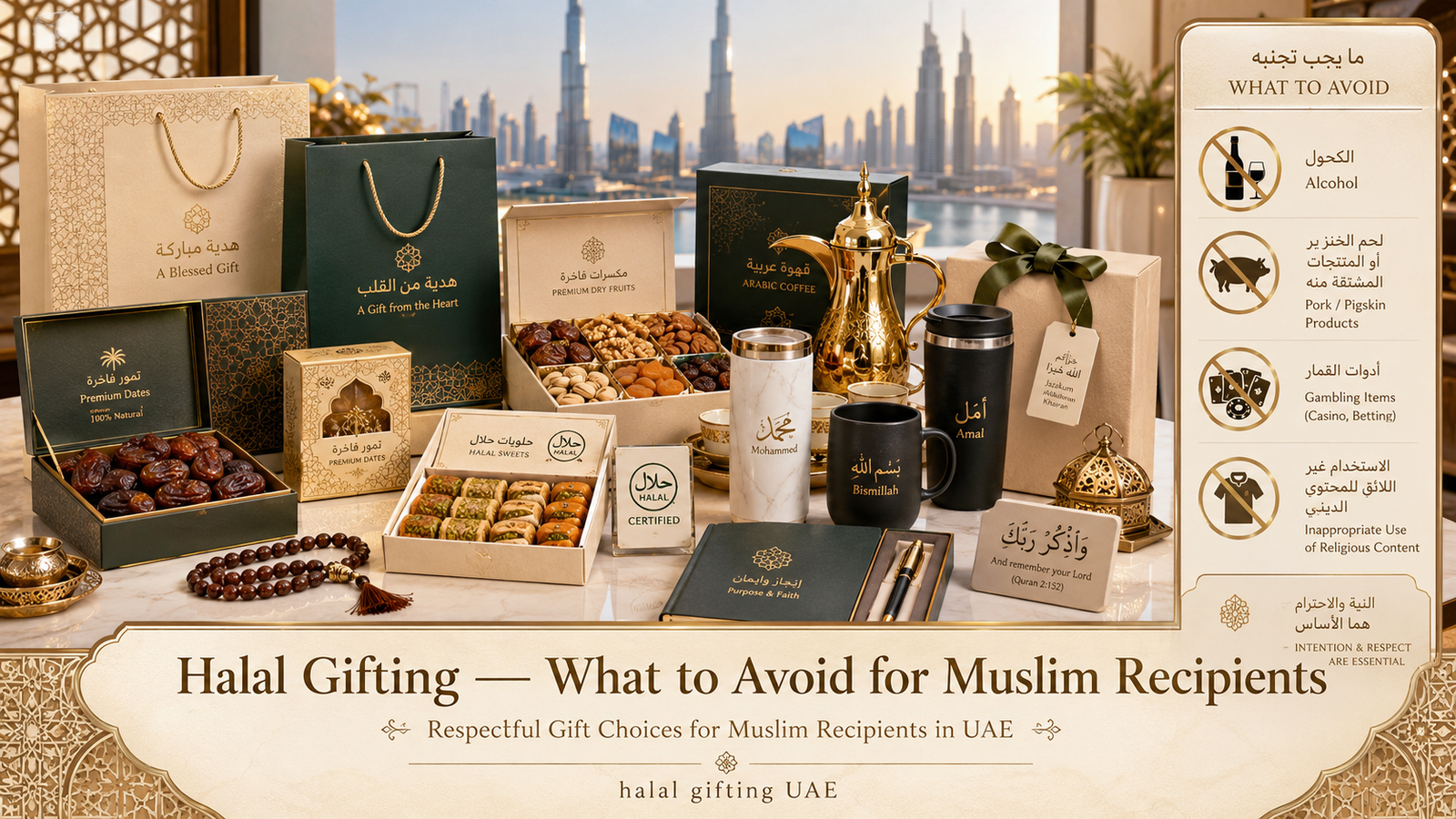
Alcohol
Alcohol is illegal in KSA and inappropriate as a gift in any business or personal context. This includes wine, spirits, beer, and any alcohol-containing items (alcohol-based perfumes, certain chocolates with alcohol fillings). Even gifts that contain trace alcohol in formulation (some skincare products) are best avoided. The most common UAE-business mistake when first gifting Saudi clients is sending a wine gift basket; this can permanently damage the relationship.
Pork and pigskin items
Pork-derived foods are inappropriate; pigskin leather goods (some lower-grade Western leather products) are inappropriate. Verify leather origin on premium gifts.
Religious imagery and figurative depictions
In some Islamic traditions (varying by individual recipient and context), depictions of human figures and certain animal figures carry religious considerations. For Saudi business gifts where the recipient’s specific religious-context preference is unknown, abstract designs, calligraphy, and geometric patterns are safer than figurative imagery. Quranic verses on commercial gift packaging are inappropriate unless the gift’s specific religious context is well-established (which is rare in B2B contexts).
Gambling, gaming, and entertainment items considered inappropriate
Playing cards, dice, casino-themed items, and certain entertainment-themed gifts that conflict with conservative Saudi cultural norms.
Personal items going across gender lines
Gifts from male UAE business contacts to female Saudi recipients (and vice versa) require additional care. Generic professional gifts (premium drinkware, leather portfolios, dates hampers) are appropriate; personal items (perfume, jewellery, anything reading as intimate) are typically inappropriate across professional gender lines.
Hierarchical Considerations
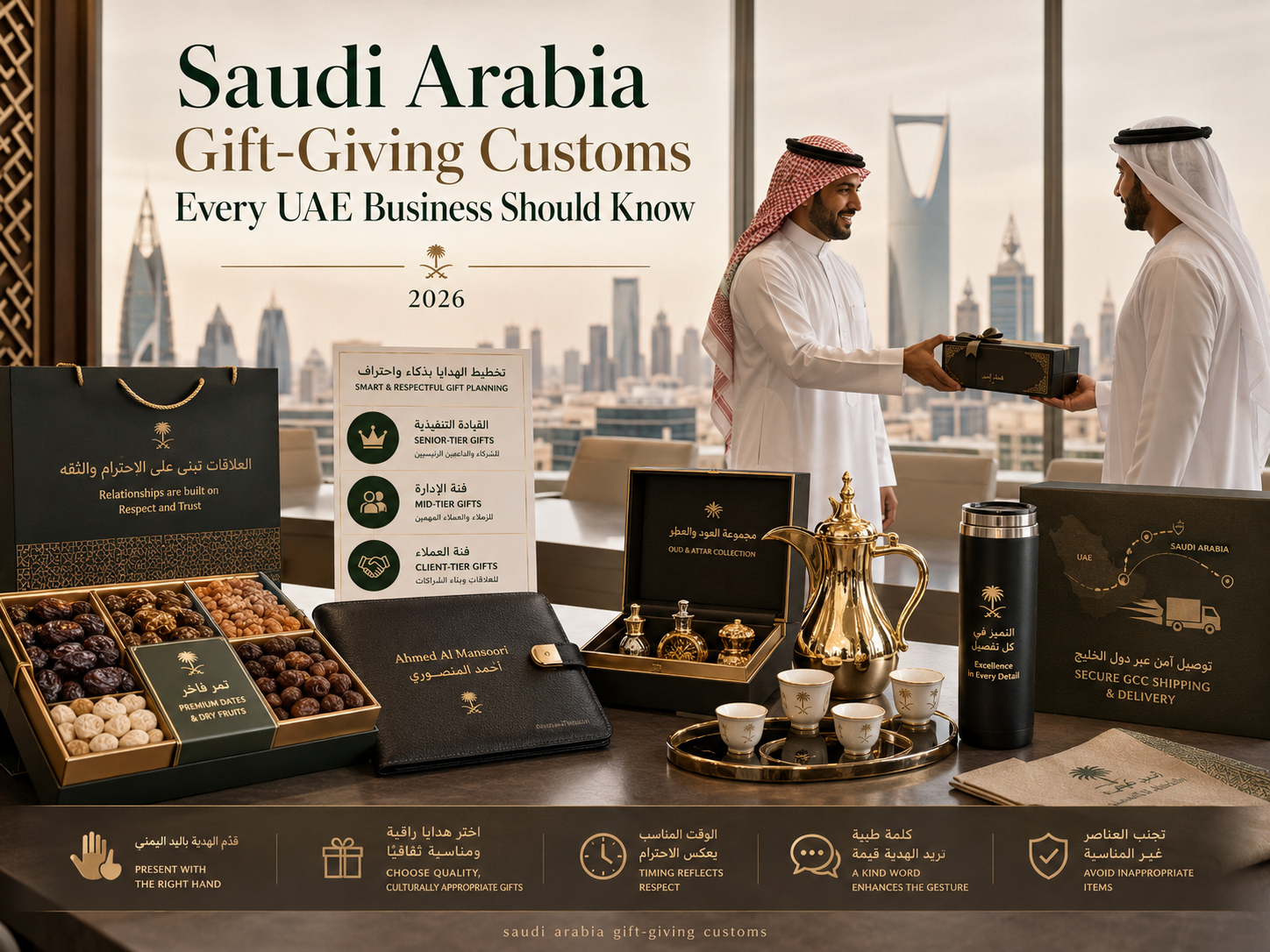
Saudi business gift programmes typically tier by recipient seniority more visibly than UAE-domestic equivalents. Senior figures (CEOs, board members, government officials): AED 1000–3000+ tier. Premium oud, leather-bound portfolios, premium dates and dry fruit hampers in elaborate packaging. Mid-senior (department heads, senior managers): AED 500–1000 tier. Premium personalised drinkware + dates + leather notebook. Broad client base (account managers, mid-level contacts): AED 200–500 tier. Personalised mugs or tumblers + dates box in branded packaging. Gifts to junior staff that visibly exceed gifts to their superiors create awkwardness; tiering matters.
Gift Presentation Conventions
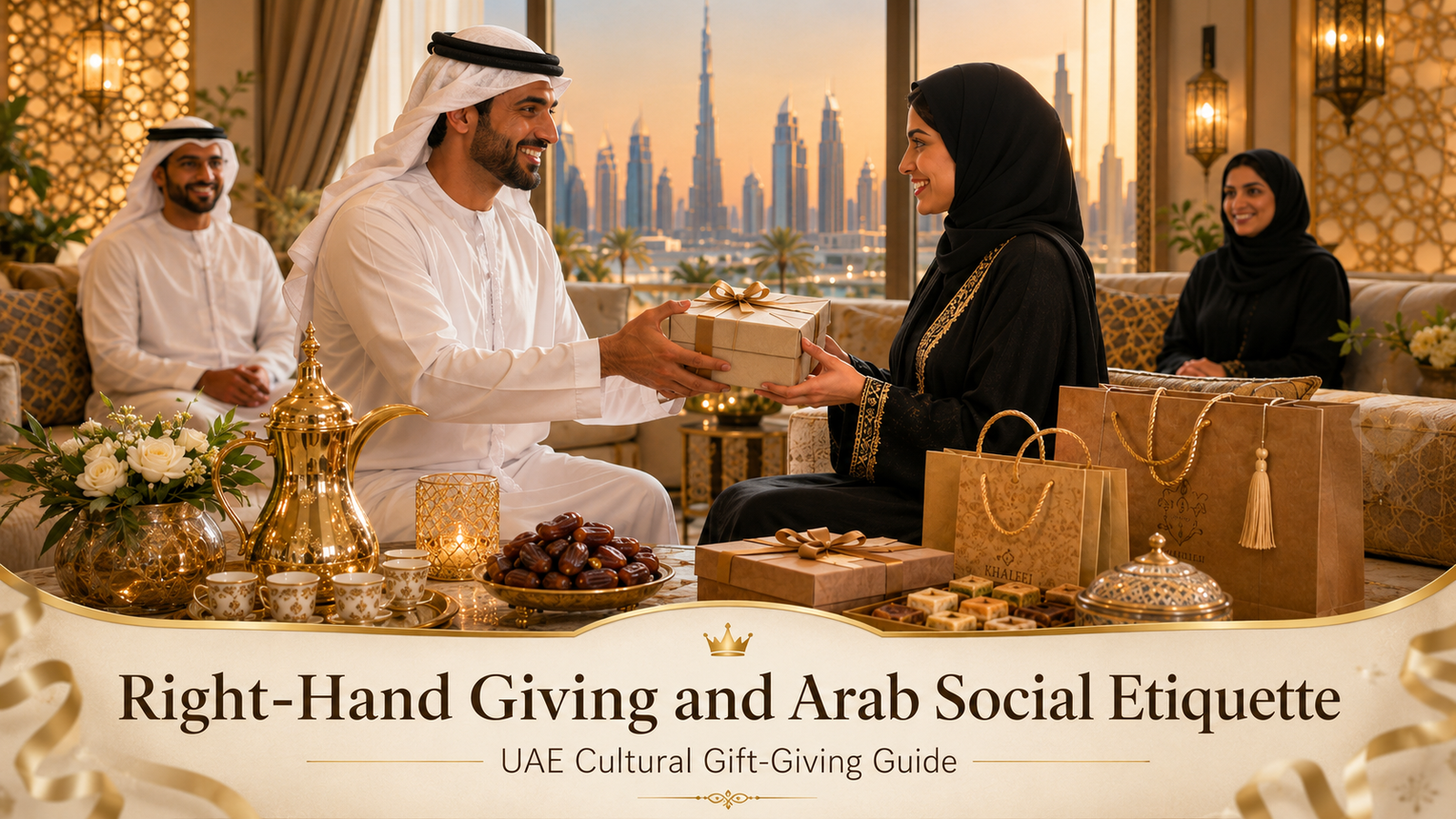
Three presentation considerations in Saudi business contexts. Right hand or both hands: traditional convention is to present gifts with the right hand or both hands; never with the left hand alone. Gifts may not be opened immediately: recipients often place gifts aside rather than opening them in front of the giver. This is not rejection; it’s traditional politeness. UAE business givers should not press for the gift to be opened during the meeting. Reciprocity expectations: Saudi business culture has strong reciprocity norms; gifts received are often reciprocated at subsequent meetings or occasions. UAE businesses giving substantial gifts should be prepared for substantial reciprocation.
Bilingual Personalisation for Saudi Recipients
Arabic personalisation on Saudi-destination gifts carries more weight than on UAE-domestic gifts. Naskh is the most-used Arabic style for traditional and religious-context Saudi business gifts because of its dignified, classical character. Diwani for ceremonial pieces (premium hampers, major-anniversary corporate gifts). Thuluth on the largest premium pieces (wall canvases, recognition awards) given to senior figures. Modern Arabic works for contemporary Saudi business contexts (younger executives, Vision 2030-era startups) but defaults to Naskh for traditional or senior recipients. Every Arabic layout is reviewed by a typography specialist before production with extra care for senior-tier Saudi gifts.
Saudi Wedding and Major-Occasion Gifts
For UAE-business contacts attending Saudi weddings, major family occasions, or senior-figure milestone moments (retirement, government appointments, major business launches), the gift register lifts to the most-substantial tier. Saudi wedding favours and major-occasion gifts often involve premium oud, multi-component leather goods, and substantial dates/dry-fruit hampers in fully-custom-printed packaging at AED 1500–5000+ per gift. The relationship with the recipient and the occasion’s significance determine the tier.
Cross-Border Logistics
UAE-to-KSA gift shipments take 7–14 days standard cross-border. For occasion-anchored gifts (Saudi National Day September 23, Saudi Founding Day February 22, weddings, Ramadan, Eid), lock orders 4 weeks before the arrival date to maintain customs clearance margin. For senior-tier gifts where customs holds would be particularly damaging to the relationship, lock 5–6 weeks ahead. Senior-tier delivery often involves hand-delivery by UAE business contacts during in-person meetings rather than couriered to office reception; the personal-delivery moment is part of the gift’s register at the senior tier.
Order Yours Today
Gift Saudi clients with the cultural register that strengthens the relationship.
Premium dates and dry fruit hampers, leather portfolios, oud and Arabic perfume, premium drinkware in personalised gift boxes — bilingual EN+AR with Naskh for traditional contexts, GCC cross-border 7–14 days.
Same-day Dubai delivery for orders placed before 11am (12pm for UV-printed items). UAE-wide delivery 1–3 business days. GCC cross-border 7–14 days. Order via WhatsApp or our online form.
Frequently Asked Questions About Saudi Gift Customs
What is the most-given UAE-to-KSA business gift category?
Premium dates and dry fruit hampers — the most universally-appropriate Saudi business gift. Premium varietals (Sukkari, Mejdoul, Ajwa from Medina for senior or religious-context gifts) in personalised gift boxes with bilingual Arabic-English calligraphy of the recipient’s name. AED 200–600 per hamper for client-tier; AED 800+ for senior-tier.
What gifts should UAE businesses avoid sending to Saudi clients?
Alcohol (illegal in KSA, inappropriate as gift), pork and pigskin items (religiously inappropriate), Quranic verses on commercial packaging without established religious context, gambling/casino-themed items, and personal items (perfume, jewellery) crossing professional gender lines. The most common mistake is sending wine gift baskets; this can permanently damage the relationship.
Should gifts to Saudi clients be tiered by recipient seniority?
Yes — Saudi business gift programmes tier by recipient seniority more visibly than UAE-domestic equivalents. Senior figures (AED 1000–3000+ tier with premium oud, leather portfolios, premium hampers in elaborate packaging). Mid-senior (AED 500–1000 with premium drinkware + dates + leather notebook). Broad client base (AED 200–500). Gifts to junior staff that visibly exceed gifts to their superiors create awkwardness.
What Arabic style works best for Saudi business gift personalisation?
Naskh is the most-used Arabic style for traditional and religious-context Saudi business gifts because of its dignified, classical character. Diwani for ceremonial premium pieces. Thuluth on the largest premium pieces given to senior figures. Modern Arabic works for contemporary Vision 2030-era contexts but defaults to Naskh for traditional or senior recipients.
Can I send oud and Arabic perfume as a Saudi business gift?
Yes — oud (agarwood) and Arabic-style perfumes carry deep regional and cultural significance in Saudi gift traditions. Premium oud blends in personalised packaging are senior-tier appropriate at AED 500–2000+. Avoid alcohol-based Western perfumes; alcohol-free Arabic-style attars are the appropriate category.
Why might a Saudi recipient not open my gift in front of me?
Saudi business convention often places gifts aside rather than opening them immediately in front of the giver. This is traditional politeness, not rejection. UAE business givers should not press for the gift to be opened during the meeting; the gift will typically be opened privately later, with thanks communicated separately.
How long does cross-border UAE-to-KSA gift shipping take?
Standard 7–14 days for general merchandise gift hampers. For occasion-anchored gifts (Saudi National Day September 23, weddings, Ramadan, Eid), lock orders 4 weeks before the arrival date. For senior-tier gifts where customs holds would damage the relationship, lock 5–6 weeks ahead with appropriate margin.
Is reciprocity expected in Saudi business gift exchanges?
Yes — Saudi business culture has strong reciprocity norms; gifts received are often reciprocated at subsequent meetings or occasions. UAE businesses giving substantial gifts should be prepared for substantial reciprocation. The gift exchange becomes part of the ongoing relationship rather than a one-way gesture.