Foil Stamping vs UV Print: Premium Branding Decisions
Foil stamping and UV printing are the two methods most often considered for premium-tier corporate branding in UAE 2026 — corporate stationery, luxury packaging, premium gift boxes, business cards for senior executives, and high-end event collateral. Both produce a distinctive, premium-looking finish, but they sit at different price points, support different design types, and read differently to recipients. Picking the right method for the brief saves both budget and design rework. This guide covers each method, when to use one over the other, and the hybrid approaches that combine both.
What Each Method Actually Does
Foil stamping
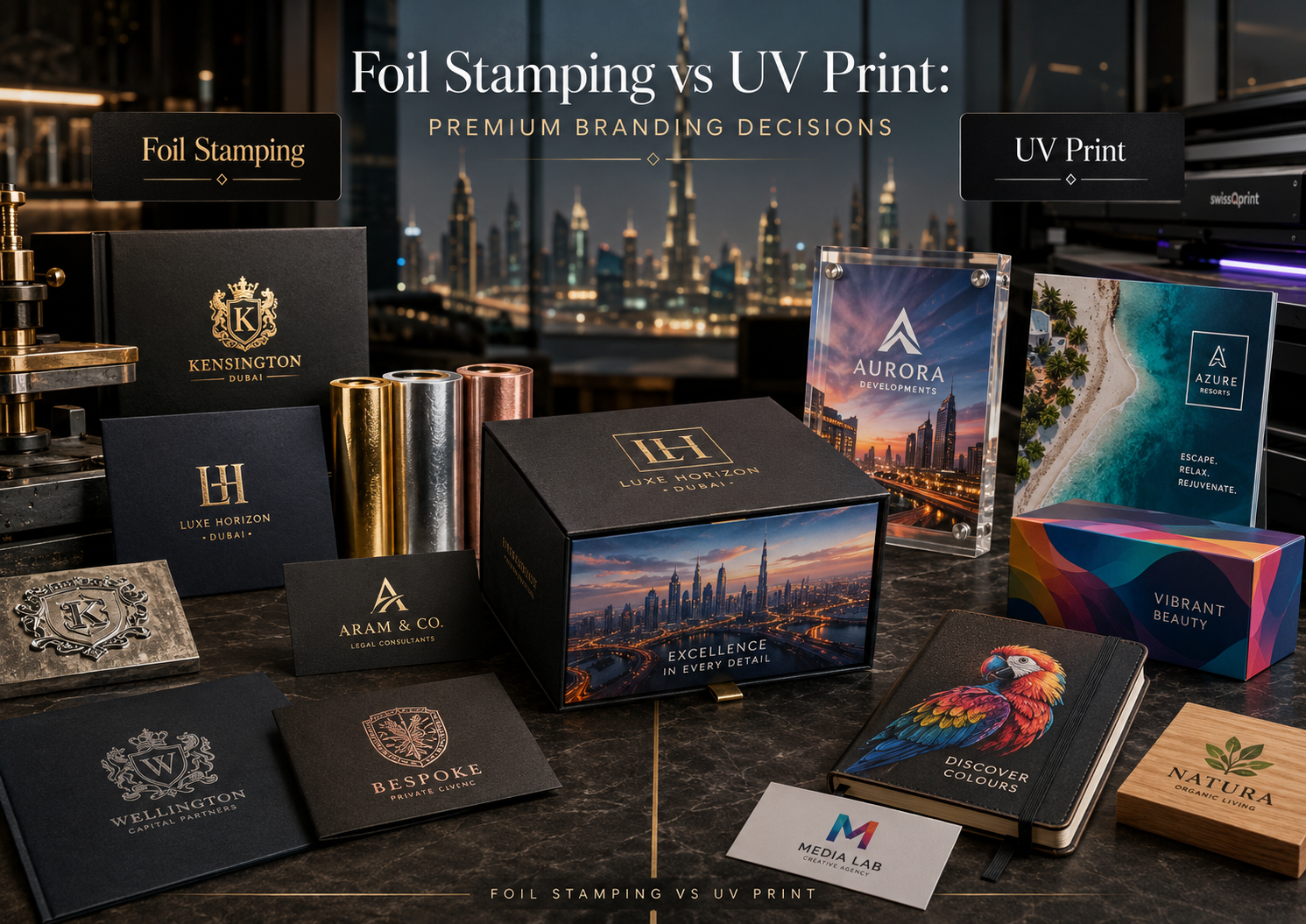
Foil stamping (also called hot foil stamping or foil blocking) uses a heated metal die to press metallic or pigmented foil onto a substrate. The die is pre-made for each design and applied with heat and pressure; the foil bonds to the surface where the die makes contact. The result is a reflective metallic finish — gold, silver, copper, rose gold, or pigmented colour — that sits slightly raised from the substrate with a distinctive sheen. Most-common foil colours in UAE corporate work: gold, silver, rose gold, and matte pigmented foils.
UV printing
UV printing uses ultraviolet-cured ink applied digitally to virtually any rigid substrate — paper, card, leather, wood, metal, acrylic. The ink cures instantly under UV light, producing a full-colour photographic-detail finish that bonds permanently to the surface. UV print supports CMYK + white-ink underlay, full-colour photographic detail, and fine raster gradients. The finish is matte-to-satin (depending on coating), without the metallic reflectivity of foil.
When to Use Foil Stamping
Foil stamping is the cleaner choice when:
- The design is a logo, monogram, or simple graphic — single-colour, vector, no photographic detail
- A metallic, reflective finish is part of the brand register (gold-tone luxury brands, premium hospitality, banking, jewellery)
- The substrate is uncoated or matte stock where foil’s reflectivity contrasts strongly
- The volume justifies the per-design die-making setup (200+ pieces typically)
Cost: foil stamping setup AED 350–800 per design (die-making) plus AED 1.50–4.00 per piece at 200–500 piece runs; AED 0.80–2.50 per piece at 1000+. Lead time: 5–7 days for first-time designs (includes die-making); 3–5 days for repeat orders using existing dies.
When to Use UV Printing
UV printing is the cleaner choice when:
- The design is full-colour or photographic — multi-colour brand graphics, photographic imagery, gradient-heavy artwork
- The substrate is rigid and non-porous (acrylic, metal, leather, treated wood)
- Volume is small-to-mid (1–200 pieces) where die-making setup for foil would be uneconomical
- Per-piece personalisation is required (each item with a different name, photo, or detail)
Cost: UV print setup-free (digital), per-piece AED 5–25 depending on substrate and coverage area. Lead time: 1–3 days for small runs; 5–7 days for 100+ piece runs.
Hybrid: Foil + UV in the Same Piece
Premium UAE corporate work increasingly combines both methods in a single piece. The classic pattern: foil-stamped logo or monogram on the cover of a private-label branded gift box, with UV-printed full-colour brand graphics or photographic detail elsewhere on the same box. The foil delivers the prestige register; the UV print handles the design’s full-colour requirements. Hybrid pieces typically cost 20–40% more than single-method equivalents but produce the most-distinctive premium finish in the UAE 2026 corporate-branding landscape. Common hybrid applications include premium gift boxes for senior corporate clients, executive-tier presentation folders, awards and recognition pieces, and luxury brand packaging where the cover gets foil and the interior or ancillary panels get full-colour UV detail.
Substrate Compatibility
Both methods support a range of substrates but with different sweet spots. Foil stamping: uncoated paper and card, matte coated card, leather, leatherette, faux-leather, fabric (specialised foils), and some plastic substrates. Best results on matte uncoated stocks where foil’s reflectivity contrasts strongly. UV printing: rigid substrates including acrylic, metal, treated wood, leather, leatherette, glass (with primer), ceramic. Best results on rigid non-porous surfaces. Coated paper supports both methods well; uncoated rough paper favours foil.
How Recipients Read Each Finish
Foil and UV print read differently to the recipient. Foil signals tradition, prestige, formality, and ceremony. Hospitality, banking, luxury retail, ceremonial wedding stationery, premium business cards for senior partners — all benefit from foil’s traditional-luxury register. UV print signals contemporary, design-forward, brand-detailed, and modern. Tech brands, contemporary D2C, design-led startups, and brands with full-colour photographic identities read better in UV. Picking the wrong method for the brand register can produce a finish that technically looks premium but doesn’t match what the brand is going for.
Bilingual EN+AR on Premium Pieces
Both foil stamping and UV printing handle bilingual EN+AR layouts. Diwani is the most-used Arabic style for foil-stamped premium pieces (its ceremonial register matches foil’s tradition signal); Naskh and Modern Arabic for UV-printed corporate pieces; Thuluth on the largest ceremonial foil-stamped pieces (premium wedding stationery, decade-anniversary corporate plaques). Every Arabic layout is reviewed by a typography specialist before production, with particular care on foil dies because die-making errors are expensive to remake.
Common Premium-Branding Mistakes
Three mistakes recur on premium-tier UAE branding briefs. Foil-stamping a photograph or full-colour design: foil only handles single-colour solid graphics. Photographic content needs UV. UV printing on textured uncoated paper for a luxury register: UV’s matte-satin finish reads as everyday-printing on uncoated stock; the prestige signal misses. Foil is the correct choice there. Mixing foil and UV without considering visual hierarchy: hybrid pieces work when the foil element is dominant and UV plays a supporting full-colour role; the reverse (UV-dominant with token foil) reads as confused.
Same-Day Dubai for UV; Lead Time for Foil
UV print premium pieces are available same-day Dubai at the 12pm cut-off. Foil-stamped pieces cannot be produced same-day on first-time designs because of the die-making step (5–7 day lead time); repeat orders using existing dies can ship in 3–5 days. For premium letterhead and corporate stationery programmes with both foil and UV elements, plan brief-to-delivery at 7–10 working days for first-time runs.
Order Yours Today
Pick foil or UV for the premium branding register that matches the brand.
Foil stamping for traditional luxury logos and monograms, UV printing for full-colour and photographic detail, hybrid pieces combining both — bilingual EN+AR with Diwani for foil and Naskh for UV.
Same-day Dubai delivery for orders placed before 11am (12pm for UV-printed items). UAE-wide delivery 1–3 business days. GCC cross-border 7–14 days. Order via WhatsApp or our online form.
Frequently Asked Questions About Foil Stamping VS Uv
What is the difference between foil stamping and UV printing?
Foil stamping uses a heated metal die to press metallic or pigmented foil onto a substrate, producing a reflective raised metallic finish. UV printing uses ultraviolet-cured ink applied digitally, producing a full-colour photographic-detail matte-to-satin finish. Foil signals tradition and prestige; UV signals contemporary and design-forward.
Which method is more expensive — foil or UV?
Foil stamping has higher setup cost (AED 350–800 per design for die-making) but compresses well at volume (AED 0.80–2.50 per piece at 1000+). UV printing is setup-free per design but costs AED 5–25 per piece. For small runs (1–100 pieces), UV is cheaper; for large runs (500+) of single-design solid graphics, foil compresses to lower per-piece cost.
When should I use foil stamping over UV printing?
Use foil when the design is a single-colour logo or monogram, a metallic reflective finish matches the brand register (luxury, hospitality, banking, jewellery), the substrate is uncoated or matte where foil’s reflectivity contrasts strongly, and volume justifies die-making setup (200+ pieces).
When should I use UV printing over foil stamping?
Use UV when the design is full-colour or photographic, the substrate is rigid non-porous (acrylic, metal, leather, treated wood), volume is small-to-mid (1–200 pieces) where foil setup would be uneconomical, or per-piece personalisation is required (each item with a different name or photo).
Can foil stamping and UV printing be combined in one piece?
Yes — premium UAE corporate work increasingly uses both. Classic pattern: foil-stamped logo or monogram on the cover of a branded gift box, with UV-printed full-colour brand graphics elsewhere. Foil delivers the prestige register; UV handles full-colour requirements. Hybrid costs 20–40% more than single-method but produces the most-distinctive premium finish.
Can foil stamping be done on full-colour photographic designs?
No — foil only handles single-colour solid graphics. Photographic content needs UV printing. This is the most-common premium-branding mistake on UAE briefs: requesting foil on a photo design produces no usable result. Single-colour vector logos and monograms are the foil sweet spot.
What Arabic styles work best for foil-stamped premium pieces?
Diwani is the most-used Arabic style for foil-stamped premium pieces because its ceremonial register matches foil’s tradition signal. Naskh and Modern Arabic for UV-printed corporate pieces. Thuluth on the largest ceremonial foil-stamped pieces. Every Arabic layout is reviewed by a typography specialist before die-making because die errors are expensive to remake.
How long does foil stamping take versus UV printing?
UV print: 1–3 days for small runs, 5–7 days for 100+ piece runs, same-day Dubai at the 12pm cut-off. Foil stamping: 5–7 days for first-time designs (includes die-making); 3–5 days for repeat orders using existing dies. Foil cannot be produced same-day on first-time designs.