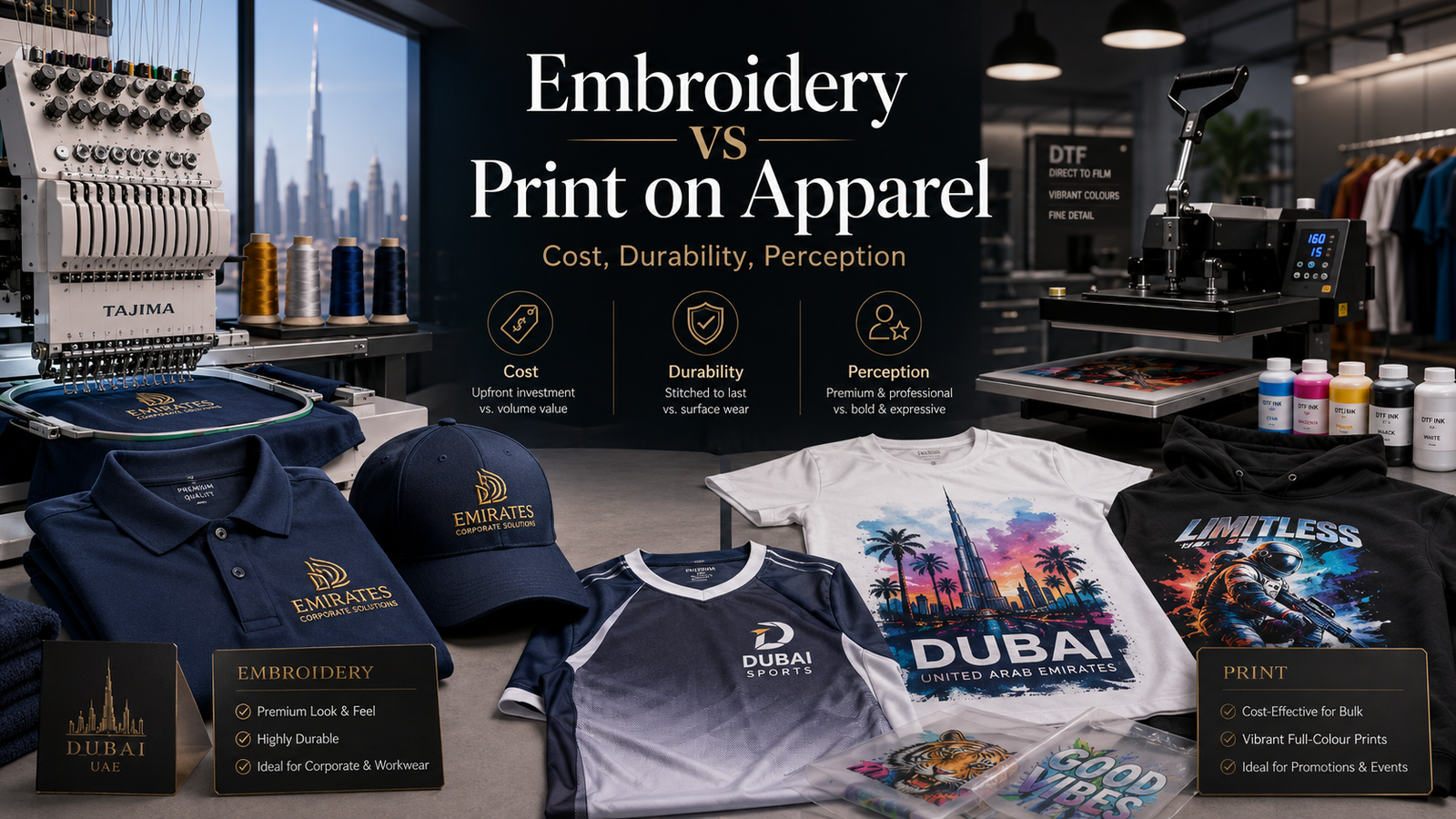
Embroidery vs Print on Apparel: Cost, Durability, Perception
Embroidery vs printing on branded apparel is one of the most-asked decisions in UAE corporate apparel procurement — and one of the most-frequently miscalibrated. Embroidery carries a senior register that print methods don’t match; print methods support full-colour designs that embroidery can’t replicate; cost structures favour different methods at different volumes; and durability differs meaningfully across the methods. Picking the right method depends on the apparel item, the design, the volume, and the perceived register the recipient should read. This guide covers each method’s strengths, the decision framework, and the specific UAE corporate apparel scenarios where one method clearly outperforms the other.
What Each Method Actually Does
Embroidery
Thread stitched into fabric using a programmed embroidery machine, with each colour requiring a separate thread and stitch programme. The design is digitised (converted from artwork to embroidery instructions) before production. The result is a raised, tactile, premium-looking finish where the design becomes part of the fabric structure rather than printed on top. Premium register, very high durability, limited colour range and fine-detail capability.
DTF (Direct-to-Film) printing
Full-colour design printed onto PET film with CMYK + white ink, heat-pressed onto the fabric. Works on virtually any fabric, supports photographic detail and unlimited colour, MOQ-friendly. Mid-tier register, moderate-to-high durability.
Screen printing
Ink applied through screen mesh onto fabric, one screen per colour. Most economical at high volumes (100+ pieces) for solid-colour designs. Mid-tier register, high durability for the colours used.
Sublimation
Dye vaporised into polyester fibre, becoming part of the fabric. Best for full-colour photographic designs on polyester apparel. Highest wash durability of any apparel method but restricted to polyester fabrics.
The Decision Framework
By register: when does embroidery clearly win?
For apparel where the recipient should read the gift as senior-tier, traditional, or formal — corporate uniforms for executive staff, polos for senior client-facing teams, premium gift apparel for senior tiers — embroidery clearly wins on register. The tactile premium quality of embroidered logos communicates “we invested in this” in a way print methods don’t replicate. Common embroidery applications: senior-staff polos, corporate uniform shirts, premium baseball caps, executive-tier hoodies.
By design: when does print clearly win?
For full-colour designs, photographic content, complex graphics with fine detail, or any design embroidery can’t replicate, print wins. Embroidery is constrained to solid-colour stitched threads with limited gradient capability; full-colour brand designs with photographic elements need DTF or sublimation. Common print-method applications: event t-shirts with full-colour graphics, conference apparel with photographic team or product imagery, design-led branded merchandise.
By volume: when does each method’s cost structure win?
At low-to-mid volumes (1–100 pieces), DTF wins on cost — no setup penalty per design, MOQ-friendly. At mid volumes (100–300 pieces) for solid-colour designs, screen printing’s per-colour-screen setup amortises and beats DTF on per-piece cost. At any volume for senior-register apparel, embroidery’s premium per-piece cost is justified by the register the recipient reads. At high volume (1000+) for photographic polyester apparel, sublimation wins on per-piece cost and durability.
By durability requirement: when does sublimation or embroidery win?
For apparel facing heavy commercial-laundry cycles (hotel staff uniforms, restaurant uniforms, high-volume staff workwear) where the apparel may see 200+ wash cycles in its useful life, embroidery and sublimation win on durability. Embroidery threads can withstand commercial laundry; DTF and screen prints can degrade over hundreds of cycles. Sublimation on polyester is the most-durable option for commercial-laundry environments.
Cost Comparisons at Typical Volumes
Indicative per-piece costs for typical UAE corporate apparel (single-design, white-or-coloured-base cotton blend or polyester).
50-piece run, simple corporate logo
T-shirt DTF: AED 50–75 per piece. T-shirt screen printing: AED 65–95 per piece (setup-heavy at 50 pieces). Polo embroidery: AED 95–140 per piece. The DTF wins on cost; embroidery on polos delivers the senior register at substantially higher per-piece cost.
200-piece run, simple corporate logo
T-shirt DTF: AED 30–50 per piece. T-shirt screen printing: AED 25–40 per piece (setup amortises). Polo embroidery: AED 65–95 per piece. Cap embroidery: AED 35–55 per piece. Screen printing wins on cost for solid-colour t-shirts; embroidery delivers the senior register on polos and caps.
500-piece run, simple corporate logo
T-shirt DTF: AED 22–38 per piece. T-shirt screen printing: AED 15–25 per piece. Polo embroidery: AED 50–75 per piece. Screen printing’s volume compression dominates at 500+; embroidery’s premium maintains across volumes.
Durability — How Long Does Each Last?
Indicative wash-cycle durability for typical apparel (cotton-blend base, regular consumer wash conditions).
- Embroidery: 500+ wash cycles. Threads can fray slightly over years of heavy washing but the design remains visible and intact.
- Sublimation (polyester only): 1000+ wash cycles. The design is dyed into the fibre and effectively lasts the apparel’s useful life.
- Screen printing: 100–300 wash cycles depending on ink quality. Can crack on heavily-flexed areas (chest, elbows) over years.
- DTF: 50–150 wash cycles for premium DTF; lower-grade DTF can degrade earlier. The white-ink underlay can yellow over time on light fabrics.
For apparel intended to last 2+ years through regular use, embroidery and sublimation are the durability winners. For event swag and short-term-use apparel, DTF and screen printing are appropriate at lower per-piece costs.
Embroidery on Specific Apparel Items
Polos (the embroidery sweet spot)
Polos are the apparel item where embroidery delivers maximum register value. Senior-staff polos, customer-facing team polos, premium event polos — all benefit from embroidered logos at AED 65–95 per piece in 100-piece runs. The polo’s structured nature suits embroidery’s tactile finish.
Caps and headwear
Personalised caps are typically embroidered rather than printed. The cap’s stitched construction suits embroidery; printing on caps produces less durable results. AED 35–55 per piece for embroidered caps in 100-piece runs.
Hoodies and zip-ups
Personalised hoodies can be embroidered (chest logo, sleeve detail) or printed (full-colour graphics, photographic designs). Hybrid approach common: embroidered chest logo + printed back graphic. AED 130–200 per piece for embroidered hoodies in 100-piece runs.
T-shirts (typically print, sometimes embroidered)
T-shirts are typically printed rather than embroidered because the casual t-shirt register matches print methods better. Embroidered t-shirts work for senior-tier event apparel where the premium register is the goal; for everyday corporate t-shirts, DTF or screen printing is the standard.
Bilingual EN+AR on Apparel
For UAE corporate apparel with bilingual personalisation, both embroidery and print methods support the layout. Naskh and Modern Arabic are the most-used Arabic styles for corporate apparel; Diwani for premium event apparel. Embroidery handles bilingual single-colour text cleanly at moderate-to-large sizes; for fine bilingual text or full-colour bilingual designs, DTF wins on capability. Every Arabic layout is reviewed by a typography specialist before embroidery digitising or print production.
Common Embroidery vs Print Mistakes
Four mistakes recur. Embroidering full-colour photographic designs: embroidery can’t reproduce photographic content; the result is muddy and disappointing. Use DTF or sublimation for full-colour designs. Screen printing 50-piece runs: screen printing’s setup cost makes 50-piece runs uneconomical compared to DTF. Screen printing is the high-volume choice. DTF on polyester for heavy-laundry workwear: sublimation is the more-durable choice for polyester commercial-laundry apparel; DTF on polyester degrades faster under heavy washing. Embroidered t-shirts for casual events: embroidery’s premium register doesn’t match casual t-shirt context; DTF or screen printing matches the register better.
Order Yours Today
Match the apparel decoration method to the register and durability requirement.
Embroidery for senior-register polos and caps, DTF for full-colour t-shirts and small runs, screen printing for high-volume solid-colour, sublimation for commercial-laundry polyester — bilingual EN+AR support across all methods.
Same-day Dubai delivery for orders placed before 11am (12pm for UV-printed items). UAE-wide delivery 1–3 business days. GCC cross-border 7–14 days. Order via WhatsApp or our online form.
Frequently Asked Questions About Embroidery VS Print Apparel
Should I choose embroidery or print for corporate polo shirts?
Embroidery — polos are the apparel item where embroidery delivers maximum register value. Senior-staff polos, customer-facing team polos, premium event polos all benefit from embroidered logos at AED 65–95 per piece in 100-piece runs. The polo’s structured nature suits embroidery’s tactile finish; the senior register is the polo’s design strength.
When does DTF print clearly win over embroidery?
Three scenarios: full-colour photographic designs (embroidery can’t reproduce photo content), low-to-mid volumes (1–100 pieces) where DTF’s setup-free advantage matters, and complex graphics with fine detail (embroidery is constrained to solid-colour stitched threads). DTF is the standard choice for full-colour brand designs on cotton t-shirts.
How long does embroidered apparel last compared to printed?
Embroidery: 500+ wash cycles with the design remaining visible and intact. Sublimation on polyester: 1000+ wash cycles (effectively the apparel’s useful life). Screen printing: 100–300 wash cycles depending on ink quality. DTF: 50–150 wash cycles for premium DTF, lower-grade can degrade earlier. Embroidery and sublimation are the durability winners for 2+ year intended-use apparel.
What is the cost difference between embroidered and printed corporate t-shirts?
At 50 pieces: T-shirt DTF AED 50–75 per piece vs polo embroidery AED 95–140 per piece. At 200 pieces: T-shirt DTF AED 30–50 vs polo embroidery AED 65–95. At 500 pieces: screen printing AED 15–25 for solid-colour t-shirts vs embroidery AED 50–75 on polos. Embroidery’s premium maintains across volumes; the register difference justifies the cost difference for senior-tier apparel.
Can embroidery handle bilingual EN+AR text?
Yes — embroidery handles bilingual single-colour text cleanly at moderate-to-large sizes. For fine bilingual text or full-colour bilingual designs, DTF wins on capability. Naskh and Modern Arabic are the most-used Arabic styles for corporate apparel embroidery; Diwani for premium event apparel. Every Arabic layout is reviewed by a typography specialist before embroidery digitising.
Should I embroider or print on baseball caps?
Embroidery is the standard for caps and headwear — the cap’s stitched construction suits embroidery, and printing on caps produces less durable results. AED 35–55 per piece for embroidered caps in 100-piece runs. The very small number of cap-printing applications (full-colour photographic graphics on cap fronts) are exceptions; default to embroidery for cap branding.
Is embroidery suitable for t-shirts?
Embroidered t-shirts work for senior-tier event apparel or premium gift apparel where the premium register is the goal. For everyday corporate t-shirts (casual events, staff giveaways, conference swag), DTF or screen printing matches the register better. The embroidery-on-t-shirt premium is structurally a register mismatch with casual t-shirt context.
Should I use sublimation or embroidery for hotel staff uniforms?
Sublimation on polyester uniforms — the most-durable method for commercial-laundry apparel. Embroidery is durable but threads can fray slightly over hundreds of commercial wash cycles; sublimation is dyed into the polyester fibre and effectively lasts the uniform’s useful life. For 200+ wash cycle commercial environments, sublimation is the durability winner.