Returns-Friendly Packaging Design for UAE E-commerce
Returns-friendly packaging design — packaging engineered to support easy and dignified returns processing — has become a substantial operational lever for UAE e-commerce sellers across Amazon UAE, Noon, Carrefour Online, Namshi, and direct-to-consumer e-commerce. UAE consumer expectations for returns convenience have moved substantively higher with major e-commerce platforms standardising hassle-free returns policies (Amazon UAE 30-day returns, Noon 15-30 days). The packaging design choices that support easy returns — reusable mailer formats, double-adhesive seal strips, return-instruction integration, dimensional optimisation for returns shipping — affect customer satisfaction, return-handling labour, returns-shipping costs, and the operational economics of UAE e-commerce returns processing. This guide covers returns-friendly packaging design principles, material and format selection, integration with major UAE e-commerce platforms, per-unit economics, and operational best practices.
The Returns-Friendly Packaging Design Principles
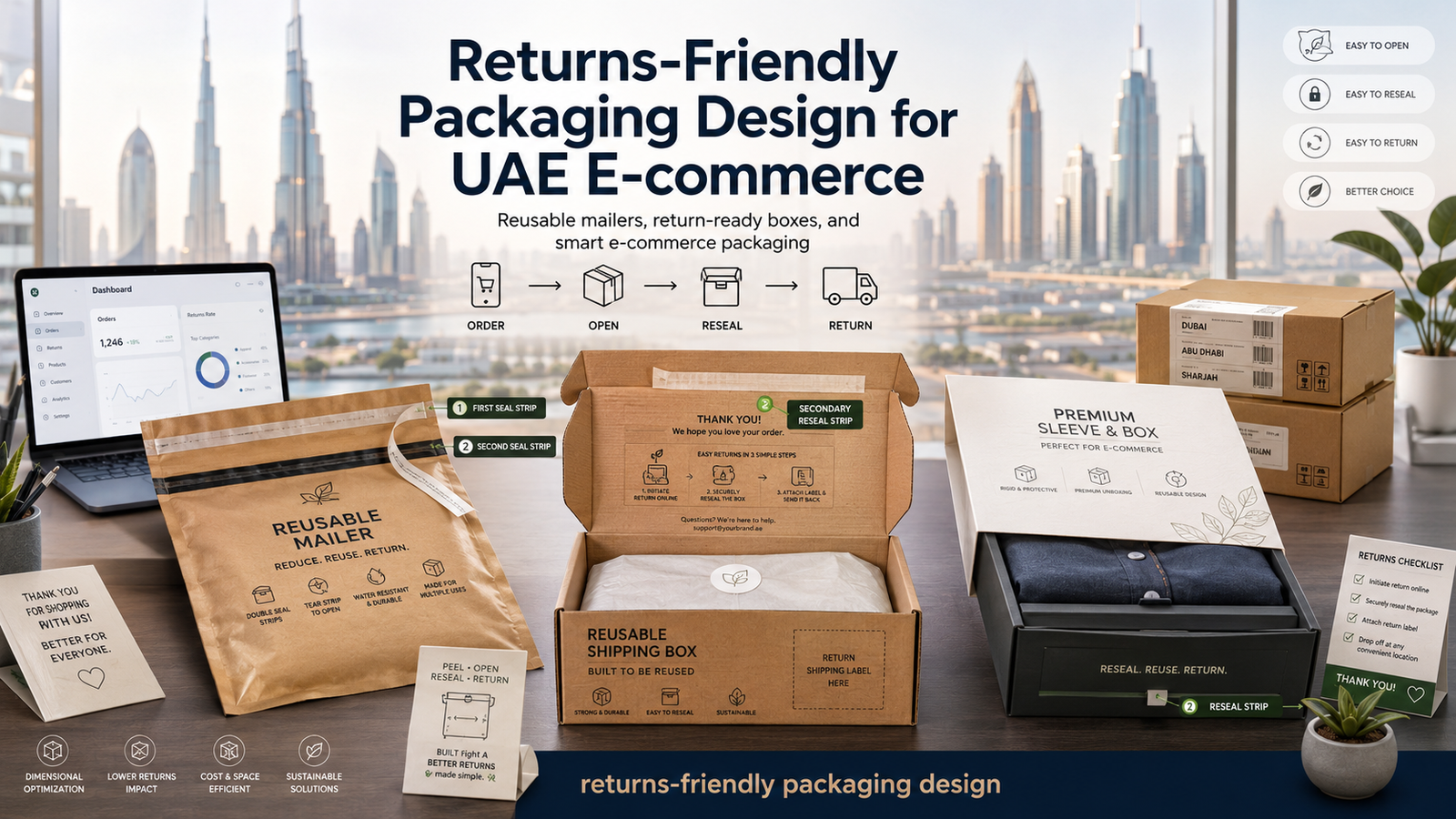
Four principles anchor returns-friendly packaging design. Reusability for return shipping: the package itself functions as the return shipment container — eliminating the customer burden of finding return shipping. This typically uses double-adhesive seal strips (customer opens with the first strip, then closes for return with the second), reusable mailer formats with integrated return adhesive, or two-piece sleeve-and-box formats that reassemble for return. Dimensional optimisation for return shipping: packaging dimensioned to match product dimensions closely — minimising dimensional weight for return shipping cost. Major UAE shipping carriers (Aramex, DHL UAE, Emirates Post, Fetchr) calculate shipping based on the greater of actual weight or dimensional weight; oversized packaging substantially increases return shipping cost. Return-instruction integration: printed return instructions integrated into packaging itself — return shipping label placement, return form attachment, return process step-by-step printed on inner packaging surface for visibility when the customer opens the package. Damage-resistant during return transit: packaging engineered to withstand return shipping transit without further degradation.
Material and Format Selection
Reusable poly mailer bags with double-adhesive seal
The most-substantial returns-friendly format for UAE e-commerce — poly mailer bags (often kraft poly or recycled poly for sustainability alignment) with two adhesive seal strips. Customer opens the package using the first strip, then uses the second strip to seal the package for return shipping. Per-unit economics: AED 1.50-8 per mailer at standard sizes and volumes — 30-80% premium over single-seal conventional mailers, with the returns-handling and customer-satisfaction benefits warranting the premium for returns-sensitive product categories. Best for: apparel, accessories, soft goods, books, smaller consumer electronics — categories where returns are operationally substantial and the products withstand poly mailer protection without rigid packaging requirements. The mailing bag printing UAE programmes cover poly mailer formats including returns-friendly double-adhesive variants.
Reusable corrugated boxes with adhesive return seal
Corrugated cardboard shipping boxes with integrated return-friendly design — typically featuring a secondary adhesive strip for return resealing, optional return tear-strip for clean opening, and dimensional engineering for return shipping efficiency. Per-unit economics: AED 4-25 per box at standard sizes and volumes — 20-50% premium over conventional shipping boxes. Best for: consumer electronics, home goods, fragile items, premium gift items, and broader product categories requiring rigid packaging protection. The shipping box printing UAE programmes cover corrugated returns-friendly variants.
Sleeve-and-box reusable formats
Two-piece sleeve-and-box formats — a printed outer sleeve and a rigid inner box that reassemble for return shipping. Per-unit economics: AED 8-45 per set at standard sizes — premium register relative to conventional packaging. Best for: premium gift packaging, premium consumer electronics, premium apparel and accessories where the packaging itself contributes to brand experience.
Integration with Major UAE E-commerce Platforms
Three integration considerations apply across major UAE e-commerce platforms. Amazon UAE: Amazon’s returns process generates return shipping labels electronically; returns-friendly packaging supports Amazon’s process by providing the resealable packaging the customer needs without additional steps. Amazon’s FBA (Fulfillment by Amazon) programme handles returns processing for FBA-fulfilled inventory; FBA-eligible packaging warrants Amazon-specification compliance review at packaging design stage. Noon: Noon’s returns process operates similarly with electronic return label generation. Noon partner sellers handle returns under Noon’s marketplace returns framework. Direct-to-consumer e-commerce: direct-to-consumer brands operating proprietary e-commerce (independent of Amazon UAE, Noon) have full control over returns process design — returns-friendly packaging combines with proprietary return shipping label generation, return process customer communication, and brand-experience integration. Carrefour Online and broader marketplace: Carrefour Online and broader UAE marketplace platforms operate at varying returns process maturity — returns-friendly packaging supports the customer experience regardless of platform maturity.
Per-Unit Economics and Programme Cost
The economics of returns-friendly packaging integrate three cost dimensions. Per-unit packaging cost premium: 20-80% premium over conventional packaging depending on material and format — kraft poly returns mailers at 30-50% premium, corrugated returns boxes at 20-40% premium, premium sleeve-and-box formats at 50-150% premium. Returns-handling cost savings: substantial — returns-friendly packaging eliminates operational steps and customer service interventions required when customers don’t have appropriate return packaging. For categories with substantial returns rates (apparel 15-25% returns rate, consumer electronics 8-15%, broader consumer goods 5-12%), the returns-handling cost savings often exceed the per-unit packaging premium. Customer satisfaction and lifetime value impact: substantively-positive — returns-friendly packaging consistently rates as a substantial customer satisfaction driver; the lifetime value impact of improved returns experience exceeds the per-unit packaging cost premium across customer cohorts.
Operational Best Practices
Four operational practices anchor effective returns-friendly packaging programmes. Return-rate-based packaging tier selection: apply returns-friendly packaging selectively to product categories with substantial returns rates (apparel, consumer electronics, fragile items) rather than universally — categories with minimal returns rates (consumables, low-cost items) don’t warrant the packaging premium. Returns-process customer communication integration: the packaging design includes clear return instructions integrated visually with the product unboxing experience. Sustainable returns-friendly packaging alignment: returns-friendly packaging combines naturally with sustainable packaging programmes — kraft poly returns mailers, recycled card returns boxes, and biodegradable returns packaging deliver both returns convenience and sustainability framework alignment. The custom packaging printing UAE programmes integrate returns-friendly sustainable variants across e-commerce, retail, and broader packaging contexts. Returns-data feedback loop: returns data (returns rate, returns-reason analysis, returns-shipping-damage analysis) feeds back into packaging design iteration — packaging dimensions, material specifications, and format selection refined based on actual returns data across product cycles.
Order Yours Today
Execute UAE e-commerce returns-friendly packaging programmes optimised for Amazon UAE, Noon, and direct-to-consumer contexts.
Reusable kraft poly mailers with double-adhesive seal (AED 1.50-8), reusable corrugated returns boxes (AED 4-25), sleeve-and-box premium formats (AED 8-45) — across apparel, electronics, fragile items, premium gifts. Sustainable kraft and recycled-content variants available. Returns-instruction integration, Amazon FBA-compliant variants, dimensional optimisation for UAE shipping carriers.
Same-day Dubai delivery for orders placed before 11am (12pm for UV-printed items). UAE-wide delivery 1–3 business days. GCC cross-border 7–14 days. Order via WhatsApp or our online form.
Frequently Asked Questions About Returns-Friendly Packaging UAE E-commerce Design
What is returns-friendly packaging design?
Returns-friendly packaging is packaging engineered to support easy and dignified returns processing — the package itself functions as the return shipment container, eliminating customer burden of finding return packaging. Common features include double-adhesive seal strips (customer opens with first strip, closes for return with second), dimensional optimisation matching product dimensions to minimise return shipping cost, integrated return instructions printed on inner packaging surfaces, and damage-resistant engineering for return transit. The substantive benefits include reduced returns-handling cost, improved customer satisfaction, and operational efficiency across UAE e-commerce returns processing.
What materials work best for returns-friendly packaging in UAE?
Three material categories work substantively. Reusable poly mailer bags with double-adhesive seal (often kraft poly or recycled poly for sustainability alignment, AED 1.50-8 per mailer, 30-80% premium over single-seal mailers) for apparel, accessories, soft goods, books, smaller electronics. Reusable corrugated cardboard boxes with adhesive return seal (AED 4-25 per box, 20-50% premium over conventional shipping boxes) for consumer electronics, home goods, fragile items, premium gifts. Sleeve-and-box reusable formats (AED 8-45 per set, premium register) for premium gift packaging, premium electronics, premium apparel where packaging contributes to brand experience.
How does returns-friendly packaging integrate with Amazon UAE?
Amazon UAE’s returns process generates return shipping labels electronically; returns-friendly packaging supports Amazon’s process by providing the resealable packaging the customer needs without additional steps — the customer opens the package, prints the Amazon-provided return label, applies the label to the package, and uses the second adhesive strip to reseal for return shipping. Amazon’s FBA (Fulfillment by Amazon) programme handles returns processing for FBA-fulfilled inventory; FBA-eligible packaging warrants Amazon-specification compliance review at packaging design stage to ensure the packaging meets Amazon’s FBA prep requirements alongside returns-friendly design.
What is the cost premium for returns-friendly packaging?
Per-unit packaging cost premium ranges 20-80% over conventional packaging depending on material and format. Kraft poly returns mailers at 30-50% premium over single-seal mailers. Corrugated returns boxes at 20-40% premium over conventional shipping boxes. Premium sleeve-and-box formats at 50-150% premium. The cost premium typically offsets through returns-handling cost savings — eliminating operational steps and customer service interventions required when customers don’t have appropriate return packaging. For categories with substantial returns rates (apparel 15-25%, consumer electronics 8-15%, broader consumer goods 5-12%), returns-handling savings often exceed packaging premium.
How should returns-friendly packaging include return instructions?
Return-instruction integration works best when printed return instructions are integrated visually with the product unboxing experience — return shipping label placement, return form attachment, return process step-by-step printed on inner packaging surfaces visible when the customer opens the package. The customer sees the return information naturally during unboxing rather than searching for return instructions later. Common implementations include printed inner-flap instructions on shipping boxes, printed inner-surface instructions on poly mailers visible after opening, and tear-off return forms attached to inner packaging. The instruction format coordinates with the e-commerce platform’s returns process (Amazon UAE, Noon, direct-to-consumer).
Should sustainability and returns-friendly design combine in packaging programmes?
Yes — returns-friendly packaging combines naturally with sustainable packaging programmes for substantively-aligned outcomes. Kraft poly returns mailers (kraft paper-fibre poly mailers with double-adhesive seal) deliver both returns convenience and sustainability framework alignment. Recycled card returns boxes (70-100% recycled corrugated cardboard with returns-friendly design) deliver both benefits. Biodegradable returns packaging (PBAT or starch-based bioplastic mailers with double-adhesive seal) extends sustainability alignment further. The combined design approach aligns with UAE Net Zero 2050, Dubai Plastic-Free Initiative, and corporate ESG frameworks while delivering returns convenience.
Which product categories warrant returns-friendly packaging?
Apply returns-friendly packaging selectively based on returns rate. Substantial-returns categories warranting returns-friendly packaging: apparel (typical returns rate 15-25%), consumer electronics (8-15%), fragile items and homewares (5-12%), accessories and jewellery (8-15%), shoes and footwear (15-20%). Modest-returns categories where returns-friendly packaging may not warrant the premium: consumables (under 3% returns), low-cost items (under AED 50 with under 5% returns), specialty items with non-returnable characteristics. The returns-rate threshold for returns-friendly packaging investment typically sits at 5-8% returns rate — categories above this threshold benefit from the packaging premium.
How should returns data feed back into packaging design?
Returns-data feedback loop integrates returns rate analysis, returns-reason analysis, and returns-shipping-damage analysis into packaging design iteration. Returns rate: categories with rising returns rates may warrant packaging redesign for returns convenience or product-fit issues; categories with declining returns rates suggest packaging effectiveness. Returns-reason analysis: damage-during-shipping returns suggest packaging protection improvements; product-condition returns suggest packaging-quality or product-presentation improvements; size or fit returns suggest packaging shouldn’t change but product communication should. Returns-shipping-damage analysis: damage occurring during return transit suggests packaging engineering improvements for return-transit conditions. Iteration cycles typically operate quarterly or semi-annually with substantial e-commerce volume.