Sustainable Packaging UAE: Kraft, Recycled, Biodegradable Options
Sustainable packaging in UAE has shifted from niche specialty register into mainstream commercial register across the past five years — driven by UAE federal sustainability framework (UAE Net Zero 2050), Dubai’s strategic environmental positioning (Dubai Net Zero 2050, Dubai Plastic-Free Initiative), GCC-wide environmental regulation tightening, consumer preference shifts particularly among UAE millennial and Gen-Z demographics, and the substantial corporate ESG reporting expectations now applying to UAE-listed and major-multinational entities operating in UAE. The substantive availability of sustainable packaging materials and production capability in UAE supports comprehensive sustainable packaging programmes across e-commerce, retail, hospitality, gift packaging, and corporate-branded packaging contexts. This guide covers the substantial sustainable packaging material categories (kraft, recycled card, biodegradable plastics, compostable films, FSC-certified papers), UAE supplier landscape, per-unit economics, regulatory and ESG-framework alignment, design considerations, and the practical operational considerations for transitioning packaging programmes to sustainable register.
Sustainable Packaging Material Categories
Kraft paper and kraft card
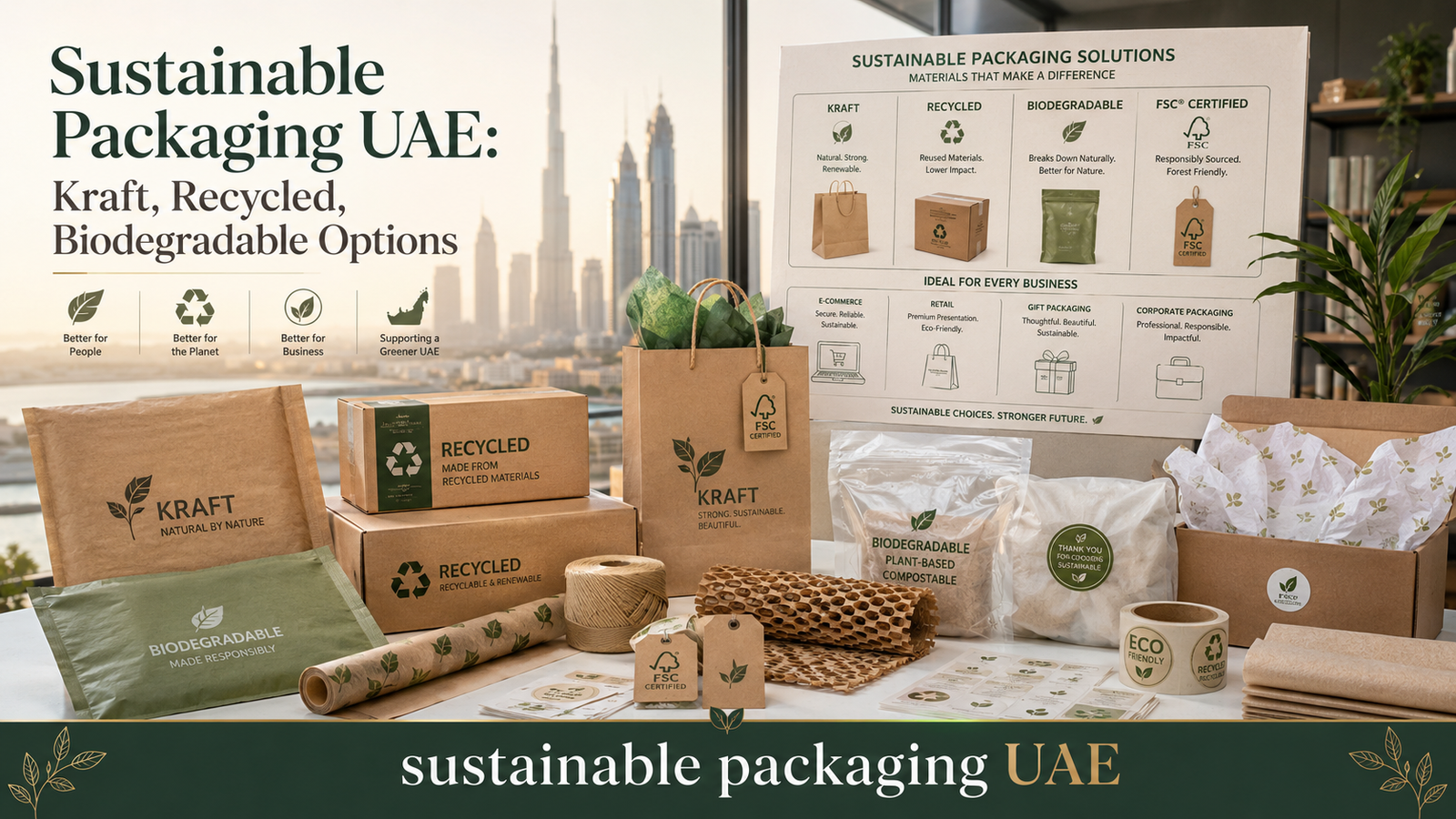
Kraft paper and kraft card are the most-substantial sustainable packaging material categories in UAE — natural unbleached or minimally-bleached paper produced from sustainably-sourced wood pulp, with characteristic natural brown colour and visible fibre texture. Sustainability characteristics: renewable raw material (sustainably-managed forestry), recyclable through standard paper recycling streams, biodegradable in natural environments, low manufacturing carbon footprint relative to plastic packaging. Production options: kraft mailer bags, kraft shipping boxes, kraft gift boxes, kraft wrapping paper, kraft labels and stickers, kraft tissue paper for void-fill, kraft tape for sealing. UAE supply landscape: substantial — major UAE packaging suppliers carry kraft inventory across all common sizes and formats. Per-unit economics: AED 0.50-3.50 per piece for standard kraft mailers, AED 2-15 per piece for kraft shipping boxes, AED 3-25 per piece for premium kraft gift boxes. Premium custom-printed kraft packaging at AED 5-50+ per piece depending on size and print complexity. The custom packaging printing UAE programmes operate kraft-tier packaging across e-commerce, retail, and gift packaging.
Recycled card and recycled paper
Recycled card and recycled paper materials use post-consumer recycled paper content as the primary raw material — typically 70-100% recycled content depending on grade. Sustainability characteristics: diverts paper from waste streams into new packaging, substantially-reduced raw material and manufacturing carbon footprint compared to virgin paper, recyclable again through standard paper streams, biodegradable. Visual characteristics: recycled card typically retains the visible fibre texture of recycled paper sources — slightly-flecked appearance distinguishing recycled card from virgin card. Recycled white card with bleaching is available but at higher per-unit cost than natural recycled card. UAE supply landscape: substantial — UAE packaging suppliers carry recycled card across standard sizes; FSC-certified recycled card is widely available. Per-unit economics: AED 1-5 per piece for standard recycled card mailers, AED 3-18 per piece for recycled card shipping boxes, AED 4-30 per piece for premium recycled card gift packaging. The shipping box printing UAE programmes integrate recycled card across shipping packaging tiers.
Biodegradable plastics
Biodegradable plastics (PLA polylactic acid, PBAT polybutylene adipate terephthalate, starch-based bioplastics) are plant-derived plastic alternatives that biodegrade under composting conditions. Sustainability characteristics: plant-derived raw materials (corn starch, sugarcane, cassava typically), biodegradable under industrial composting conditions (some materials also biodegrade in home composting and natural environments), reduced fossil-fuel raw material dependency. UAE-specific consideration: industrial composting infrastructure in UAE is limited — biodegradable plastics that require industrial composting conditions to break down don’t deliver the full sustainability benefit in UAE waste-stream contexts where the materials may still end up in landfill where biodegradation doesn’t occur. Materials biodegradable under natural-environment conditions (PBAT, starch-based blends in some formulations) deliver more-complete sustainability in UAE context. Production options: biodegradable mailer bags, biodegradable shipping bags, biodegradable food-service packaging (where applicable to gift hampers including consumables). Per-unit economics: AED 1.50-8 per piece for biodegradable mailers, AED 3-20 per piece for biodegradable shipping packaging. 30-100% premium over equivalent conventional plastic packaging.
Compostable films and packaging
Compostable films include cellulose-based clear films (cellulose acetate, regenerated cellulose), PLA-based clear films, and bagasse (sugarcane fibre) pulp packaging for premium-tier sustainable packaging contexts. Production options: compostable window envelopes for gift packaging, compostable display packaging, bagasse trays and inserts for gift hampers. Per-unit economics: AED 3-25 per piece depending on application — premium register relative to conventional packaging.
FSC-certified premium papers
FSC (Forest Stewardship Council)-certified papers carry independent third-party certification of sustainable forestry sourcing — appropriate for premium sustainable packaging programmes requiring credible sustainability documentation for ESG reporting and corporate sustainability framework compliance. Premium FSC-certified papers across full range from natural kraft through bleached premium card.
UAE Regulatory and ESG Framework Alignment
Three frameworks shape sustainable packaging programme selection in UAE. UAE federal sustainability framework: UAE Net Zero 2050 strategic initiative, UAE Climate Change and Environment regulatory framework, UAE Single-Use Plastic Ban (implemented at emirate level — Abu Dhabi 2022, Dubai 2024, broader emirate-level rollouts). Sustainable packaging programmes align with the UAE national sustainability direction. Dubai-specific framework: Dubai Plastic-Free Initiative, Dubai Plan 2030 sustainability targets, Dubai Net Zero 2050 commitments. Dubai-based companies increasingly apply substantial sustainability framework expectations to packaging procurement decisions. Corporate ESG framework alignment: UAE-listed entities (ADX, DFM) and major-multinational subsidiaries operating in UAE apply substantial ESG reporting frameworks — sustainable packaging contributes to corporate ESG metrics across waste reduction, carbon footprint reduction, and sustainable supply chain reporting. The mailing bag printing UAE programmes increasingly integrate sustainable mailer options across e-commerce contexts.
Design Considerations for Sustainable Packaging
Sustainable packaging design integrates four considerations. Visual sustainability cues: the natural kraft texture, visible recycled fibre flecking, and natural unbleached colour palette of sustainable materials communicate sustainability visually — design treatments that leverage these visual cues reinforce the sustainability positioning rather than fighting against the material’s natural appearance. Sustainability certification marks: FSC certification mark, recycled content percentage marks, compostable certification marks, and biodegradability certification marks build credibility for substantively-sustainable packaging programmes — design integration of these marks supports the substantive sustainability framework alignment. Ink and print selection: sustainable packaging programmes warrant ink-and-print selection that maintains the sustainability framework — vegetable-based inks rather than petroleum-based inks where available, water-based inks for flexographic printing, minimal ink coverage (avoiding heavy full-bleed printing) to maintain the kraft or recycled card’s visual character. End-of-life messaging: packaging design can incorporate clear end-of-life messaging guiding the recipient to recycle, compost, or reuse the packaging — supporting the substantive sustainability outcome.
Transitioning Packaging Programmes to Sustainable Register
Three transition approaches work for UAE companies moving packaging programmes to sustainable register. Material substitution within existing format: the most-accessible transition — replacing conventional materials (plastic mailers, virgin paper card, bleached white card) with sustainable equivalents (biodegradable mailers, kraft, recycled card) while maintaining existing packaging dimensions, formats, and operational workflows. Low transition complexity, immediate sustainability impact. Format redesign for sustainability: moderate transition — redesigning packaging formats to optimise for sustainability (eliminating unnecessary inner packaging, reducing packaging weight, optimising packaging dimensions to product dimensions). Higher transition complexity but substantively-deeper sustainability impact. Comprehensive packaging programme restructure: substantial transition — comprehensive packaging programme redesign integrating sustainable materials, optimised formats, supply chain restructuring for shorter logistics, and consumer-facing sustainability programme communication. High transition complexity, substantively-comprehensive sustainability outcome.
Order Yours Today
Execute UAE sustainable packaging programmes aligned with UAE Net Zero 2050, Dubai Plastic-Free Initiative, and corporate ESG frameworks.
Kraft paper and card, recycled card and paper (70-100% recycled), biodegradable plastics (PLA, PBAT, starch-based), compostable films and packaging, FSC-certified premium papers — across e-commerce mailers, shipping boxes, gift boxes, wrapping, labels, and corporate-branded packaging at AED 0.50-50+ per piece across material categories and volumes.
Same-day Dubai delivery for orders placed before 11am (12pm for UV-printed items). UAE-wide delivery 1–3 business days. GCC cross-border 7–14 days. Order via WhatsApp or our online form.
Frequently Asked Questions About Sustainable Packaging UAE
What sustainable packaging materials are available in UAE?
Five substantial material categories. Kraft paper and kraft card (natural unbleached paper from sustainably-sourced wood pulp, AED 0.50-50+ per piece). Recycled card and recycled paper (70-100% recycled content, AED 1-30 per piece). Biodegradable plastics (PLA, PBAT, starch-based bioplastics, AED 1.50-20 per piece). Compostable films (cellulose-based and PLA clear films, bagasse pulp, AED 3-25 per piece). FSC-certified premium papers for credible sustainability documentation. UAE packaging suppliers carry substantial inventory across kraft and recycled card; biodegradable plastics and compostable materials available across major UAE packaging suppliers.
How does kraft packaging compare to conventional white card?
Kraft packaging uses natural unbleached or minimally-bleached paper produced from sustainably-sourced wood pulp, with characteristic natural brown colour and visible fibre texture. Sustainability advantages: renewable raw material from sustainably-managed forestry, recyclable through standard paper streams, biodegradable, lower manufacturing carbon footprint than bleached white card. Visual character: natural brown colour and fibre texture create a substantively-distinct visual register from white card — design treatments leverage this visual character. Per-unit economics: kraft typically costs similar to or slightly less than equivalent virgin white card, with substantial cost advantages over bleached premium white card. Production options span mailers, shipping boxes, gift boxes, wrapping paper, labels, and tape.
Are biodegradable plastics effective for UAE waste-stream conditions?
Partially — UAE industrial composting infrastructure is limited, which affects which biodegradable plastics deliver their full sustainability benefit in UAE waste-stream contexts. Biodegradable plastics requiring industrial composting conditions (typical PLA polylactic acid) don’t fully biodegrade in UAE landfill waste streams. Materials biodegradable under natural-environment conditions (PBAT polybutylene adipate terephthalate, starch-based bioplastic blends in some formulations) deliver more-complete sustainability in UAE waste-stream context. UAE companies selecting biodegradable plastics warrant attention to which biodegradation conditions apply to the specific material — the sustainability claim varies by material formulation and end-of-life destination.
What UAE regulations apply to packaging sustainability?
Three frameworks shape UAE packaging sustainability. UAE federal: Net Zero 2050 strategic initiative, Climate Change and Environment regulatory framework, Single-Use Plastic Ban (Abu Dhabi 2022, Dubai 2024, broader emirate-level rollouts). Dubai-specific: Plastic-Free Initiative, Dubai Plan 2030 sustainability targets, Net Zero 2050 commitments. Corporate ESG framework: UAE-listed entities (ADX, DFM) and major-multinational subsidiaries operating in UAE apply substantial ESG reporting frameworks where sustainable packaging contributes to corporate metrics across waste reduction, carbon footprint reduction, and sustainable supply chain reporting.
What is FSC certification and why does it matter for sustainable packaging?
FSC (Forest Stewardship Council) certification provides independent third-party certification of sustainable forestry sourcing for paper and card packaging materials. FSC certification matters for sustainable packaging programmes requiring credible sustainability documentation — ESG reporting, corporate sustainability framework compliance, and consumer-facing sustainability claims that warrant third-party verification rather than unverified manufacturer claims. Premium FSC-certified papers are available across full range from natural kraft through bleached premium card in UAE. FSC certification cost premium typically 5-15% over equivalent non-certified paper, with the credibility benefit warranting the premium for substantively-sustainable programmes.
How should sustainable packaging be designed visually?
Four considerations anchor sustainable packaging design. Visual sustainability cues: natural kraft texture, visible recycled fibre flecking, and natural unbleached colour palette communicate sustainability visually — design treatments leveraging these cues reinforce the positioning. Sustainability certification marks (FSC, recycled content percentage, compostable certification, biodegradability certification) build credibility — design integration supports framework alignment. Ink and print selection: vegetable-based inks rather than petroleum-based where available, water-based inks for flexographic printing, minimal ink coverage maintaining kraft or recycled card’s visual character. End-of-life messaging guides recipients to recycle, compost, or reuse the packaging.
What is the per-unit cost difference between sustainable and conventional packaging?
Per-unit cost varies by material category. Kraft packaging typically costs similar to or slightly less than equivalent virgin paper packaging — sustainability gain without cost premium. Recycled card packaging typically costs 5-20% premium over equivalent virgin card. Biodegradable plastics typically cost 30-100% premium over equivalent conventional plastic. Compostable films and packaging typically cost 50-150% premium. FSC-certified papers typically cost 5-15% premium over equivalent non-certified paper. The total sustainability programme cost depends on material mix; kraft-and-recycled-card-anchored programmes can achieve substantial sustainability outcomes at minimal cost premium, while comprehensive sustainability programmes integrating biodegradable plastics and compostable materials warrant 30-100% cost premium budget allocation.
How should UAE companies transition packaging programmes to sustainable register?
Three transition approaches work. Material substitution within existing format: most-accessible transition — replacing conventional materials with sustainable equivalents while maintaining existing dimensions, formats, and workflows. Low transition complexity, immediate sustainability impact. Format redesign for sustainability: moderate transition — redesigning formats to optimise for sustainability (eliminating unnecessary inner packaging, reducing weight, optimising dimensions to products). Higher complexity but deeper impact. Comprehensive packaging programme restructure: substantial transition — comprehensive redesign integrating sustainable materials, optimised formats, supply chain restructuring, and consumer-facing sustainability communication. High complexity, comprehensive outcome.