
Barcode Printing for FNSKU and EAN: A Fulfilment Essentials Guide
Barcode printing is one of the most-overlooked operational categories in UAE e-commerce fulfilment — the FNSKU labels Amazon UAE FBA requires on every unit, the EAN-13 barcodes for retail-channel distribution, the SSCC labels for pallet-level shipping, and the QR codes for traceability. Most first-time UAE Amazon sellers and retail brands underestimate the production complexity of barcode labelling at scale; the barcodes that fail to scan at FBA receipt or POS produce expensive operational issues. This guide covers FNSKU and EAN barcode printing for UAE fulfilment in 2026 — the technical specifications, the production methods, the quality requirements, and the operational realities of barcode labelling at e-commerce scale.
What FNSKU and EAN Barcodes Actually Are
FNSKU (Fulfillment Network Stock Keeping Unit)
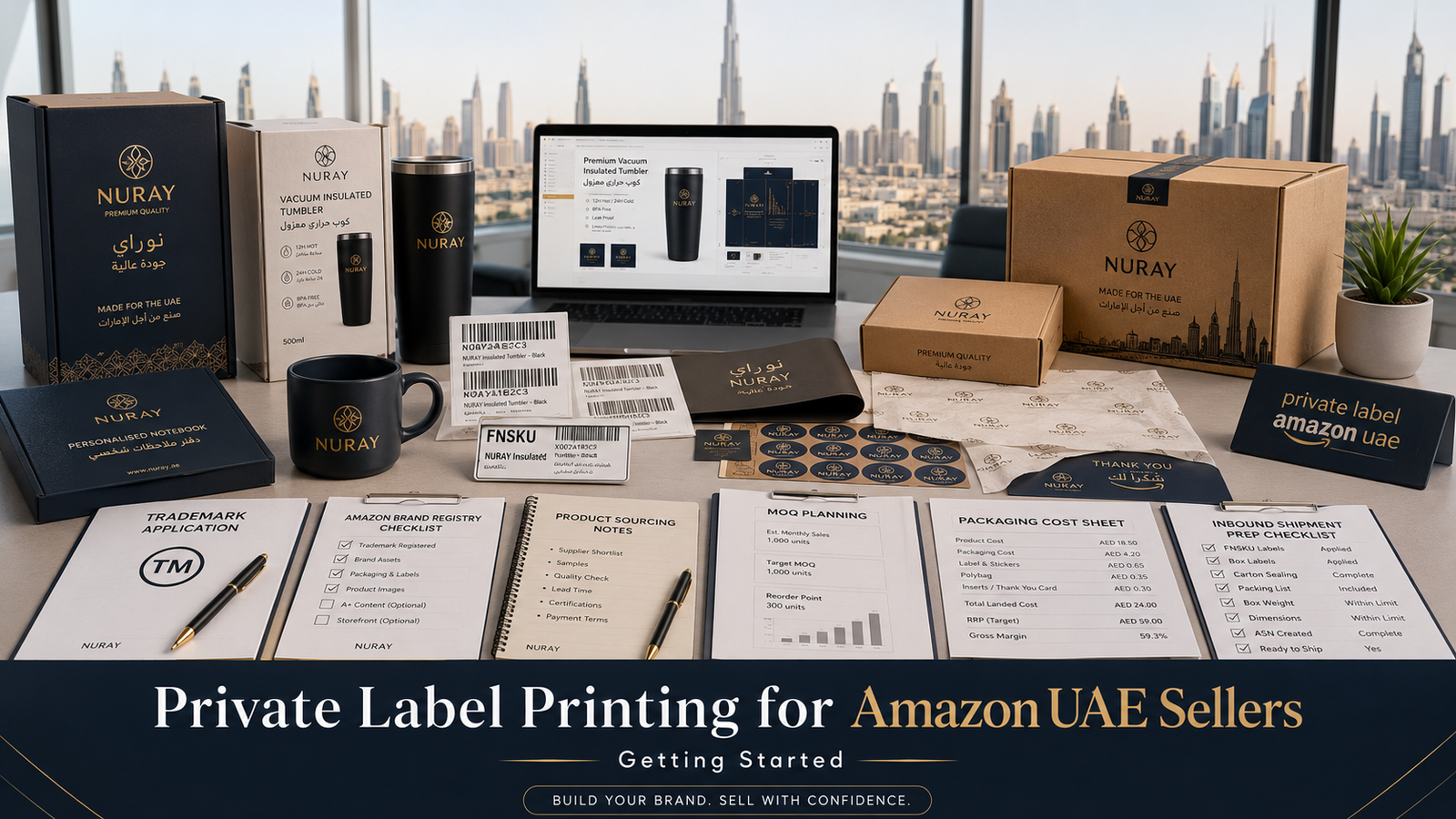
Amazon’s internal barcode system for FBA inventory. Each unique product variant in an Amazon seller’s catalogue has a unique FNSKU code (typically X-prefix followed by 9 alphanumeric characters). Generated through Seller Central; printed as Code 128 barcode format on FBA-bound inventory. Required on every unit shipping to FBA UAE warehouses; missing FNSKU produces FBA receipt failure. The FNSKU label typically includes the barcode itself plus the product title and the FNSKU code printed below for human-readable verification.
EAN-13 (European Article Number)
The international retail barcode standard. 13-digit numeric code in EAN-13 barcode format. Required for retail-channel distribution (supermarkets, traditional retail), used in some Amazon contexts as the master product identifier (the ASIN may be linked to the EAN-13 in Amazon’s catalogue). Generated through GS1 (the official barcode authority) for retail compliance; UAE retail brands typically register through GS1 UAE for UAE-issued EANs. Amazon FBA fulfilment programmes use either FNSKU (Amazon-only inventory) or EAN-13 (multi-channel inventory) depending on the channel strategy.
SSCC (Serial Shipping Container Code)
Pallet-level barcode for shipping container tracking. 18-digit code in Code 128 barcode format. Used by FBA and retail logistics for pallet-tracking through the supply chain. Less commonly required for individual sellers; relevant for higher-volume sellers shipping at pallet scale.
Barcode Production Methods
Direct thermal printing
The dominant method for high-volume FNSKU and EAN labelling. Thermal printers (Zebra, Honeywell, TSC) print barcodes onto thermal-paper labels at high speed and low per-label cost. Suitable for sellers running their own labelling in-house; thermal printers cost AED 600–2500 depending on speed and label width capacity. AED 0.05–0.20 per label in materials.
Sticker labels via UV digital print
For sellers outsourcing barcode label production rather than running in-house thermal printing, UV digital printing on sticker label material produces high-quality FNSKU and EAN labels at moderate per-piece cost. AED 0.30–1.20 per label at 1000–5000 piece runs. Private label programmes often include barcode sticker production as part of broader retail-brand label production.
Pre-printed labels integrated into product packaging
For higher-volume sellers, FNSKU or EAN barcodes printed directly onto product packaging during the packaging production run rather than applied as stickers post-production. Custom packaging printing programmes can integrate barcode placement into the packaging design. Lowest per-unit cost at high volume; requires coordination between packaging production and the seller’s barcode generation pipeline.
Barcode Quality Requirements
Three quality dimensions for FNSKU and EAN barcodes. Print resolution — barcodes need 200 DPI minimum for reliable scanning; 300 DPI is the safe production standard. Below 200 DPI produces scanning failures at FBA receipt or retail POS. Quiet zone (white space around the barcode) — minimum 2.5mm white space on each side of the barcode for reliable scanning. Insufficient quiet zones are a common scanning-failure cause that’s invisible to non-specialist visual inspection. Substrate quality — labels must be on materials that hold the print without smudging, fading, or peeling under normal handling. Cheap label materials produce barcodes that fail in the FBA inbound process.
Barcode Sizing Standards
Common barcode sizes for UAE e-commerce fulfilment. FNSKU labels: 50×30mm typical, 60×40mm for larger product applications. The label includes the barcode plus product title plus FNSKU code; 50×30mm is the minimum that fits all three legibly. EAN-13 retail barcodes: 30×20mm minimum to maintain scanning reliability at retail POS; 35×25mm for safer scanning margin. SSCC pallet labels: 100×150mm typical for pallet-level visibility. Below the minimum sizes, scanning reliability degrades; above standard sizes adds material cost without functional benefit.
Quality Control for Barcode Production
Three QC steps for barcode production. Scan-test sampling at production: sample-scan barcodes during production runs using the same scanner technology used by FBA receipt or retail POS. Failed scans during production sampling indicate a quality issue requiring intervention. Visual inspection for print defects: visible streaks, ink smudges, misalignments, or missing bar segments produce scanning failures. Visual inspection catches the obvious defects. Pre-shipment scan verification: before shipping FBA inventory, scan-verify a representative sample (1-3% of the batch) to confirm scan reliability. The pre-shipment verification catches systematic issues before they reach FBA.
Common Barcode Production Mistakes
Five mistakes recur on first-time UAE seller barcode programmes. Insufficient print resolution: using office laser printers (typically 300 DPI but often degraded by toner saving modes) for FNSKU labels produces scanning failures at FBA. Use dedicated thermal printers or outsource to UV digital production. Inadequate quiet zone: trimming labels too close to the barcode edges produces scanning failures even when the barcode itself is clean. Maintain minimum 2.5mm quiet zone on all sides. Wrong barcode format: generating EAN-13 when FNSKU is required (or vice versa). FNSKU is Code 128 format; EAN-13 is its own format. Missing human-readable text: FNSKU labels require the human-readable FNSKU code printed below the barcode for verification. Missing the human-readable line produces FBA receipt issues. Cheap label material: labels that smudge, fade, or peel during FBA inbound handling produce scanning failures and inventory delays.
Production Lead Times
Indicative production lead times for UAE barcode label production. Thermal-printed FNSKU labels (in-house): immediate; production runs at 100–500 labels per minute depending on printer speed. UV digital printed sticker labels: 3–5 working days for 1000–5000 piece runs; 5–7 days for 5000–20,000 piece runs. Pre-printed barcodes integrated into packaging: the lead time of the underlying packaging production (10–14 days for custom-printed retail boxes typically) plus any incremental complexity from the barcode integration.
FNSKU vs EAN Decision Framework
For UAE Amazon sellers, the FNSKU vs EAN decision is channel-strategic. Amazon-only inventory: FNSKU labels suffice; EAN registration not required. Most first-time and dedicated Amazon UAE sellers operate on this basis. Multi-channel inventory (Amazon + retail + other marketplaces): EAN-13 registration through GS1 is required for retail-channel compliance; FNSKU labels then layer over the EAN-labelled units for FBA-specific routing. Cross-border GCC fulfilment: EAN-13 enables broader marketplace and retail distribution beyond Amazon UAE; the GS1 registration cost is justified by the channel diversification.
Same-Day Dubai for Last-Minute Barcode Labels
Same-day Dubai applies for sticker label production at the standard 12pm UV-printed cut-off. Single-piece and small-volume rush orders for late-arrival inventory or missing-label situations are handled within the same-day window. Thermal-printed labels (in-house production) are immediately available without same-day cut-off considerations.
Order Yours Today
Spec barcode printing for UAE fulfilment that scans cleanly at FBA and retail.
FNSKU labels for Amazon UAE FBA, EAN-13 for retail distribution, thermal printing for in-house, UV digital sticker labels for outsourced production — 200+ DPI, 2.5mm quiet zones, pre-shipment scan verification.
Same-day Dubai delivery for orders placed before 11am (12pm for UV-printed items). UAE-wide delivery 1–3 business days. GCC cross-border 7–14 days. Order via WhatsApp or our online form.
Frequently Asked Questions About Fnsku Barcode Printing
What is the difference between FNSKU and EAN barcodes?
FNSKU (Fulfillment Network Stock Keeping Unit) is Amazon’s internal barcode for FBA inventory — Code 128 format, generated through Seller Central, required on every unit shipping to FBA UAE warehouses. EAN-13 is the international retail barcode standard — 13-digit numeric, generated through GS1, required for retail-channel distribution. Amazon-only sellers use FNSKU; multi-channel sellers use EAN-13 with FNSKU labels layered over.
What print resolution do FNSKU and EAN barcodes need?
200 DPI minimum for reliable scanning; 300 DPI is the safe production standard. Below 200 DPI produces scanning failures at FBA receipt or retail POS. Office laser printers (typically 300 DPI but often degraded by toner-saving modes) are insufficient for FNSKU labels; use dedicated thermal printers or outsource to UV digital production.
What is the typical FNSKU label size?
50×30mm is the standard FNSKU label size — fits the barcode plus product title plus FNSKU code legibly. 60×40mm for larger product applications where the larger label has space. Below 50×30mm, the human-readable text doesn’t fit reliably; below the minimum produces FBA receipt issues.
Should I print FNSKU labels in-house or outsource?
In-house thermal printing for sellers with consistent FBA inventory volume — Zebra, Honeywell, or TSC thermal printers at AED 600–2500 depending on speed and label width. Outsource to UV digital printing for occasional or moderate volume — AED 0.30–1.20 per label at 1000–5000 piece runs. Pre-printed barcodes integrated into packaging for high-volume sellers.
What is a ‘quiet zone’ on a barcode?
Minimum 2.5mm white space on each side of the barcode for reliable scanning. Insufficient quiet zones (trimming labels too close to barcode edges) produce scanning failures even when the barcode itself is clean. The quiet zone is invisible to non-specialist visual inspection but critical for scanner reliability.
Do EAN-13 barcodes need to be registered through GS1?
Yes — for legitimate retail-channel use, EAN-13 codes must be registered through GS1 (the official barcode authority). UAE retail brands typically register through GS1 UAE. Self-generated EAN codes without GS1 registration are not valid for retail distribution; supermarkets and traditional retail will reject products with non-registered EANs.
What barcode quality control steps are needed before FBA shipment?
Three steps: scan-test sampling during production (sample-scan using FBA-equivalent scanner technology), visual inspection for print defects (streaks, smudges, misalignments, missing bar segments), and pre-shipment scan verification on a representative 1-3% sample to confirm scan reliability. The pre-shipment verification catches systematic issues before reaching FBA.
What barcode mistakes cause FBA receipt failures most often?
Five common mistakes: insufficient print resolution (office laser printers degraded by toner saving), inadequate quiet zone (labels trimmed too close to barcode edges), wrong barcode format (EAN-13 when FNSKU is required), missing human-readable text below the barcode, and cheap label material that smudges or peels during handling. Each produces FBA receipt failures and inventory delays.