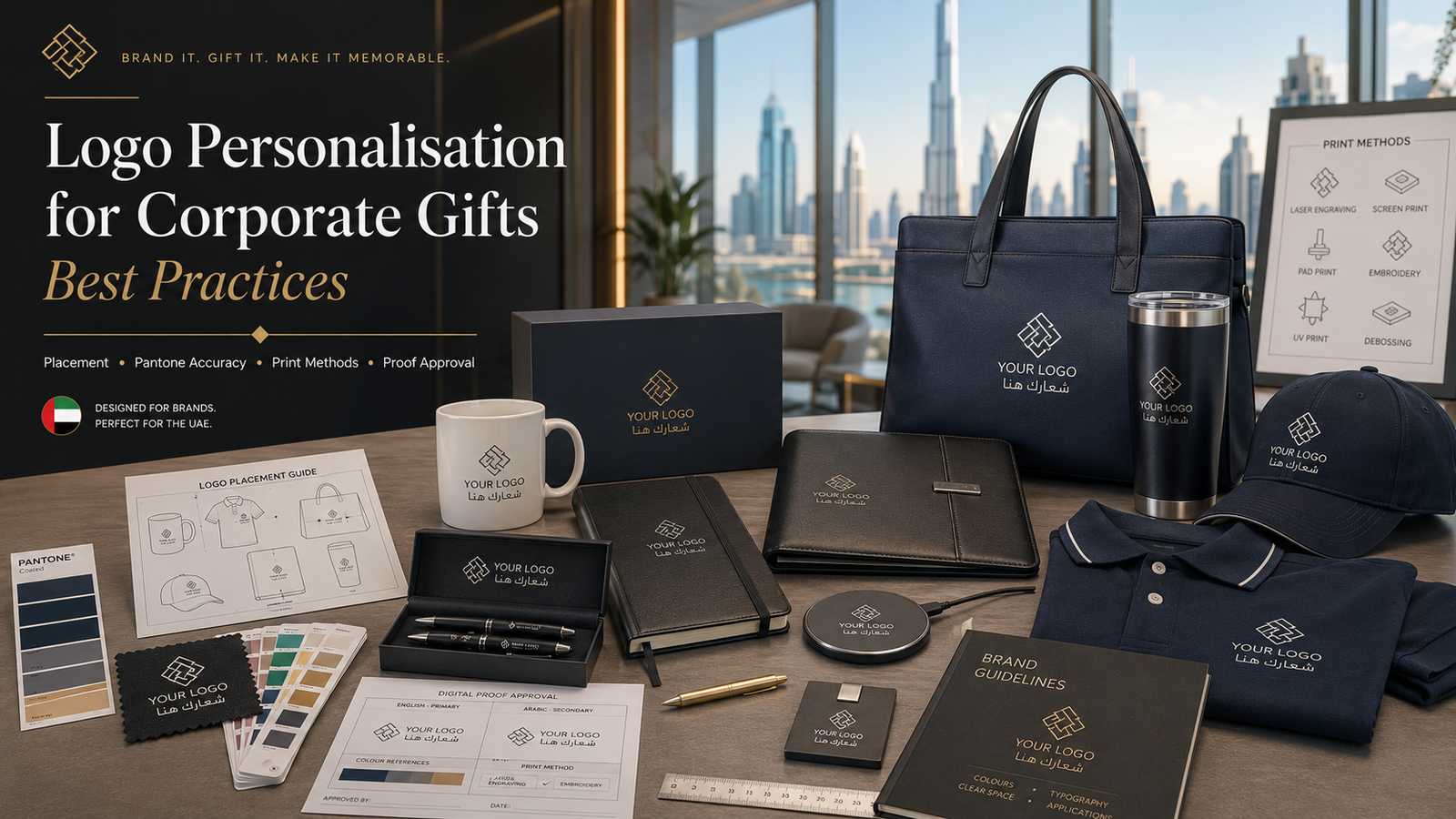
Logo Personalisation for Corporate Gifts: Best Practices
Logo personalisation on corporate gifts in UAE is the operational discipline that distinguishes thoughtful corporate gift programmes from generic branded swag. The corporate recipient — whether employee, client, prospect, or partner — registers logo personalisation as a signal of the brand’s professional rigour; well-executed logo work reinforces brand quality, while poorly-executed logo work undermines the entire programme regardless of underlying gift quality. This guide covers logo placement, sizing principles, print method selection, brand-guideline adherence, bilingual EN+AR layout considerations, and operational realities of running logo personalisation at production scale across UAE-domestic and GCC cross-border contexts.
Why Logo Personalisation Quality Disproportionately Matters
Three reasons logo work disproportionately affects corporate gift programme ROI. Brand-equity signal: the recipient registers logo quality as a proxy for the brand’s overall standards. A premium gift with poorly-executed logo work signals inconsistency that undermines brand equity; thoughtful logo work reinforces premium positioning. Lifetime-visibility multiplier: corporate gifts get used over months and years; the logo is visible at every use — poor placement or sizing creates compounding negative brand impressions across the gift’s lifetime. Recipient discrimination: senior recipients discriminate between well-executed and poorly-executed logo work measurably; programmes targeting senior-tier recipients need premium logo personalisation specifically.
Logo Placement Decisions
Surface area and visual hierarchy
Logo placement should respect the gift’s overall visual hierarchy. On drinkware, the logo positions typically on the centre-front face at eye-level when held; secondary placements (handle-side branding, base personalisation) work as part of multi-element designs. On apparel, the logo positions on the left chest, the back centre, or sleeves depending on garment type and brand register — chest-pocket placement reads as professional corporate; back-centre as casual lifestyle; sleeve-discreet as premium understated. On notebooks and stationery, the logo typically positions on the front cover lower-right or centre-bottom, with the recipient’s personalisation occupying the more-prominent placement. The logo mug printing workflows handle placement decisions at production scale across mug shapes and personalisation registers.
Sizing principles
Logo sizing should sit in the 15–25% range of the available surface area for most corporate gift applications. Smaller logos (5–15% of surface) read as premium-restraint — suitable for senior-tier gifts and minimalist brand registers. Larger logos (25–40% of surface) read as bold-corporate — suitable for trade show merchandise, employee-tier gifts, and brand-prominent contexts. Logos exceeding 40% of surface typically read as performative and undermine the gift register. The recipient’s surface engagement (which face of the mug they look at, which side of the notebook faces outward, which angle the gift sits at on a desk) informs the sizing decision.
Multi-element layouts
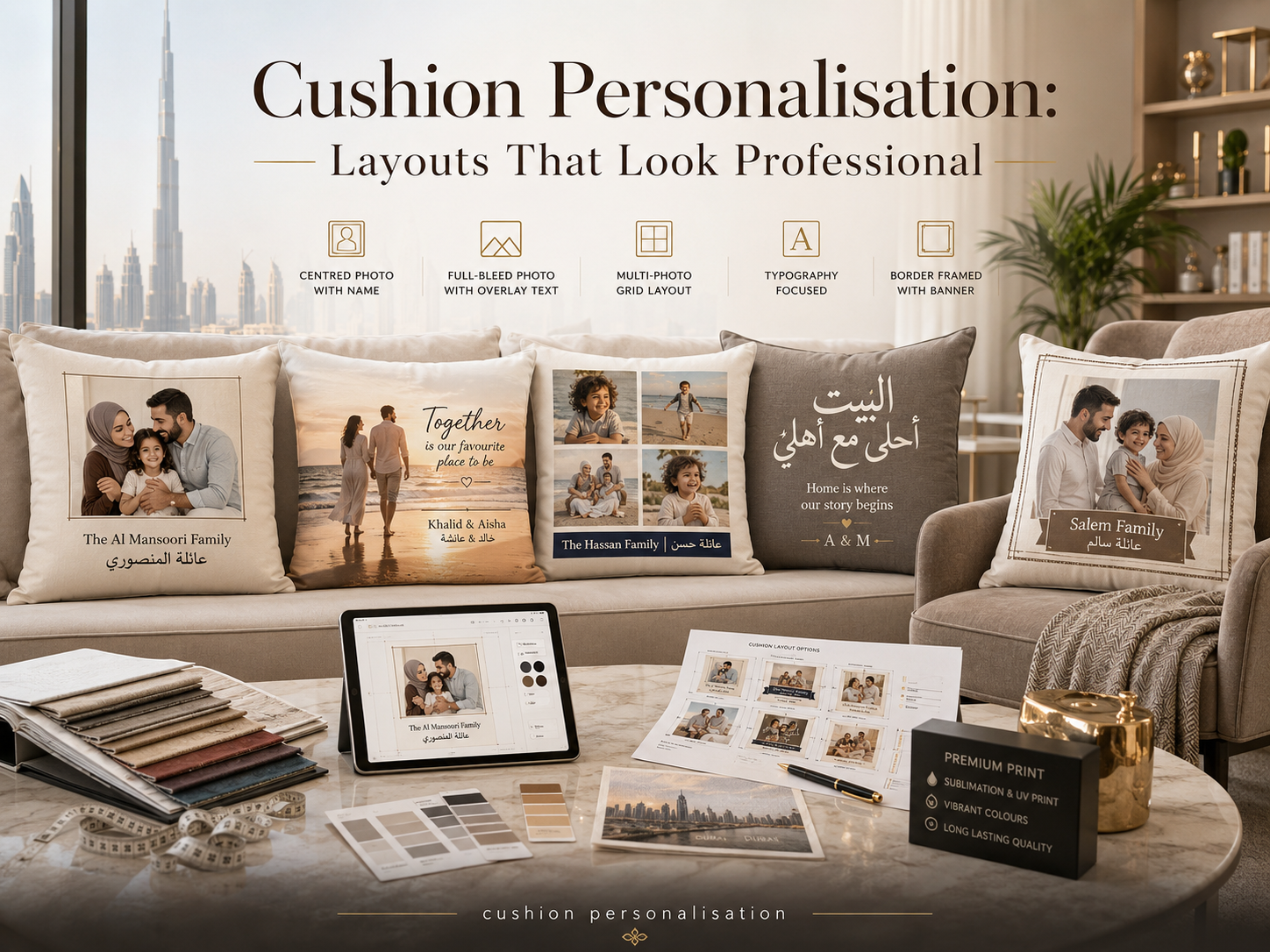
For gifts combining brand logo, recipient personalisation (name, milestone, occasion), and decorative elements, the layout hierarchy matters. The recipient’s personalisation typically occupies the prominent placement; the brand logo sits at a secondary placement (footer, base, opposite face, or smaller-scale corner placement). This hierarchy signals that the gift is genuinely for the recipient rather than a branded promotional piece — a meaningful distinction at the senior recipient register.
Print Method Selection for Logo Quality
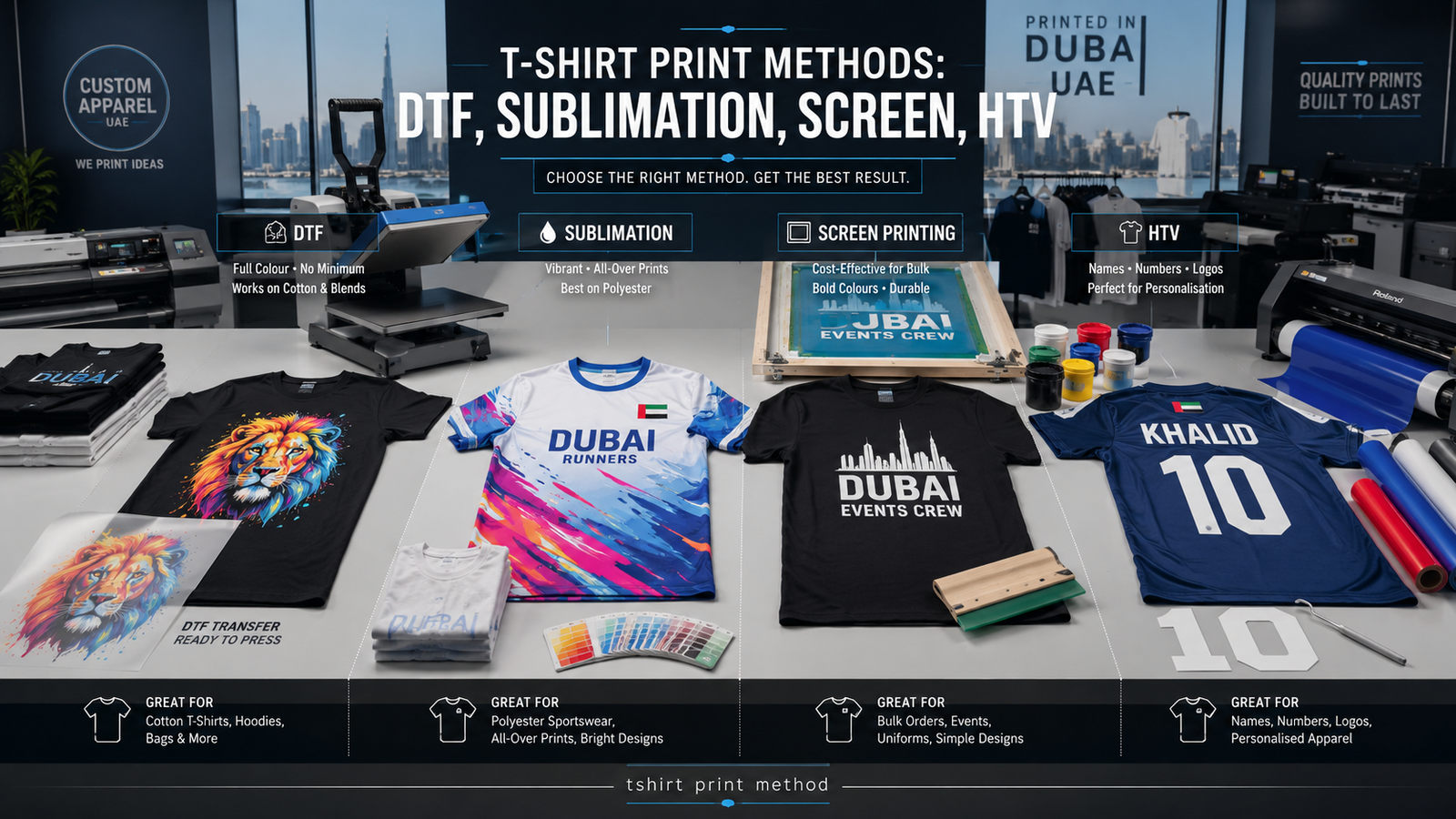
Five print methods cover most corporate gift logo applications, each with specific logo-quality characteristics. Pad printing: high-precision single-colour logo application on small curved surfaces (pens, USBs, small tech accessories). Pixel-precise edge quality. UV printing: direct-to-substrate full-colour logo printing with high colour accuracy, suitable for hard surfaces (drinkware, glass, leather, wood). Same-day capability for last-minute personalisation. Screen printing: high-volume single-to-multi-colour logo application — economical at 200+ piece volumes, professional finish, durable on apparel and bags. Sublimation: full-colour photographic-quality logo printing on polyester and polyester-coated substrates. Wash durability for apparel applications. Embroidery: premium tactile logo finish on apparel, bags, caps — three-dimensional quality that screen and DTF cannot replicate. Best for solid-colour logos at appropriate size (avoid below the embroidery minimum); fine logo detail below threshold produces character-connection issues. The custom logo printing programmes handle method selection across the corporate gift mix.
Colour and Pantone Adherence
Corporate logo colour accuracy is one of the highest-stakes quality bars in logo personalisation. Pantone matching: brands with specific Pantone colour codes for their logo (most established brands have this in their brand guidelines) require Pantone-accurate reproduction. Screen printing and pad printing handle Pantone matching cleanly; UV and sublimation approach Pantone accuracy via CMYK colour profiles with appropriate calibration. CMYK fallback: brands without specific Pantone codes work in CMYK colour space — the colour values that print accurately across UV, sublimation, and DTF methods. Substrate colour interaction: the substrate colour affects how the logo reads — light-coloured logos on dark substrates require white-ink underlay (UV and DTF support this); dark logos on light substrates print directly without underlay. Logo file requirements: vector files (AI, EPS, SVG) for screen printing, embroidery, and pad printing; high-resolution PNG or PDF (300+ DPI) for UV and sublimation; embroidery requires digitisation from the vector source.
Brand Guideline Adherence
Three brand-guideline considerations sit at the heart of professional logo personalisation. Logo lockup integrity: the brand’s specific lockup (relationship between mark and wordmark, spacing, geometric proportions) must be preserved across all applications. Stretching or reproportioning the logo signals brand-discipline failure. Clear space: brand guidelines typically specify minimum clear space around the logo — the visual buffer separating it from other design elements. Respecting this preserves readability and integrity. Minimum size: brand guidelines specify a minimum size below which the logo should not be reproduced. Violating minimum produces unreadable logos; the appropriate response is to reposition or resize.
Bilingual EN+AR Logo Considerations
UAE corporate gift programmes frequently incorporate bilingual EN+AR brand elements alongside the logo. Trilingual layouts: brand mark + English company name + Arabic company name (typically transliteration or Arabic-original wordmark) in coordinated layouts. Arabic logo wordmark variants: many established UAE brands have dedicated Arabic logo wordmark variants — separate from English logo variants — designed for Arabic-typography integrity rather than transliteration. Use the appropriate variant for the gift’s target recipient context. Right-to-left layout considerations: Arabic reads right-to-left; bilingual layouts respect both reading directions. Arabic typography style selection (Naskh standard, Diwani ceremonial, Modern contemporary) follows the brand’s broader Arabic typography conventions. Every Arabic layout is reviewed by a typography specialist before production. The private label printing programmes apply the same bilingual logo principles to multi-brand contract manufacturing across UAE production.
Operational Realities of Logo Personalisation at Production Scale
Three operational realities shape professional logo personalisation. Proof and approval workflow: every corporate gift logo personalisation should generate a digital proof before bulk production — printed mock-up or 3D rendering showing actual placement, size, colour, and registration on the substrate. The proof cycle prevents bulk errors that produce hundreds of defective pieces. Production capacity and lead times: screen printing and embroidery have setup-heavy cycles; lock orders 4–6 weeks before delivery for bulk runs. UV and sublimation handle faster turnarounds; same-day Dubai available for small-run last-minute personalisation at standard 11am or 12pm cut-offs. Quality control checkpoints: bulk programmes should integrate first-piece approval before run, mid-run sampling, end-of-run final approval. Catching registration drift mid-run preserves consignment quality.
Common Logo Personalisation Mistakes
Five mistakes recur across first-iteration corporate gift programmes. Logo stretching to fit surface: reproportioning the logo to fit a non-matching surface aspect ratio undermines brand integrity. The fix is to reposition or resize within proportion, or use a logo variant designed for the surface aspect. Colour drift across substrates: the same Pantone colour can read differently on different substrates (matte vs gloss, light vs dark, paper vs ceramic). Test colour reads on actual substrate samples before bulk production. Logo below minimum size: reproducing the logo below brand-guideline minimum produces unreadable logos; the appropriate response is to reposition or scale up rather than violate minimum. Inconsistent placement across gift mix: within a single gift programme spanning multiple gift types (mugs, notebooks, totes, apparel), inconsistent logo placement across the mix produces visual incoherence. Brand-guideline placement specifications should drive consistency. Skipping proof approval: proceeding to bulk production without proof approval is the single highest-risk operational mistake — bulk consignment errors are expensive to remediate.
Order Yours Today
Execute corporate gift logo personalisation at the brand-equity standards your programme deserves.
Pantone-accurate logo printing across mugs, drinkware, apparel, notebooks, totes, and premium gifts — pad printing, UV, screen printing, sublimation, embroidery methods, bilingual EN+AR trilingual layouts, proof approval workflow, same-day Dubai for last-minute personalisation.
Same-day Dubai delivery for orders placed before 11am (12pm for UV-printed items). UAE-wide delivery 1–3 business days. GCC cross-border 7–14 days. Order via WhatsApp or our online form.
Frequently Asked Questions About Corporate Logo Personalisation
What is the best size for a corporate logo on a personalised gift?
Logo sizing should sit in the 15–25% range of the available surface area for most corporate gift applications. Smaller logos (5–15% of surface) read as premium-restraint — suitable for senior-tier gifts and minimalist brand registers. Larger logos (25–40% of surface) read as bold-corporate — suitable for trade show merchandise and brand-prominent contexts. Logos exceeding 40% typically read as performative and undermine the gift register.
Where should the logo be placed on different corporate gifts?
On drinkware, centre-front face at eye-level when held; secondary placements (handle-side, base) for multi-element designs. On apparel, left chest reads as professional corporate; back-centre as casual lifestyle; sleeve-discreet as premium understated. On notebooks and stationery, front cover lower-right or centre-bottom, with recipient personalisation occupying the more-prominent placement. The logo placement hierarchy signals that the gift is genuinely for the recipient rather than a branded promotional piece.
What print method gives the highest-quality logo on corporate gifts?
Method depends on substrate and volume. Pad printing for high-precision single-colour on small curved surfaces (pens, USBs). UV printing for full-colour on hard surfaces (drinkware, glass, leather). Screen printing for high-volume single-to-multi-colour on apparel and bags (200+ pieces). Sublimation for full-colour photographic quality on polyester apparel. Embroidery for premium tactile finish on apparel and bags — three-dimensional quality screen and DTF cannot replicate.
How do I ensure Pantone colour accuracy across corporate gifts?
Screen printing and pad printing handle Pantone matching cleanly via Pantone-accurate inks. UV and sublimation approach Pantone accuracy via CMYK colour profiles with appropriate calibration — work with the production team to confirm Pantone-to-CMYK conversion accuracy on the specific substrate. The substrate colour affects how the logo reads (matte vs gloss, light vs dark, ceramic vs paper) — test colour reads on actual substrate samples before bulk production. Vector logo files (AI, EPS, SVG) preserve colour accuracy through production prep.
Should corporate gifts include both English and Arabic branding?
Yes for UAE-context corporate gifts — bilingual EN+AR brand elements alongside the logo are the regional default. Trilingual layouts (brand mark + English wordmark + Arabic wordmark) work as the standard format. Many established UAE brands have dedicated Arabic logo wordmark variants designed for Arabic-typography integrity rather than transliteration — use the appropriate variant. Naskh as standard Arabic style for corporate contexts; Diwani for ceremonial; Modern Arabic for contemporary brand register.
What are the most common logo personalisation mistakes to avoid?
Five recur. Logo stretching to fit surface — reproportioning undermines brand integrity (fix: reposition, resize within proportion, or use a variant designed for the aspect). Colour drift across substrates — same Pantone reads differently on different substrates. Logo below minimum size — produces unreadable results. Inconsistent placement across gift mix — within a programme spanning multiple gift types, inconsistent placement produces visual incoherence. Skipping proof approval — proceeding to bulk production without proof is the highest-risk operational mistake.
How long does logo personalisation take at production scale?
Screen printing and embroidery have setup-heavy production cycles; lock orders 4–6 weeks before delivery for bulk runs (100–1000+ pieces). UV printing and sublimation handle faster turnarounds — 1–2 weeks typical for 50–500 piece runs. Same-day Dubai available for small-run last-minute logo personalisation (1–20 pieces) at the standard 11am cut-off for sublimated/fabric items, 12pm for UV-printed pieces. Production capacity for major corporate gift seasons (Ramadan, end-of-year, UAE National Day) fills early — engage suppliers early.
Why is proof approval important before bulk corporate gift production?
Proof approval prevents bulk-production errors that produce hundreds of defective pieces — the single highest-risk operational mistake in corporate gift programmes. Every logo personalisation should generate a digital proof (printed mock-up or 3D rendering showing actual logo placement, size, colour, and registration on the substrate) before bulk production starts. The proof approval cycle confirms placement decisions, colour accuracy, sizing, and any bilingual layout considerations. Skipping proof approval produces remediation costs that exceed the proof workflow’s marginal time investment substantially.