
Arabic Gift-Giving Etiquette: A Guide for UAE Expats
For an expat who has just landed in the UAE, the gift-giving signals are layered and quietly important. A small mistake — gifting alcohol to an observant Muslim colleague, presenting a gift with the left hand, choosing a depiction of a religious figure for a print — does not always provoke a visible reaction, but it does register, and it shapes the relationship in ways that take a long time to undo. The reverse is also true: a gift that respects the cultural detail signals competence, attention, and a willingness to integrate that almost nothing else can communicate as efficiently.
This guide covers the Arabic gift-giving etiquette that matters most for expats in the UAE — across professional, social, and family contexts — with personalisation choices that respect the codes.
The Right Hand Rule — and Why It Matters
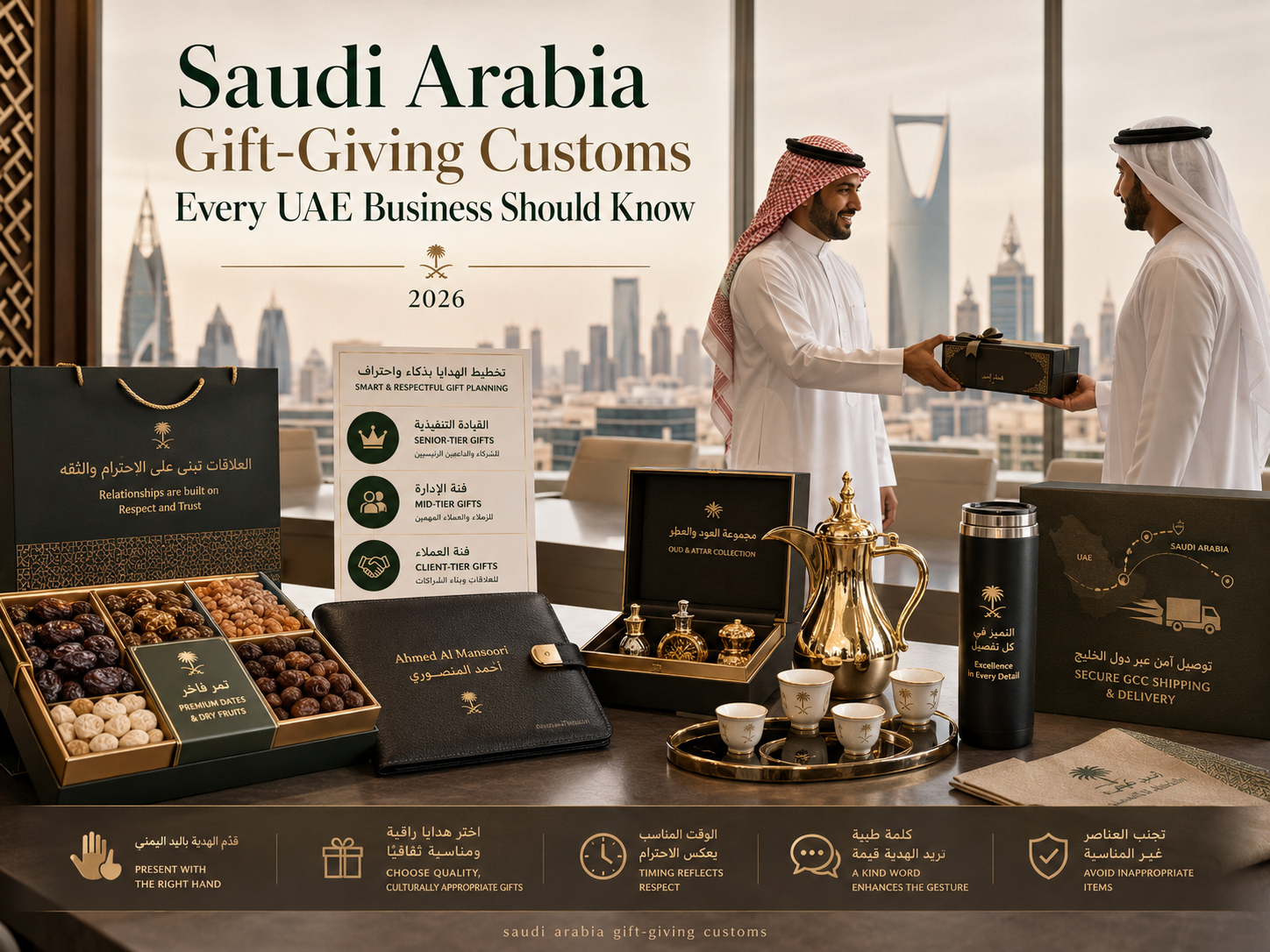
Gifts are presented and received with the right hand, or with both hands if the gift is large. The left hand is associated with personal hygiene in traditional Arab and Islamic contexts and is not used for offering food, gifts, or formal items. Two-hand presentation is universally acceptable and is the safest default for any expat: it reads as respectful regardless of context. This is one of the easiest cultural details to get right and one of the most frequently missed by new expats.
The same right-hand convention applies when receiving a gift from someone else. If you are handed something with two hands, receive it with two hands. If you are unsure, defaulting to two hands is the safe move and never reads as awkward. Eye contact during the handover, a brief verbal acknowledgment, and waiting until the gift-giver invites opening (rather than tearing into it immediately) are the small gestures that matter alongside the hand-rule itself.
What Not to Gift — The Avoid List
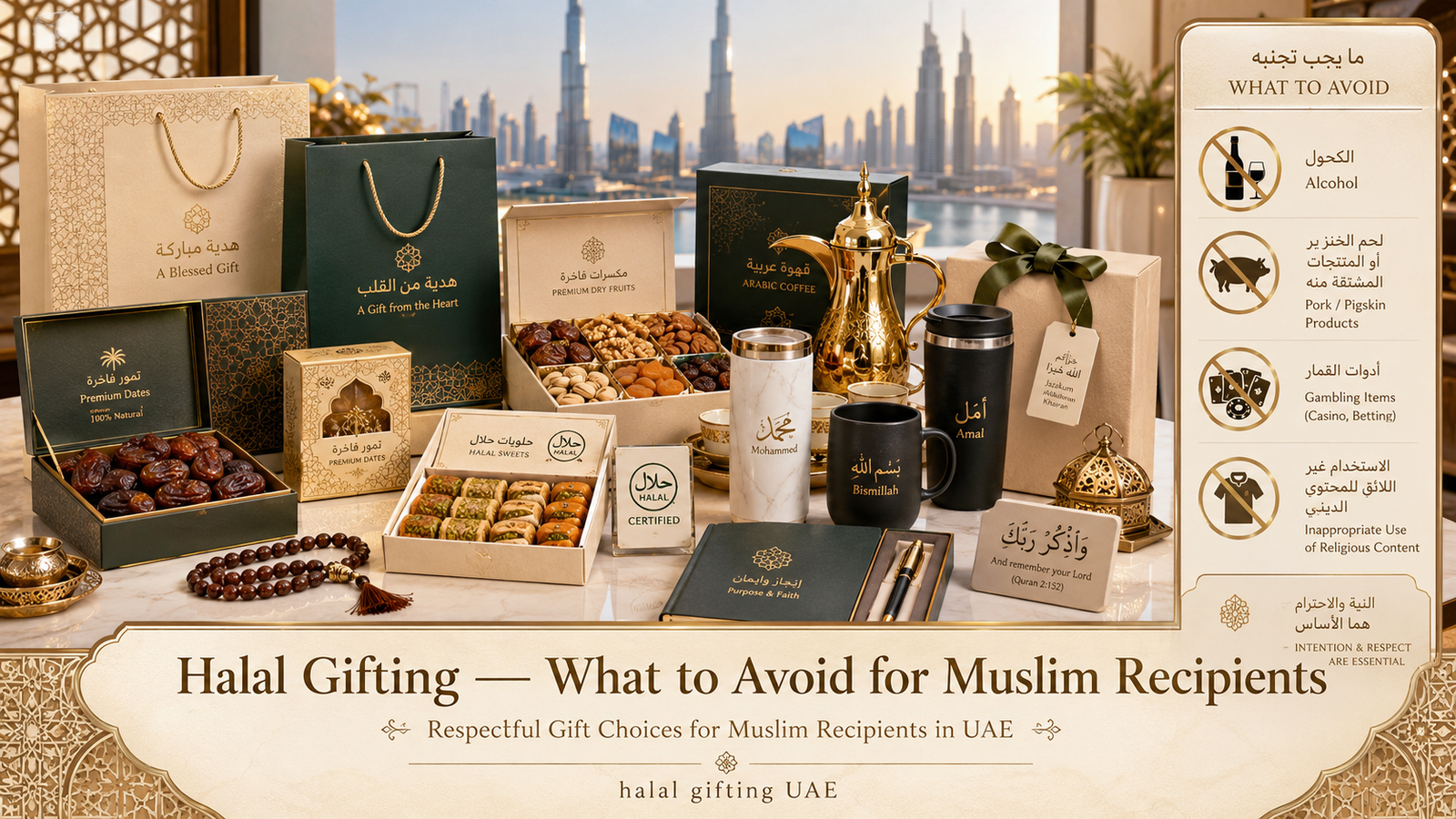
Some categories are clear-cut; others depend on the recipient. The clear-cut avoidances:
Alcohol
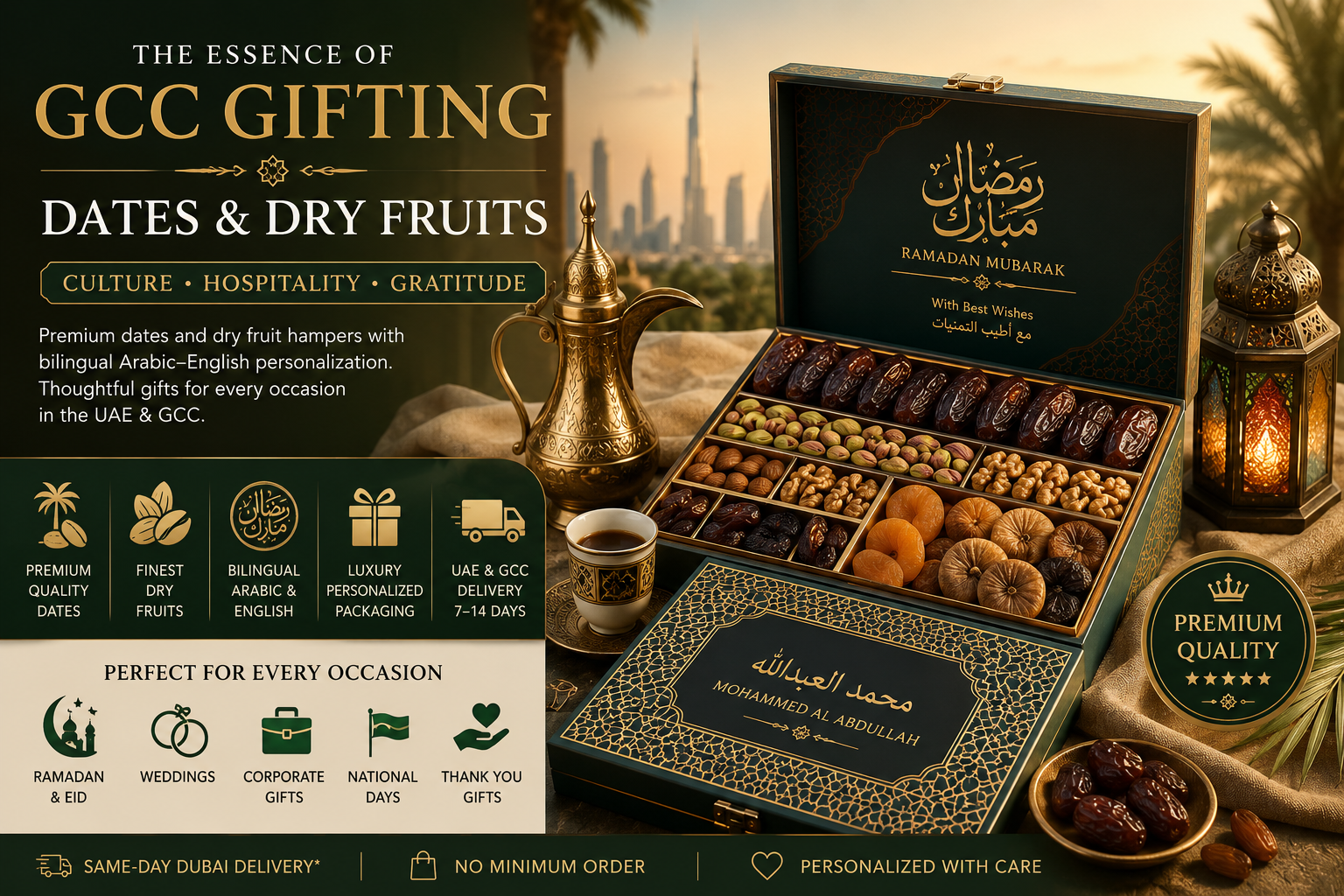
Alcohol is not appropriate as a gift for observant Muslim colleagues, business contacts, or family contexts. Even with a non-observant Muslim recipient, sending alcohol crosses lines unless you are certain of the relationship. The safer default is a high-quality non-alcoholic alternative — premium dates, a personalised dates gift box, or a gourmet hamper with chocolates, nuts, and tea.
Pork-derived products
Anything containing pork — leather goods labelled as pigskin, certain confectionery, charcuterie hampers — is not appropriate. Verify ingredients on packaged food gifts.
Religious figure depictions
Depictions of religious figures (in any tradition) are not produced for gift contexts. This is a production rule for cultural respect and a separate issue from copyright. Quranic verses are produced with extra typography care and are appropriate for many contexts; depictions of prophets are not.
Trademarked sports and entertainment IP
Branded football clubs, league marks, Disney/Marvel/Pixar characters, copyrighted song lyrics — none of these are produced, for legal reasons. Generic sports themes, generic football jerseys without team marks, and original or out-of-copyright traditional pieces are all available.
Gifts During Ramadan and Eid
Ramadan and Eid are the two biggest gift-flow moments in the UAE annual calendar. Ramadan gifts (typically given in the first week or two of the month) lean toward dates, traditional sweets, prayer-focused items, and personalised hampers. Eid gifts trend more celebratory — clothing, gold-tone accents on personalised items, and Eidiyah envelopes for children. For broader Ramadan gifting context, see Ramadan gifts UAE.
For business contexts during Ramadan, scaling up the thoughtfulness while avoiding extravagance is the right register — a personalised dates box with the recipient’s name in bilingual calligraphy works across nearly every relationship. Avoid heavy-cologne gifts during Ramadan as fasting recipients are particularly sensitive to scents during the day.
Wedding Gifting Culture
UAE weddings often span multiple events and gifts can flow at each — Mehndi (for South Asian Muslim weddings), Henna nights, the main ceremony, and the walima. For expat colleagues invited to UAE Muslim weddings, a wedding favours UAE approach — a small personalised piece with the couple’s bilingual names — is universally appropriate. Cash gifts in a personalised Eidiyah-style envelope are also common and accepted, particularly from senior colleagues to junior ones. Avoid gifts with imagery of the couple unless explicitly requested.
Personalisation in Arabic — Typography Care
Adding Arabic to a gift signals respect, but only if the calligraphy is correct. The five Arabic styles available are Naskh (classical, religious-text-safe, the default for any Quranic verse or traditional context), Diwani (royal, decorative, premium for weddings and high-status gifts), Kufic (geometric, modern aesthetic), Modern Arabic (contemporary, clean for everyday gifts), and Thuluth (large-scale formal, premium wall-canvas applications). Custom hand-calligraphy adaptation is also available as a premium tier.
Every Arabic design is reviewed by a typography specialist before production. This matters because incorrect dot placement, incorrect ligature, or wrong-style script for the context (Diwani for a Quranic verse, for example) reads as careless to native speakers, even if the gift is otherwise high-quality. Quranic verses receive extra typography care — never produced in Diwani or stylised forms, always in Naskh or appropriate classical scripts, with diacritical marks verified.
Personalised Names — Both Arabic and English
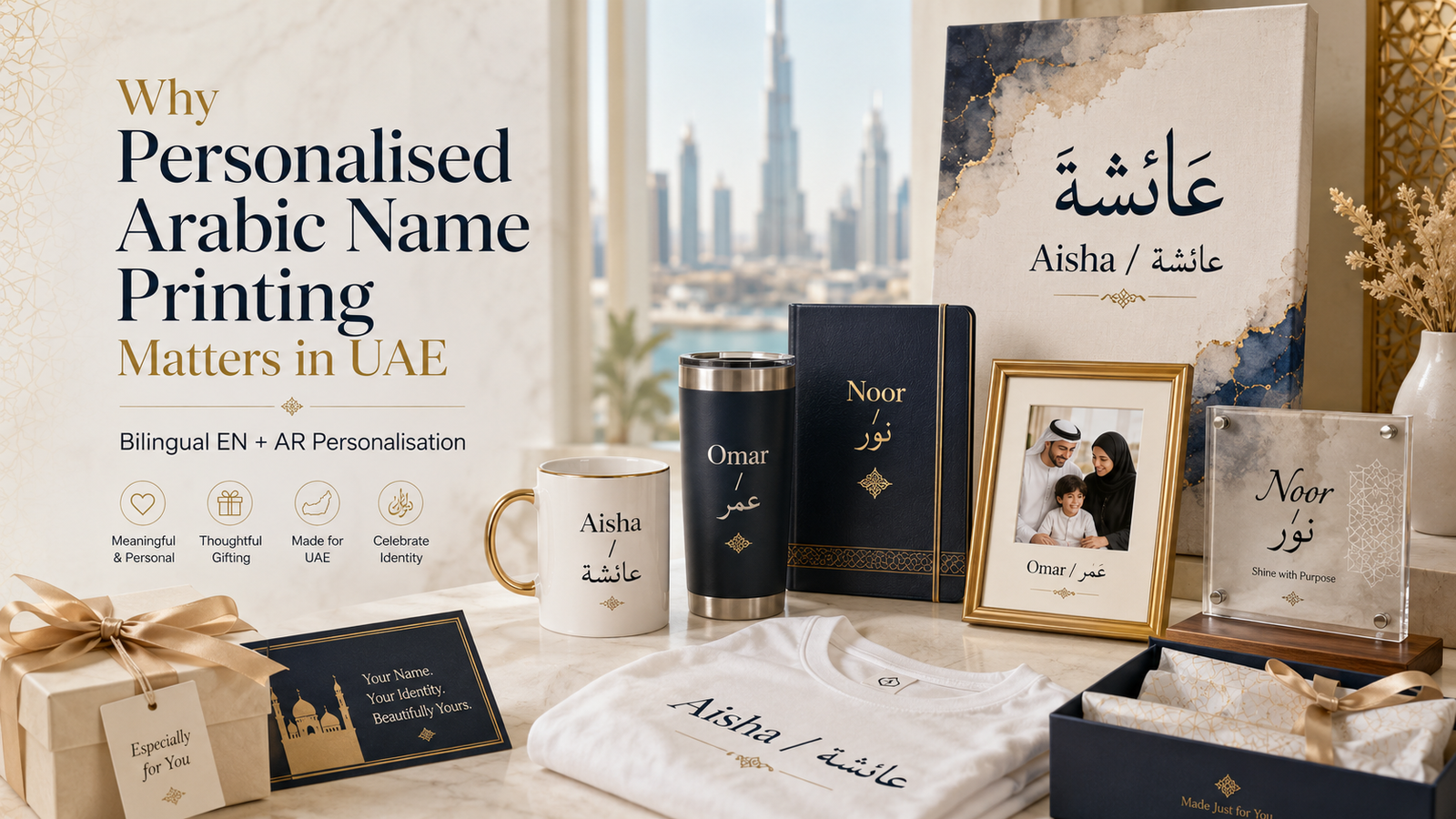
The default for UAE gift personalisation is bilingual EN+AR. Adding the recipient’s name in Arabic alongside English signals attention and effort, even when the recipient is bilingual or English-dominant. For names that have multiple Arabic spellings (transliterations vary), confirm the preferred spelling with the recipient or a close family member before personalising — getting the spelling wrong is more noticeable than not including Arabic at all.
Same-Day Dubai Option for Cultural Moments
Cultural gift moments are often time-sensitive — a colleague returning from Hajj, an Aqiqah you were just invited to, a Ramadan break-fast invitation. Same-day Dubai delivery covers these. Cut-off is 11am for fabric and ceramic items (mugs, hoodies, totes, caps, dates boxes where the inner is stocked) and 12pm for UV-printed items (frames, plaques, cushions, dates boxes with personalisation). Same-day zones cover Marina, JLT, Bluewaters, Downtown, Business Bay, DIFC, Palm Jumeirah, JBR, Dubai Hills, JVC, Sports City, Mirdif, Deira, Bur Dubai, Karama, Al Barsha, and International City. UAE-wide outside Dubai is 1–3 business days. GCC cross-border (KSA, Oman, Kuwait, Bahrain) is 7–14 days.
Order Yours Today
Get the cultural detail right — and let the gift do the rest.
Bilingual personalised dates boxes, Naskh and Diwani calligraphy prints, Ramadan and Eid hampers, and wedding favours — all reviewed by a typography specialist, all with same-day Dubai delivery.
Same-day Dubai delivery for orders placed before 11am (12pm for UV-printed items). UAE-wide delivery 1–3 business days. GCC cross-border 7–14 days. Order via WhatsApp or our online form.
Frequently Asked Questions About Arabic Gift Giving etiquette
How should I present a gift to a colleague in UAE?
With the right hand, or with both hands if the gift is large. The left hand is not used for presenting food, gifts, or formal items in traditional Arab and Islamic contexts. Two-hand presentation is the safest default and is universally acceptable.
Can I gift alcohol to a Muslim colleague in UAE?
No — alcohol is not appropriate as a gift for observant Muslim colleagues or business contexts. The safer default is a premium non-alcoholic alternative such as personalised dates, a gourmet hamper, or a chocolate and tea selection.
Should I personalise a gift in Arabic if the recipient speaks English?
Yes — bilingual EN+AR personalisation is the default offering and signals attention and effort even with English-dominant recipients. Confirm the preferred Arabic spelling of the name with the recipient or a family member before personalising, as transliterations vary.
Which Arabic calligraphy style is best for a Quranic verse gift?
Naskh is the standard for Quranic text — classical, traditional, and the only style appropriate for religious passages. Diwani and Thuluth are not used for Quranic verses. Every Quranic gift receives extra typography care and is reviewed by a typography specialist.
Is it appropriate to give a personalised gift to a senior colleague in UAE?
Yes — personalisation is universally appreciated across seniority levels, but lean toward classical and restrained typography (Naskh, Modern Arabic) for senior colleagues rather than ornate styles. The presentation matters as much as the item — branded packaging and a handwritten note land better than the gift alone.
What is the right gift to bring to a UAE Muslim wedding as an expat colleague?
A small personalised piece with the couple’s bilingual names — a wedding favour, framed calligraphy print, or personalised dates box — is universally appropriate. Cash in a personalised Eidiyah-style envelope is also accepted, particularly from senior to junior colleagues.
What gifts should I avoid during Ramadan in UAE?
Avoid alcohol, pork-derived products, and heavy-cologne gifts (fasting recipients are particularly sensitive to scents during the day). Personalised dates boxes, traditional sweets hampers, and prayer-focused items all work well during Ramadan.
Can I include depictions of religious figures on personalised gifts?
No — depictions of religious figures (in any tradition) are not produced for gift contexts, regardless of style or framing. Quranic verses, calligraphic name art, and abstract Islamic patterns are all available with extra typography care.
What should I gift a colleague who has returned from Hajj?
A bilingual welcome-home calligraphy piece, a personalised dates gift box, or a small framed Quranic verse in Naskh script. See the full Hajj welcome-home gift collection for context-appropriate options.