
Naskh vs Diwani vs Kufic: Which Arabic Font for Your Gift
Picking an Arabic font for a personalised gift in the UAE is the difference between a piece that looks considered and one that looks generic. The same name printed in Naskh reads as classical and respectful; in Diwani it reads as romantic and ceremonial; in Kufic it reads as architectural and modern. None of these are interchangeable — each one carries a register, a context, and a set of unspoken rules about where it does and does not belong. Get the choice right and the gift lifts. Get it wrong and a Quranic verse reads as a wedding invitation.
This guide walks through the three main families, the two supporting styles you will encounter (Modern Arabic and Thuluth), and a practical decision framework for which to use on a mug, frame, cushion, or wedding favour.
A Short Primer on Arabic Script
Arabic is a cursive script — letters connect, change shape based on position in the word, and have built-in calligraphic logic. Unlike Latin scripts where Times New Roman and Helvetica are functionally interchangeable for most purposes, Arabic typefaces carry strong contextual associations. The major calligraphic styles are roughly 1,000 years old, originated in different regional courts (Baghdad, Damascus, Istanbul, Cairo), and were used for specific document types (Quranic copying, royal correspondence, monumental inscriptions). Those original associations still shape what feels right today.
Modern personalised-gift Arabic typography draws on five main styles: Naskh, Diwani, Kufic, Thuluth, and a contemporary “Modern Arabic” category that includes cleaner, more recent typefaces. The first three cover roughly 90% of UAE gift contexts. For the broader principles of laying out names in two scripts at once, see the bilingual name printing guide.
Naskh — The Default for Almost Everything
Naskh is the most-used Arabic style globally and the safest default for any UAE gift context where you are not sure. It is the style used in nearly every printed Quran, most Arabic books, and most professional and religious contexts. Naskh letters are clean, balanced, and proportional — they are designed to be read at length without fatigue.
When to use Naskh
Use Naskh when the gift is religious or religious-adjacent (Quranic verses, prayer-related items, Aqiqah and Tasmiya pieces); when the recipient is older or more traditional; when the gift is a corporate piece where you cannot risk misreading the register; when you are uncertain. Naskh is the universal donor — it is rarely wrong.
What to avoid with Naskh
Naskh can feel slightly formal for sentimental personal gifts between younger couples or close friends. For a wife’s birthday or a Friendship Day mug aimed at a 30-something expat friend group, Diwani or Modern Arabic usually lands better.
Diwani — Royal, Romantic, Ceremonial
Diwani originated in the Ottoman court and was used for royal correspondence and official decrees. The letterforms are flowing, elaborate, with flourishes that link letters in ways Naskh does not. Visually it reads as decorative, premium, and emotionally warm.
When to use Diwani
Use Diwani for weddings (it is the standard wedding Arabic font), anniversary gifts, romantic personalised pieces for partners, premium milestone gifts (50th birthdays, golden anniversaries), and any context where you want the script itself to be part of the visual statement. Wedding favours destined for Saudi Arabia are almost always laid out in Diwani for the couple’s names.
What to avoid with Diwani
Never use Diwani for Quranic verses or any religious passage — it is the wrong register, and Arabic-literate viewers will read it as inappropriate even if the verse itself is accurate. Diwani also reads as too ornate for clean modern corporate aesthetics; if you are personalising a sleek tumbler with a CEO’s name, Modern Arabic or Naskh works better.
Kufic — Geometric, Modern, Architectural
Kufic is the oldest of the three, originally a monumental script used on early mosques and stone inscriptions. Modern Kufic (sometimes called “Square Kufic”) strips Arabic letterforms down to geometric, almost Bauhaus-like compositions. It looks closer to graphic design than to traditional calligraphy.
When to use Kufic
Use Kufic for design-forward gifts: contemporary nursery name prints (especially for design-conscious parents), modern-aesthetic wedding favours where the couple has a minimalist style, branded pieces aimed at design or architecture professionals, and any gift where the recipient values graphic restraint over ornament.
What to avoid with Kufic
Kufic reads as contemporary-art rather than classical, so it can feel out of register at traditional occasions, religious contexts, or for older recipients. It also requires more layout craft — a poorly executed Kufic name reads as awkward where a poorly executed Naskh name still reads as legible.
Two More Styles You Will See: Thuluth and Modern Arabic
Thuluth is the large-scale formal style used historically for monumental architecture and Quranic chapter headings. Letters are tall, dramatic, with strong vertical emphasis. Use it for large-format pieces — wall canvases, premium plaques, framed Quranic verses sized for a living room rather than a desk. Avoid for small surfaces (mugs, coasters, phone cases) where the height of letters loses impact.
Modern Arabic is the umbrella term for clean, contemporary Arabic typefaces designed for digital and print legibility. Think of it as the Arabic equivalent of Helvetica or Inter — neutral, current, friendly. Use it for everyday personal gifts, contemporary corporate pieces, friendship gifts, and any context where you want Arabic that reads as “now” rather than “centuries ago.”
Choosing the Right Font for the Gift Type
Surface and scale narrow the choice further than register alone:
Mugs (small curved surface)
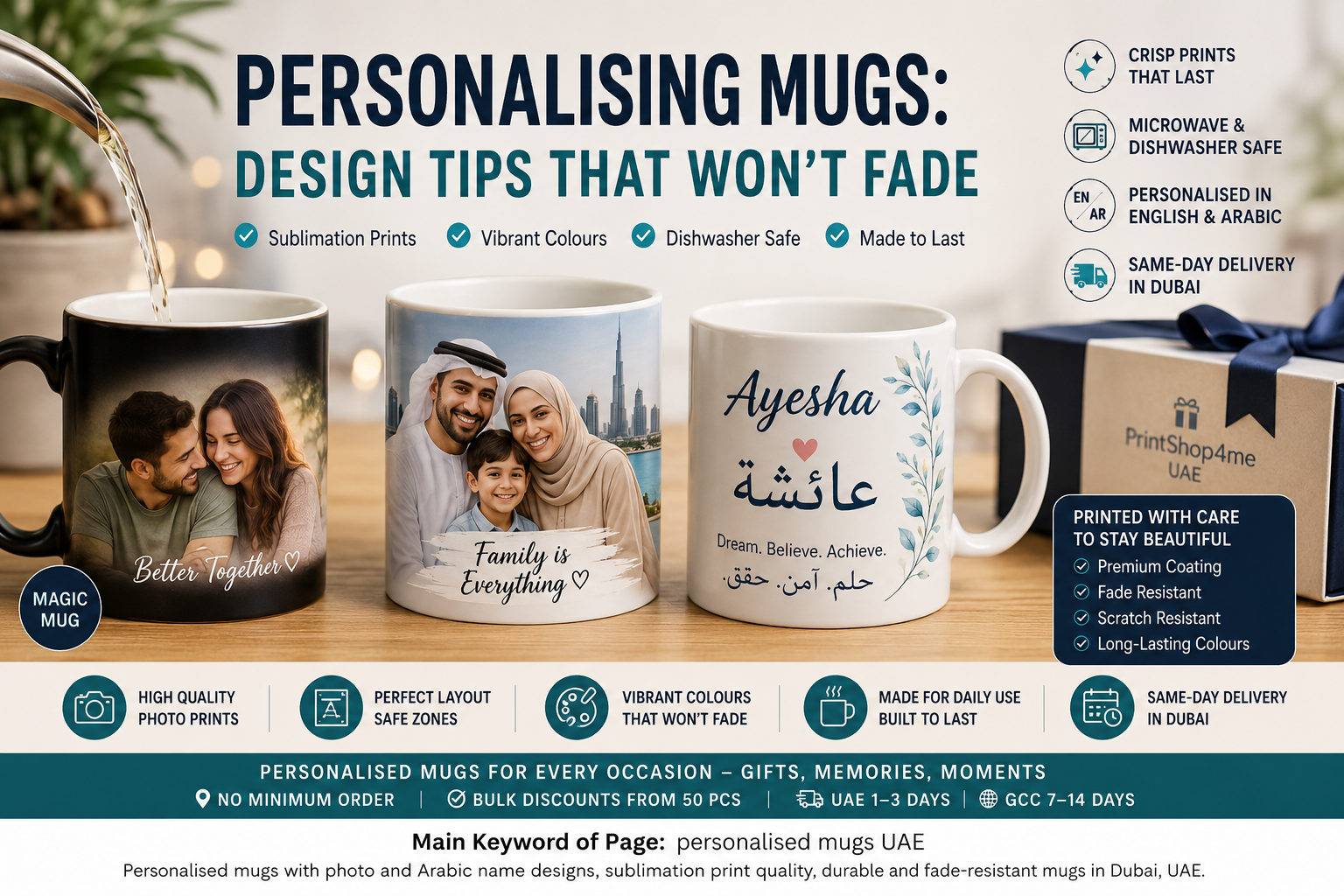
Naskh or Modern Arabic. Diwani works at larger sizes but can lose the flourishes when curved tight on an 11oz mug. Kufic works for design-forward recipients. Thuluth does not work — height is wasted on a curved surface.
Photo Frames and Plaques (medium flat surface)
Photo frames comfortably hold any of the three main styles. Diwani for romantic and family contexts; Naskh for traditional; Kufic for modern. Thuluth at 8×10 inches and above.
Cushions (medium fabric surface)
Diwani and Modern Arabic are the most-used. Avoid Kufic on textured fabric — the geometric precision suffers; soft fabrics blur the sharp angles.
Wall Canvases (large surface)
Thuluth dominates here for premium and Quranic contexts. Diwani for ceremonial pieces. Modern Arabic for contemporary art-style commissions. Naskh works at any size.
Bilingual EN+AR — Balancing Two Scripts
The single trickiest layout problem in UAE personalised gifts is putting English and Arabic together without one feeling like an afterthought. Two principles: match the optical weight (a thin English typeface paired with a heavy Arabic one looks unbalanced) and respect the reading direction (Arabic right-to-left, English left-to-right — vertical stacks work better than horizontal pairings on small items). Modern Arabic pairs cleanly with most contemporary English sans-serifs. Diwani pairs well with elegant English script fonts. Naskh pairs comfortably with traditional English serifs.
Typography Specialist Review and Same-Day Dubai
Every Arabic layout — regardless of style — is reviewed by a typography specialist before production. This is non-negotiable because the most common Arabic typography mistake is incorrect dot placement (which can change the meaning of a word) or wrong-style script for the context (Diwani for a Quranic verse). Even a perfectly typed name can be laid out incorrectly if the chosen style does not match the gift’s context. The review takes minutes and is included in the production timeline. Same-day Dubai delivery cut-off is 11am for fabric and ceramic items and 12pm for UV-printed pieces. There is no minimum order — a single bilingual personalised piece is produced at the same Dubai facility as 50-piece bulk runs. UAE-wide delivery is 1–3 business days; GCC cross-border to KSA, Oman, Kuwait, and Bahrain is 7–14 days.
Order Yours Today
Pick the right Arabic font for your gift — and get the layout right.
Naskh, Diwani, Kufic, Modern Arabic, Thuluth, and custom hand-calligraphy adaptation. Every layout reviewed by a typography specialist. Same-day Dubai delivery on personalised orders.
Same-day Dubai delivery for orders placed before 11am (12pm for UV-printed items). UAE-wide delivery 1–3 business days. GCC cross-border 7–14 days. Order via WhatsApp or our online form.
Frequently Asked Questions About Naskh vs diwani V.S Kufic
Which Arabic font is best for a wedding gift in UAE?
Diwani is the standard wedding Arabic font — it reads as romantic, royal, and ceremonial. For more contemporary couples, Modern Arabic also works. Reserve Naskh for religious-context pieces and Kufic for design-forward couples with a minimalist aesthetic.
Can I use Diwani for a Quranic verse?
No — Diwani is not appropriate for Quranic verses or religious passages. Use Naskh or Thuluth instead. Quranic gifts receive extra typography care and are reviewed by a typography specialist before production, with diacritical marks verified.
Which Arabic font works best on a personalised mug?
Naskh and Modern Arabic. Both render cleanly at small sizes and on curved surfaces. Diwani can lose flourishes when wrapped tight on an 11oz mug. Kufic works for design-forward recipients. Thuluth does not work on mugs — height is wasted on curved surfaces.
What is the difference between Kufic and Modern Arabic?
Kufic is geometric and architectural — letters reduced to almost Bauhaus-like square compositions, originally from monumental stone inscriptions. Modern Arabic is the umbrella for clean, contemporary digital-age typefaces — closer to Helvetica or Inter in spirit. Kufic feels like graphic art; Modern Arabic feels like everyday legibility.
Is custom hand-calligraphy adaptation available?
Yes — for premium pieces, hand-calligraphy adaptation is available as a tier above the standard typeface options. Useful for one-off ceremonial gifts, large wall canvases, and premium wedding pieces where the calligraphy itself is part of the gift’s visual identity.
Which Arabic font should I use if I am unsure?
Naskh — it is the universal donor across UAE gift contexts. Religious, secular, traditional, contemporary, formal, casual: Naskh rarely reads as wrong. Use it as the default and only switch when you have a specific reason.
Can I get bilingual EN+AR personalisation on any gift?
Yes — bilingual EN+AR is the default offering across all items: mugs, frames, cushions, plaques, tumblers, hoodies, totes. Every Arabic layout is reviewed by a typography specialist before production.
How long does Arabic typography review take?
Review is included in the production timeline at no additional charge. For same-day Dubai orders placed before the 11am or 12pm cut-off, review is completed within the same window. For bulk runs, review is part of the standard 3–7 day production cycle.
Can I send a gift with bilingual Arabic personalisation from UAE to Saudi Arabia?
Yes — GCC cross-border delivery to KSA, Oman, Kuwait, and Bahrain is 7–14 days. Personalisation is produced at the Dubai facility before shipping. Wedding favours destined for Saudi weddings are typically laid out in Diwani.