Inserts and Thank-You Cards: D2C Unboxing Strategy
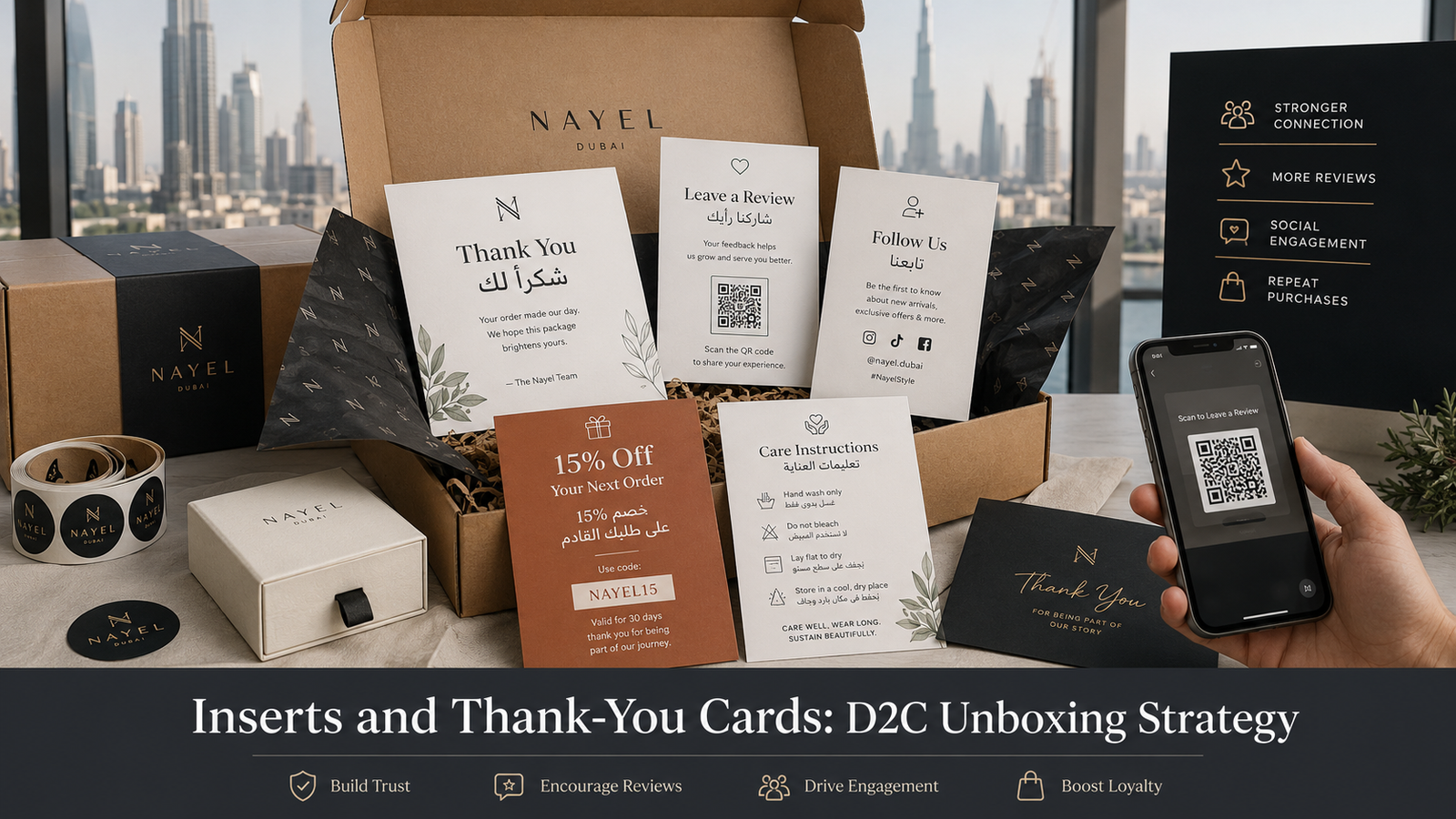
Inserts and thank-you cards in D2C (direct-to-consumer) e-commerce packaging are the highest-ROI brand-building investment most UAE D2C brands underuse. A simple AED 0.30–1.20 printed card in the customer’s package drives review rate, repeat purchase rate, brand recall, and social-media sharing rate measurably. Most first-time UAE D2C sellers skip inserts entirely; the brands that integrate considered inserts into their unboxing experience consistently outperform on the metrics that matter for D2C scale. This guide covers the insert categories that work, the design principles, the production realities, and the bilingual EN+AR considerations specific to UAE D2C contexts.
Why Inserts Outperform Other Branding Investments
Three reasons inserts are disproportionately high-impact. The unboxing emotional moment: the customer is at maximum positive engagement with the brand at the moment they open the package. An insert at this moment captures that emotional engagement and translates it into specific behaviours (review, repeat purchase, social share). Direct request, low friction: a printed insert with a specific request (“leave a review”, “follow us on Instagram”, “use code WELCOME15 for 15% off”) converts at substantially higher rate than email-based equivalents. Per-package marginal cost: AED 0.30–1.20 per insert is a fraction of the typical D2C unit acquisition cost; the ROI per insert investment is usually positive within the first repeat-purchase cycle.
Insert Categories That Work
Personalised thank-you cards
The single most-impactful insert category. Printed card with the brand voice’s thank-you message, the customer’s first name (if collected at checkout), and an optional product care or use tip. AED 0.50–1.50 per card. Drives the unboxing emotional moment most effectively; customers who receive personalised thank-you cards review at 2–3× the rate of customers who don’t.
Review-request cards
Specific request for the customer to leave a review on Amazon UAE, the brand’s website, or relevant marketplace platform. Often paired with a small incentive (“photo review = 10% off next order”) or a low-friction QR code. AED 0.30–0.80 per card. The single most-effective driver of review rate when paired with a clear post-purchase moment.
Social-follow cards
Card with the brand’s Instagram, TikTok, or relevant social handles and a specific request to follow or tag. Often paired with a giveaway hook (“tag us for chance to win”) or community-building messaging. AED 0.30–0.80 per card. Effective for D2C brands building social-first customer relationships.
Discount-code cards
Card with a discount code for the customer’s next purchase, with appropriate redemption window and minimum-order conditions. AED 0.30–0.80 per card. Drives repeat-purchase rate measurably; the discount code’s specific framing (welcome discount, loyalty discount, friend-referral discount) determines the messaging register.
Product care and use tips
For products requiring specific care or use instructions, dedicated insert with detailed guidance — particularly effective for personalised products, premium gifts, and items where misuse generates customer service issues. AED 0.40–1.00 per card. Reduces customer service inquiry volume while reinforcing product premium quality.
Multi-piece insert sets
For premium D2C brands, coordinated insert sets — thank-you card + product care card + brand story card + social-follow card. AED 1.50–3.50 per set. Reserved for premium-tier products and high-LTV customer relationships where the multi-component insert investment matches the customer’s lifetime value.
Insert Design Principles
1. Match brand identity system
Inserts work best as part of a coherent brand identity system — same typography, same colour palette, same brand-voice tone as the broader brand. Inserts that feel disconnected from the brand’s website, packaging, and product undermine the brand-coherence the customer expects at the unboxing moment.
2. Specific request, not generic appreciation
Inserts that ask for specific behaviour (“Leave a review on Amazon UAE”, “Follow us @brandname for behind-the-scenes”) outperform generic appreciation messaging (“Thank you for your purchase”). The specific request gives the customer a clear next action; generic messaging asks for nothing and produces no behaviour.
3. Restrained design over information density
Amateur insert design crams too much information onto a small card surface. Professional insert design uses restraint — the brand voice prominent, the specific request clear, with adequate white space. The customer should be able to read and act on the insert in 5–10 seconds; comprehensive information can be on the back face or via a QR code.
4. QR codes for digital follow-through
QR codes linking to review pages, social profiles, product pages, or brand experiences provide low-friction follow-through. The QR code’s destination should be the specific page the request directs to, not a generic homepage where the customer has to navigate.
5. Bilingual EN+AR for UAE D2C
For UAE D2C brands serving regional customers, bilingual EN+AR insert content acknowledges the cultural context. Modern Arabic and Naskh are the most-used Arabic styles for D2C inserts (professional and contemporary rather than ceremonial); Diwani too ornate for everyday D2C contexts. Every Arabic layout is reviewed by a typography specialist before production.
Insert Material and Production Options
Three material/production combinations cover most D2C insert applications. Premium coated card stock (250–300gsm): the dominant material for D2C inserts — supports high-quality printing, holds shape in the package, premium tactile feel. AED 0.50–1.50 per insert at 1000–5000 piece runs. Sustainable kraft paper (200–250gsm): for ESG-conscious brands and natural-aesthetic positioning. AED 0.40–1.20 per insert. Premium textured paper: for premium D2C brands where the insert’s tactile quality is part of the brand register. AED 1.00–3.00 per insert.
Production Coordination with D2C Packaging
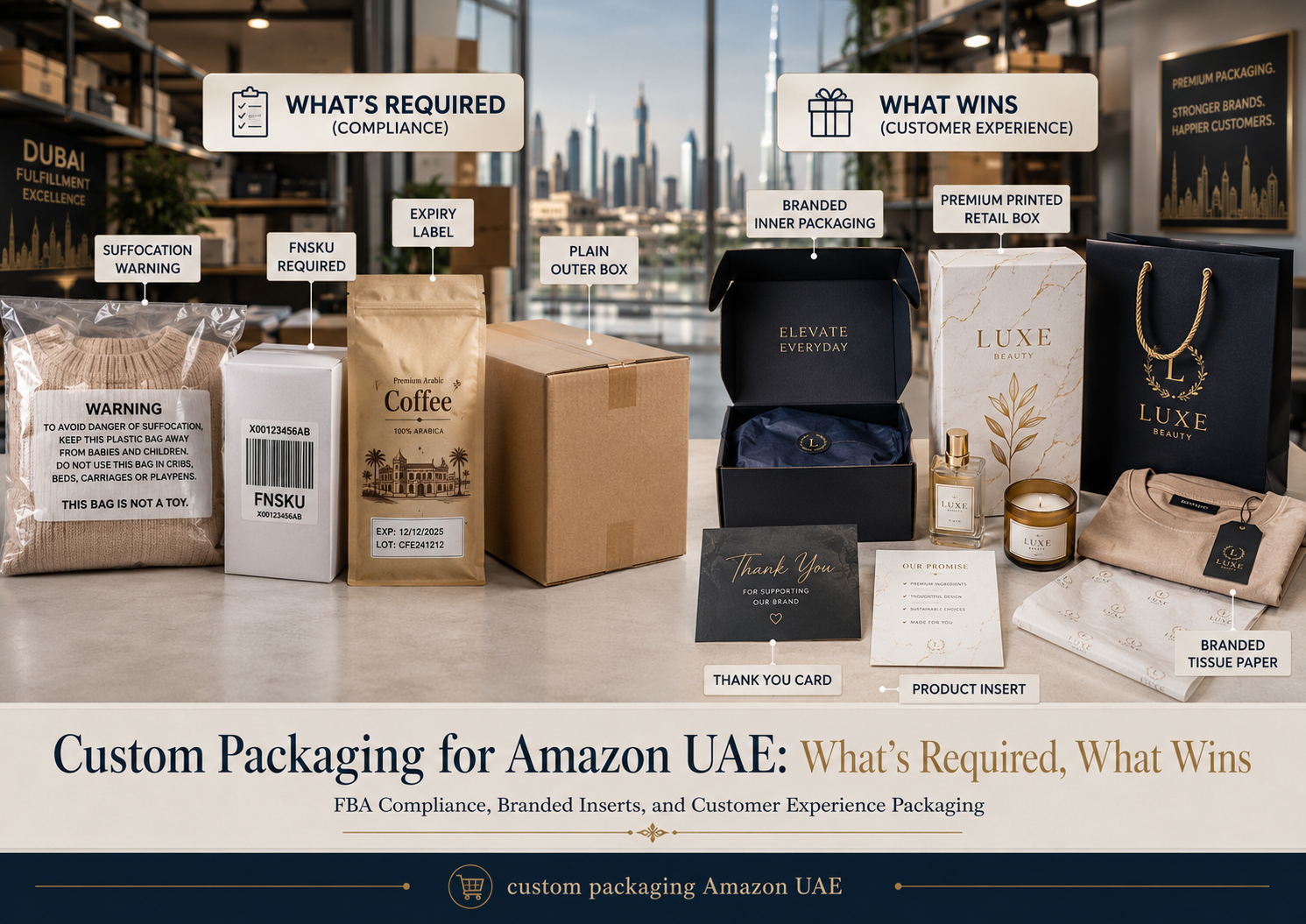
Inserts work best as part of a coordinated D2C packaging programme rather than standalone elements. Custom packaging printing workflows typically include insert production alongside outer mailer, inner protection, and product label production. Coordinated brand consistency across all touchpoints (mailer + inserts + product + thank-you message) creates the unboxing experience layering. Producing inserts separately from the broader packaging programme often produces brand-consistency drift that customers notice at the unboxing moment.
Bulk Production and Lead Times
Indicative lead times for typical D2C insert production. UV digital printed inserts: 5–7 working days for 1000–5000 pieces; 7–10 days for 5000–10,000 pieces. Offset printed inserts: 10–14 days for 5000–20,000 pieces (includes plate setup); 14–21 days for 20,000+ pieces. Premium inserts with foil stamping or speciality finishes: add 3–5 days to base print method. Plan first-launch insert programmes 4–6 weeks before the launch date; recurring insert production for established D2C brands runs tighter once the spec is locked. Flyer printing and business card printing workflows handle similar small-format production with overlapping production processes.
Order Yours Today
Make UAE D2C unboxing the highest-ROI brand-building moment.
Personalised thank-you cards, review-request inserts, social-follow cards, discount-code cards, product care tips, multi-piece sets — premium coated card stock, bilingual EN+AR with Modern Arabic and Naskh.
Same-day Dubai delivery for orders placed before 11am (12pm for UV-printed items). UAE-wide delivery 1–3 business days. GCC cross-border 7–14 days. Order via WhatsApp or our online form.
Frequently Asked Questions About D2C Thank you Cards
Why are thank-you cards the highest-ROI D2C packaging investment?
Three reasons: the unboxing emotional moment (customer at maximum positive engagement when opening the package), direct request with low friction (printed cards with specific requests convert at substantially higher rate than email equivalents), and per-package marginal cost (AED 0.30–1.20 per insert is a fraction of typical D2C unit acquisition cost; ROI usually positive within first repeat-purchase cycle).
What insert categories work best for UAE D2C brands?
Personalised thank-you cards (the single most-impactful — drives 2–3× review rate over no-insert baseline), review-request cards with QR codes, social-follow cards, discount-code cards for repeat purchase, product care and use tips, and multi-piece insert sets for premium tiers. Match the insert mix to the brand’s growth-stage priorities.
Should D2C inserts be in Arabic and English?
Yes — bilingual EN+AR is the default for UAE D2C brands serving regional customers. Modern Arabic and Naskh are the most-used Arabic styles for D2C inserts (professional and contemporary rather than ceremonial); Diwani too ornate for everyday D2C contexts. Every Arabic layout is reviewed by a typography specialist before production.
What insert material works best for premium D2C unboxing?
Premium coated card stock (250–300gsm) is the dominant material for D2C inserts — supports high-quality printing, holds shape in the package, premium tactile feel at AED 0.50–1.50 per insert. Sustainable kraft paper (200–250gsm) for ESG-conscious brands at AED 0.40–1.20. Premium textured paper for premium D2C brands at AED 1.00–3.00 per insert.
Should D2C insert messaging be generic or specific?
Specific requests outperform generic appreciation. ‘Leave a review on Amazon UAE’ or ‘Follow us @brandname for behind-the-scenes’ produces customer behaviour; ‘Thank you for your purchase’ produces nothing. The specific request gives the customer a clear next action; generic messaging asks for nothing and produces no measurable outcome.
How should D2C inserts use QR codes?
QR codes link to specific pages — review pages, social profiles, product pages, brand experiences — rather than generic homepages where the customer has to navigate. The QR code’s destination should be the specific page the request directs to. Provides low-friction digital follow-through from the physical insert moment to digital action.
How long does D2C insert production take?
UV digital: 5–7 working days for 1000–5000 pieces; 7–10 days for 5000–10,000. Offset: 10–14 days for 5000–20,000 pieces (includes plate setup); 14–21 days for 20,000+. Premium inserts with foil stamping or speciality finishes add 3–5 days. Plan first-launch insert programmes 4–6 weeks before launch; recurring insert production runs tighter once spec is locked.
Should D2C inserts coordinate with the broader packaging programme?
Yes — inserts work best as part of coordinated packaging rather than standalone elements. Custom packaging workflows typically include insert production alongside outer mailer, inner protection, and product label production. Coordinated brand consistency across all touchpoints creates the unboxing experience layering; producing inserts separately often produces brand-consistency drift customers notice at unboxing.