Pakistani Wedding Favours UAE: Cultural Touches
Pakistani weddings in UAE 2026 sit within their own cultural register distinct from Indian weddings — Pakistani weddings are predominantly Islamic-context weddings with their own ceremony structure (Mehndi, Baraat, Valima reception), distinct visual aesthetic registers across Punjabi/Sindhi/Pashtun/Balochi regional traditions, and gift conventions that combine South Asian wedding elements with Islamic religious framing. UAE’s substantial Pakistani expatriate community generates significant wedding-favour demand each year, and the favours that work share specific cultural touches that distinguish them from generic South Asian wedding gifts. This guide covers Pakistani wedding favour categories that resonate with UAE Pakistani families, the ceremony-specific gift conventions, and the bilingual personalisation considerations.
The Pakistani Wedding Ceremony Structure
Pakistani weddings are typically multi-day events with distinct ceremonies, each with its own gift conventions. Mehndi (henna ceremony): the celebration evening before the main wedding where the bride’s hands and feet are decorated with henna. Mehndi favours are typically smaller, festive-coloured, and oriented toward the bride’s female friends and family. Baraat (groom’s procession and main wedding): the central ceremony where the groom’s family arrives at the bride’s family for the formal Nikah (Islamic marriage contract) and celebration. Baraat favours are typically the most-substantial wedding favour tier given to the broader guest list. Valima (reception): the post-Baraat reception, traditionally hosted by the groom’s family. Valima favours often complement Baraat favours or run as a distinct gift programme. UAE Pakistani weddings often consolidate these ceremonies into 2-3 days of celebration; the favour programme spans the multiple ceremony moments.
Pakistani Wedding Favour Categories
Personalised dates and dry fruit boxes
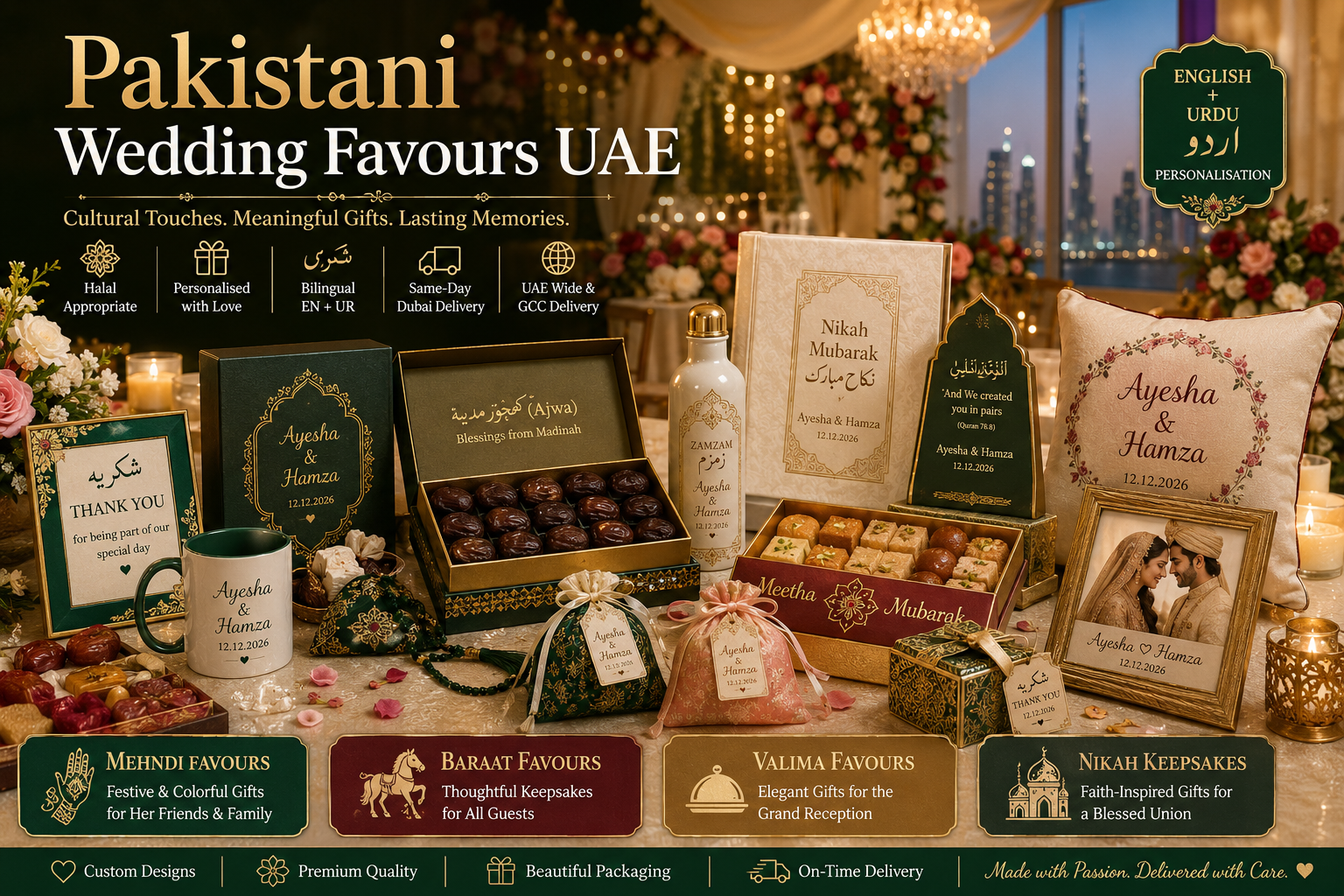
Universal UAE wedding favour category that works particularly well for Pakistani Islamic-context weddings. Personalised dates gift boxes with the couple’s bilingual names and wedding date in custom-printed gift packaging. Premium dates carry deep significance in Islamic tradition; the gift’s religious-cultural fit is intrinsic. AED 60–150 per box at favour-volume tiers (100–500 pieces).
Personalised photo frames with bilingual couple names
Small personalised photo frames (10×15cm typical) with the couple’s bilingual EN+Urdu names and a placeholder for a wedding photo provided post-event. Naskh and Modern Arabic styles for Arabic-language Urdu pairing; Nastaliq style for traditional Urdu typography (Nastaliq is the Urdu’s traditional calligraphic style, distinct from but related to Arabic Naskh). AED 80–180 per piece.
Personalised mugs and drinkware
Personalised mugs with the couple’s bilingual names, wedding date, and wedding-themed designs. Practical favour that gets used long after the wedding. AED 50–100 per piece in 100–500 piece volumes. Suitable for the broader Baraat and Valima guest tiers.
Personalised cushions for couple-keepsake gifts
Personalised cushions as wedding favour for closer-relationship guests — bilingual couple names with wedding photo overlay. AED 150–280 per piece. Reserved for closer family and very-close-friend tiers.
Mehndi-specific small favours
For the Mehndi ceremony specifically, smaller and more festive-coloured favours — small personalised photo frames in green and gold tones, mehndi-themed personalised items, festive small hampers with traditional South Asian sweets. AED 40–100 per piece.
Custom-curated mini hampers
Multi-component mini hampers combining a personalised piece (frame or mug) + premium dates + traditional Pakistani sweets (gulab jamun, mithai, kheer ingredients) in custom-printed packaging. AED 150–300 per hamper. Suitable for closer-relationship guest tiers.
Regional Pakistani Wedding Variations
Pakistani weddings vary across regional traditions. Punjabi weddings: elaborate decoration, vibrant colour palettes (often featuring red, gold, green), traditional music and ceremonies that may extend across multiple days. Favour register typically more elaborate. Sindhi weddings: distinct ceremony structure with specific Sindhi traditions, often featuring traditional Sindhi colours and motifs. Favour packaging may include traditional Sindhi pattern elements. Pashtun weddings: regional traditions with traditional Pashtun aesthetic; favour register often more restrained than Punjabi. Balochi weddings: regional traditions with their own ceremony structure and visual aesthetic. Cosmopolitan UAE Pakistani weddings: often blend multiple regional elements with contemporary design — UAE Pakistani families spanning multiple regional backgrounds choose blended favour designs.
Bilingual EN+Urdu Personalisation
Pakistani wedding favour personalisation typically uses bilingual EN+Urdu rather than EN+Arabic. Urdu is written in Nastaliq script — a traditional calligraphic style related to but distinct from Arabic Naskh. Three personalisation considerations. Nastaliq for traditional Urdu personalisation: the traditional Urdu calligraphic style; reads as authentic for Pakistani cultural register. Carries the ceremonial register for wedding context. Modern Urdu typography for contemporary Pakistani brand register; works alongside Nastaliq depending on the family’s design preference. Trilingual EN+Urdu+Arabic for UAE-context weddings where the host country acknowledgement is part of the favour. Each script has its own typography conventions; specialist review process applies before production. Wedding favours programmes for Pakistani UAE weddings handle multi-script options at production scale.
Per-Guest Budget Tiers for Pakistani Wedding Favours
AED 40–80 per favour (Mehndi tier and broader Baraat guests): single small personalised piece. Suitable for the broader wedding guest list (200+ guests). AED 80–180 per favour (Baraat mid-tier and Valima guests): single substantial personalised piece (frame, mug, dates box) with quality packaging. The dominant tier for Pakistani UAE weddings. AED 180–350 per favour (close-relationship tier): multi-component mini hamper with personalised piece + premium edibles + Pakistani sweets in elaborate packaging. AED 350+ per favour (senior-relative tier): substantial multi-component hamper or premium ceremonial pieces for senior family members and very-close-relationship favours.
Pakistani Wedding Halal-Appropriate Considerations
As Islamic-context weddings, Pakistani UAE weddings follow halal-appropriate gift register. No alcohol in any favour element (alcohol-based perfumes, alcohol-containing chocolates, etc.). No pork or pigskin items in any gift element. Halal-certified consumables for any sweets, chocolates, or food elements in hampers. Traditional Pakistani sweets (gulab jamun, mithai, kheer ingredients) typically halal by tradition; verify halal certification on multi-supplier hamper assemblies. The cultural-respect cluster from broader UAE Ramadan and Eid programmes applies the same halal-appropriate baseline to Pakistani wedding favour programmes.
Cross-Border Considerations for Family Visiting from Pakistan
UAE Pakistani weddings often have substantial guest contingent travelling from Pakistan. Three considerations apply. Take-home logistics: favours that need to travel back with guests in luggage — fitting in suitcases, customs considerations on bulk edibles especially fresh-component hampers. Pakistan-bound shipping for guests who couldn’t attend: 14–21 days from UAE to Pakistan; lock cross-border orders 4 weeks before the wedding. Family in UAE attending vs Pakistan-resident guests: for UAE-resident Pakistani families, gift logistics are straightforward UAE-domestic; for Pakistan-visiting guests, ensure the favour is take-home-portable in luggage.
Order Yours Today
Curate Pakistani wedding favours that respect cultural touches and ceremony specificity.
Personalised dates boxes, photo frames with bilingual EN+Urdu (Nastaliq for traditional), mugs, mini hampers — Mehndi/Baraat/Valima ceremony tiers, halal-appropriate baseline, regional Punjabi/Sindhi/Pashtun considerations.
Same-day Dubai delivery for orders placed before 11am (12pm for UV-printed items). UAE-wide delivery 1–3 business days. GCC cross-border 7–14 days. Order via WhatsApp or our online form.
Frequently Asked Questions About Pakistani Wedding Favours UAE
How do Pakistani weddings differ from Indian weddings for favour purposes?
Pakistani weddings are predominantly Islamic-context weddings with distinct ceremony structure (Mehndi, Baraat, Valima) and Islamic religious framing. The favour register follows halal-appropriate principles (no alcohol, no pigskin, halal-certified consumables). Pakistani wedding personalisation typically uses bilingual EN+Urdu (with Nastaliq script for traditional Urdu calligraphy) rather than EN+Hindi or other Indian-context scripts.
What is the most-given Pakistani wedding favour in UAE?
Personalised dates and dry fruit boxes — universal UAE wedding favour category that works particularly well for Pakistani Islamic-context weddings. Premium dates carry deep significance in Islamic tradition; the gift’s religious-cultural fit is intrinsic. AED 60–150 per box in personalised gift packaging at favour-volume tiers.
What are the distinct Pakistani wedding ceremonies and their favour conventions?
Mehndi (henna ceremony): smaller, festive-coloured favours oriented toward female friends and family. Baraat (groom’s procession and main wedding): the most-substantial wedding favour tier given to the broader guest list. Valima (reception, hosted by groom’s family): often complements Baraat favours or runs as a distinct gift programme. UAE Pakistani weddings typically span 2–3 days with the favour programme covering multiple ceremony moments.
Should Pakistani wedding favour personalisation be in Urdu or Arabic?
Bilingual EN+Urdu rather than EN+Arabic for Pakistani wedding favours. Urdu uses Nastaliq script — a traditional calligraphic style related to but distinct from Arabic Naskh. Nastaliq for traditional Urdu personalisation reads as authentic for Pakistani cultural register. Modern Urdu typography for contemporary brand register. Trilingual EN+Urdu+Arabic for UAE-context weddings acknowledging the host country.
What is a typical Pakistani wedding favour budget per guest?
AED 40–80 per favour for Mehndi tier and broader Baraat guests (single small personalised piece). AED 80–180 for Baraat mid-tier and Valima guests (the dominant tier for Pakistani UAE weddings). AED 180–350 for close-relationship tier (multi-component mini hampers). AED 350+ for senior-relative tier (substantial hampers and premium ceremonial pieces).
Are Pakistani wedding favours subject to halal-appropriate considerations?
Yes — as Islamic-context weddings, Pakistani UAE weddings follow halal-appropriate gift register. No alcohol in any favour element (including alcohol-based perfumes, alcohol-containing chocolates), no pork or pigskin items, halal-certified consumables for sweets and chocolates. Traditional Pakistani sweets (gulab jamun, mithai, kheer) typically halal by tradition; verify halal certification on multi-supplier hamper assemblies.
How do regional Pakistani traditions affect wedding favour design?
Punjabi weddings: elaborate decoration, vibrant colour palettes (red, gold, green). Sindhi weddings: distinct traditions with traditional Sindhi colours and motifs. Pashtun weddings: typically more restrained register than Punjabi. Balochi weddings: regional traditions with own ceremony structure. Cosmopolitan UAE Pakistani weddings often blend multiple regional elements with contemporary design — UAE Pakistani families spanning multiple regional backgrounds choose blended favour designs.
Can Pakistani wedding favours travel back to Pakistan with guests?
Yes, with planning. Take-home logistics matter — favours need to fit in suitcases without customs issues on bulk edibles especially fresh-component hampers. For Pakistan-bound shipping to guests who couldn’t attend, lock orders 4 weeks before the wedding (14–21 day shipping). For UAE-resident Pakistani families, logistics are straightforward UAE-domestic delivery.